Review
. 2015 Jun;16(6):546-53.
doi: 10.1038/ni.3156.

Intrinsic host restrictions to HIV-1 and mechanisms of viral escape

Affiliations
Review

Intrinsic host restrictions to HIV-1 and mechanisms of viral escape

Viviana Simon et al. Nat Immunol. 2015 Jun.

Abstract

To replicate in their hosts, viruses have to navigate the complexities of the mammalian cell, co-opting mechanisms of cellular physiology while defeating restriction factors that are dedicated to halting their progression. Primate lentiviruses devote a relatively large portion of their coding capacity to counteracting restriction factors by encoding accessory proteins dedicated to neutralizing the antiviral function of these intracellular inhibitors. Research into the roles of the accessory proteins has revealed the existence of previously undetected intrinsic defenses, provided insight into the evolution of primate lentiviruses as they adapt to new species and uncovered new targets for the development of therapeutics. This Review discusses the biology of the restriction factors APOBEC3, SAMHD1 and tetherin and the viral accessory proteins that counteract them.


Conflict of interest statement

COMPETING FINANCIAL INTERESTS

The authors declare no competing financial interests.

Figures
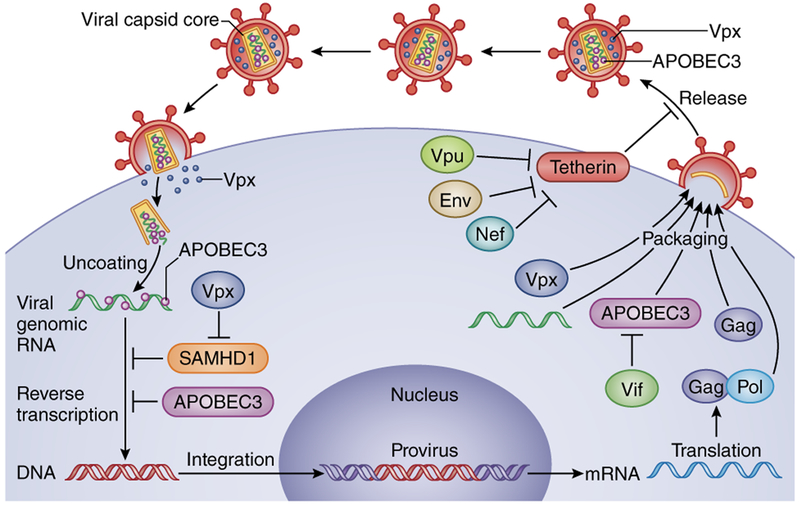
Figure 1
Figure 1
The host restriction factors SAMHD1, APOBEC3 and tetherin, and the lentiviral accessory proteins that counteract them in the context of virus replication. After virus entry, SAMHD1 and APOBEC3 interfere with reverse transcription (SAMHD1) or modify the reverse-transcribed viral DNA (APOBEC3). Tetherin acts late in the replication cycle to prevent the release of virions. Vif counteracts APOBEC3-driven mutagenesis of the viral genome, by preventing its packaging into virions. Vpx relieves the SAMHD1-mediated block to reverse transcription. Vpu prevents tetherin from holding on to the virus at the plasma membrane. HIV-2 and SIVs that lack Vpu use Env and Nef, respectively, to counteract tetherin by sequestering it intracellularly.
Figure 2
Figure 2
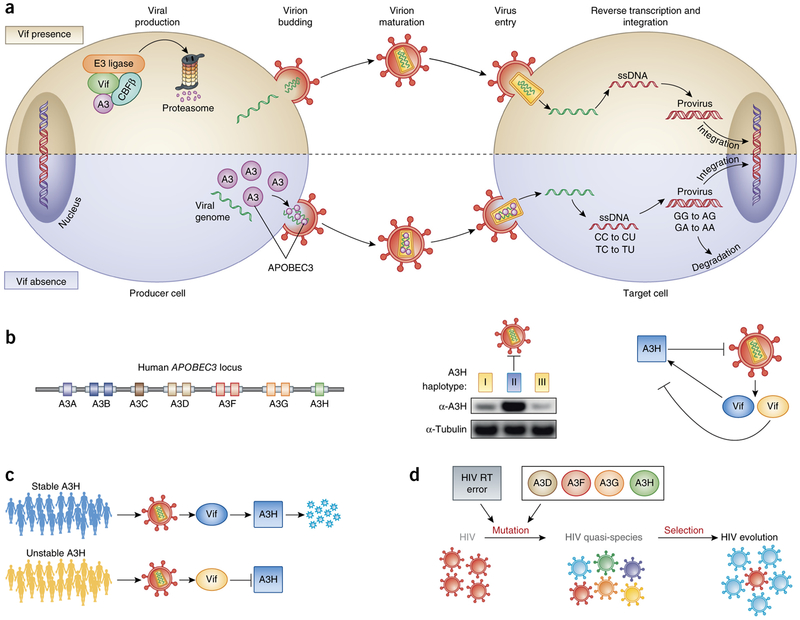
Overview of the mode of APOBEC3 (A3) restriction and the implications of suboptimal Vif activity on HIV transmission and diversification. (a) APOBEC3 proteins are degraded in the producer cell in the presence of Vif, but in the absence of Vif they are packaged into the budding viral particle. In the next cycle of infection, the APOBEC3 proteins mutagenize the viral genome during reverse transcription by deaminating cytosines to uracils in the minus-strand DNA. Mutated viral DNA may be degraded by DNA repair enzymes or integrated into the host cell genome. (b) Left, the human APOBEC3 locus encodes seven different deaminases that carry either one (A3A, A3C, A3H) or two deaminase domains (A3B, A3D, A3F, A3G). Middle, A3H stands out among the APOBEC3 proteins because its haplotypes differ in protein stability and antiviral activity: haplotypes I and III (yellow) are unstable, whereas haplotype II (blue) is stable. Right, HIV Vif alleles differ in their ability to counteract the stable A3H haplotype II. (c) HIV Vif adapts to A3H haplotypes in vivo. A3H-resistant HIV (blue Vif) efficiently replicates in patients carrying an active A3H (blue individual). A3H-sensitive HIV (yellow Vif) replicates well in patients with unstable A3H (yellow individuals), but when it is transmitted to a new host who encodes stable A3H, its spread is limited. (d) HIV sequence diversification can be caused by reverse transcriptase (RT) errors and mutagenesis by different APOBEC3 proteins (A3D, A3F, A3G, A3H).
Figure 3
Figure 3
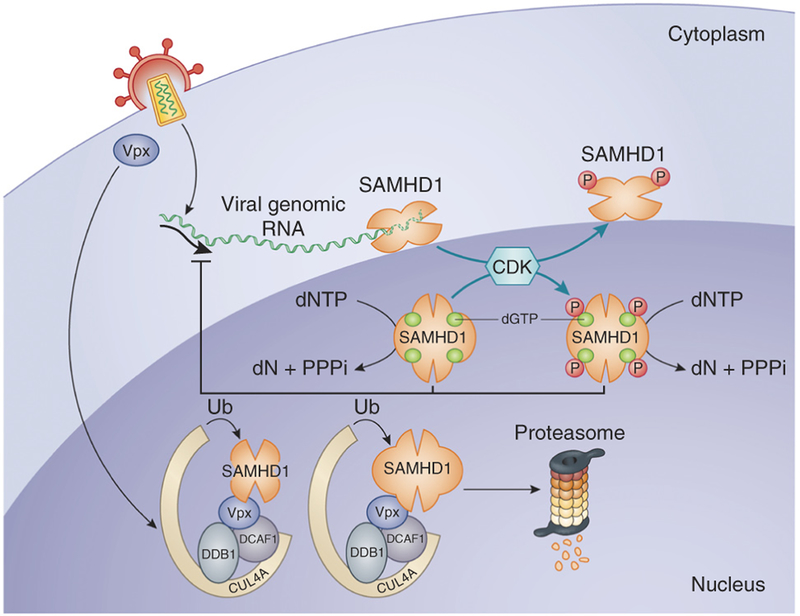
Proposed models for SAMHD1-mediated restriction. HIV-2, SIV or engineered HIV-1 containing Vpx enters a myeloid cell. Vpx transits to the nucleus and binds to the DCAF1-DDB1-CUL4A E3 ubiquitin ligase complex and to SAMHD1, which is then degraded by proteasomes in the nucleus. If the virus lacks Vpx, SAMHD1 depletes the pool of dNTPs, blocking reverse transcription of the bound tRNA primer. An alternative model calls for SAMHD1 to degrade the viral genomic RNA as it is reverse transcribed in the cytoplasm. This activity is regulated by the phosphorylation of amino acid Thr592 by CDK-1, CDK-2 and CDK-6.
Figure 4
Figure 4
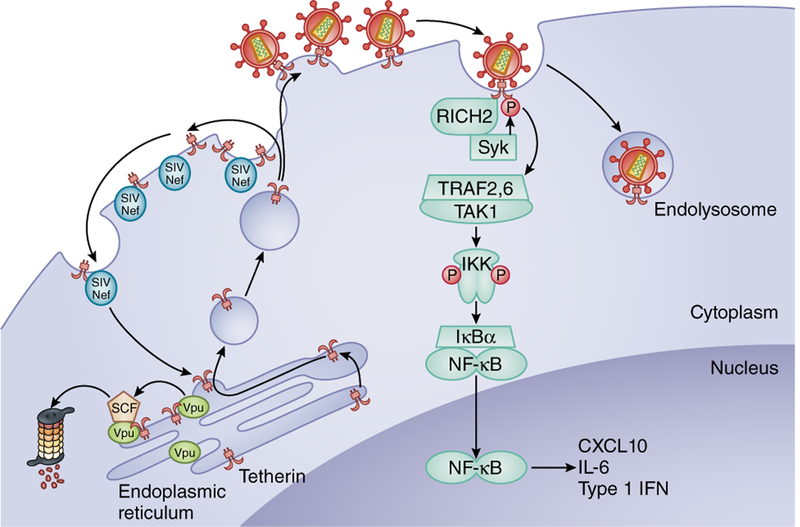
Tetherin blocks virus release, activates an innate immune response and is counteracted by Vpu or Nef. Tetherin (BST2 or CD317) prevents virus release by inserting its N-terminal transmembrane domain in the plasma membrane and its GPI-linked C terminus in the virus envelope lipid bilayer. The tethered virus is then endocytosed. Tetherin contacts cortical actin through an interaction with RICH2. Tetherin is phosphorylated on tyrosines near its N terminus by Syk. Phosphorylated tetherin activates TRAF2, TRAF6 and TAK1. The complex phosphorylates IKK, causing the degradation of IκBα and thereby activating NF-κB, which induces the transcription of the proinflammatory cytokines CXCL10, IL-6 and IFN-β. Sequestration of tetherin by HIV-1 Vpu in the ER prevents its transit to the plasma membrane. Tetherin proteasomal degradation is induced by its interaction with the SCF-β-TRCP complex. In most SIVs, Nef binds to tetherin at the plasma membrane to induce its endocytosis through an AP2-dependent pathway.

References

    1. Strebel K et al. The HIV ‘A’ (sor) gene product is essential for virus infectivity. Nature 328, 728–730 (1987). - PubMed
    1. Gabuzda DH et al. Role of Vif in replication of human immunodeficiency virus type 1 in CD4+ T lymphocytes. J. Virol 66, 6489–6495 (1992). - PMC - PubMed
    1. Cullen BR HIV-1 Vif: counteracting innate antiretroviral defenses. Mol. Ther 8, 525–527 (2003). - PubMed
    1. Simon JH, Gaddis NC, Fouchier RA & Malim MH Evidence for a newly discovered cellular anti-HIV-1 phenotype. Nat. Med 4, 1397–1400 (1998). - PubMed
    1. Sheehy AM, Gaddis N, Choi J & Malim M Isolation of a human gene that inhibits HIV-1 infection and is suppressed by the viral Vif protein. Nature 418, 646–650 (2002). - PubMed

Publication types