


Urinary Tract Stones and Osteoporosis: Findings From the Women's Health Initiative
- PMID: 25990099
- PMCID: PMC5618440
- DOI: 10.1002/jbmr.2553
Urinary Tract Stones and Osteoporosis: Findings From the Women's Health Initiative
Abstract
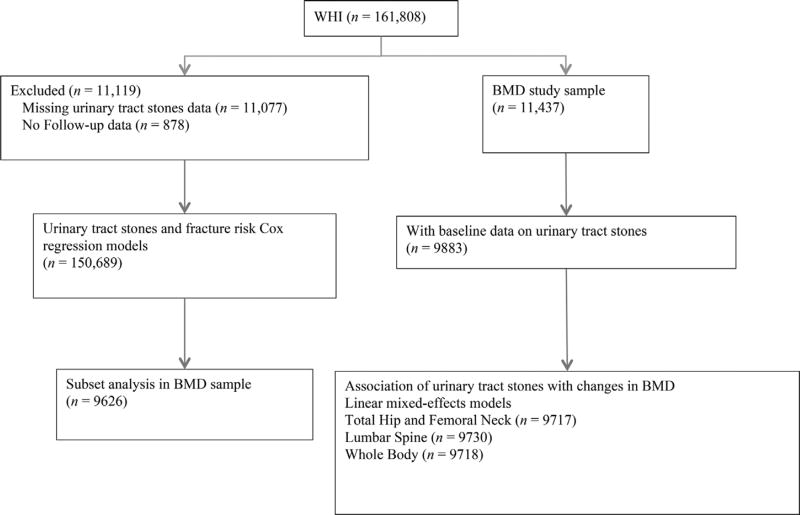
Kidney and bladder stones (urinary tract stones) and osteoporosis are prevalent, serious conditions for postmenopausal women. Men with kidney stones are at increased risk of osteoporosis; however, the relationship of urinary tract stones to osteoporosis in postmenopausal women has not been established. The purpose of this study was to determine whether urinary tract stones are an independent risk factor for changes in bone mineral density (BMD) and incident fractures in women in the Women's Health Initiative (WHI). Data were obtained from 150,689 women in the Observational Study and Clinical Trials of the WHI with information on urinary tract stones status: 9856 of these women reported urinary tract stones at baseline and/or incident urinary tract stones during follow-up. Cox regression models were used to determine the association of urinary tract stones with incident fractures and linear mixed models were used to investigate the relationship of urinary tract stones with changes in BMD that occurred during WHI. Follow-up was over an average of 8 years. Models were adjusted for demographic and clinical factors, medication use, and dietary histories. In unadjusted models there was a significant association of urinary tract stones with incident total fractures (HR 1.10; 95% CI, 1.04 to 1.17). However, in covariate adjusted analyses, urinary tract stones were not significantly related to changes in BMD at any skeletal site or to incident fractures. In conclusion, urinary tract stones in postmenopausal women are not an independent risk factor for osteoporosis.
Keywords: AGING; DXA; GENERAL POPULATION STUDIES; MENOPAUSE; OSTEOPOROSIS.
© 2015 American Society for Bone and Mineral Research.
Conflict of interest statement
All authors state that they have no conflicts of interest.
References
-
- Jaeger P, Lippuner K, Casez JP, Hess B, Ackermann D, Hug C. Low bone mass in idiopathic renal stone formers: magnitude and significance. J Bone Miner Res. 1994;9(10):1525–32. - PubMed
-
- Lauderdale DS, Thisted RA, Wen M, Favus MJ. Bone mineral density and fracture among prevalent kidney stone cases in the Third National Health and Nutrition Examination Survey. J Bone Miner Res. 2001;16(10):1893–8. - PubMed
-
- Bleicher K, Cumming RG, Naganathan V, et al. Lifestyle factors, medications, and disease influence bone mineral density in older men: findings from the CHAMP study. Osteoporos Int. 2011;22(9):2421–37. - PubMed
Publication types
MeSH terms
Grants and funding
LinkOut - more resources
Full Text Sources
Other Literature Sources
Medical
