. 2015 Jan-Apr;48(1):4-16.
doi: 10.4103/0970-0358.155260.

Pressure ulcers: Current understanding and newer modalities of treatment

Affiliations

Pressure ulcers: Current understanding and newer modalities of treatment

Surajit Bhattacharya et al. Indian J Plast Surg. 2015 Jan-Apr.

Abstract

This article reviews the mechanism, symptoms, causes, severity, diagnosis, prevention and present recommendations for surgical as well as non-surgical management of pressure ulcers. Particular focus has been placed on the current understandings and the newer modalities for the treatment of pressure ulcers. The paper also covers the role of nutrition and pressure-release devices such as cushions and mattresses as a part of the treatment algorithm for preventing and quick healing process of these wounds. Pressure ulcers develop primarily from pressure and shear; are progressive in nature and most frequently found in bedridden, chair bound or immobile people. They often develop in people who have been hospitalised for a long time generally for a different problem and increase the overall time as well as cost of hospitalisation that have detrimental effects on patient's quality of life. Loss of sensation compounds the problem manifold, and failure of reactive hyperaemia cycle of the pressure prone area remains the most important aetiopathology. Pressure ulcers are largely preventable in nature, and their management depends on their severity. The available literature about severity of pressure ulcers, their classification and medical care protocols have been described in this paper. The present treatment options include various approaches of cleaning the wound, debridement, optimised dressings, role of antibiotics and reconstructive surgery. The newer treatment options such as negative pressure wound therapy, hyperbaric oxygen therapy, cell therapy have been discussed, and the advantages and disadvantages of current and newer methods have also been described.

Keywords: Bedsore; decubitus ulcer; pressure sore; pressure ulcer.


Conflict of interest statement

Conflict of Interest: None declared.

Figures

Figure 1
Figure 1
(a-d) Various grading of pressure ulcer [Table 2]. (e) A very severe trochanteric pressure ulcer where destruction is so severe that the femoral head dislocated and came out
Figure 2
Figure 2
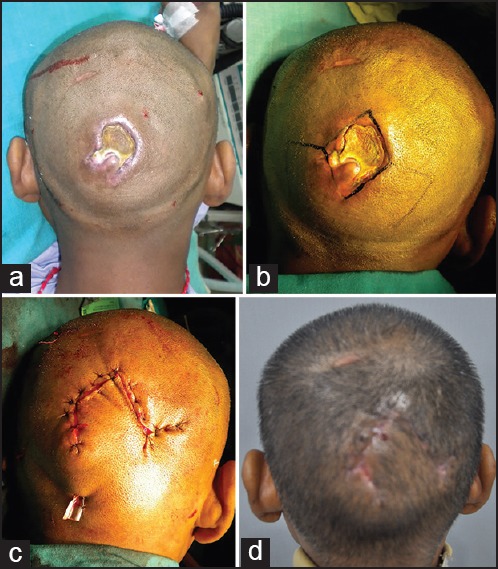
Occipital pressure ulcer (a) managed by marginal debridement and coverage using Limberg's flap (b and c). A 2-week post-operative picture of flap (d)
Figure 3
Figure 3
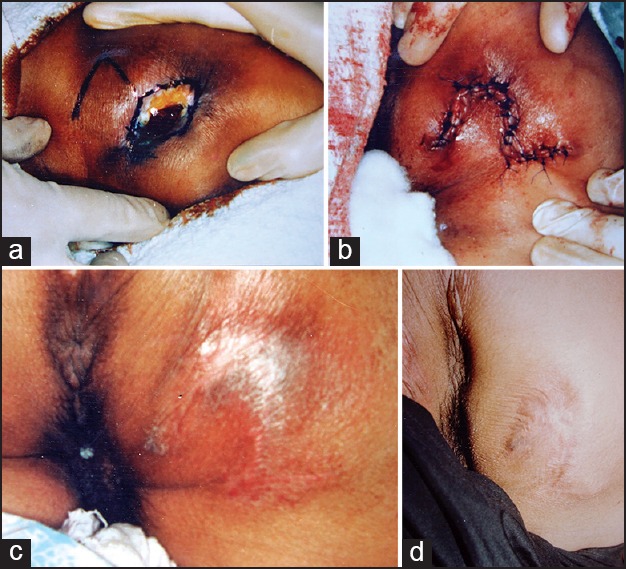
Sacral pressure ulcer (a) managed by marginal debridement and cover by Limberg's flap (b). 3-months follow-up (c) and 2 years follow-up (d) shows that flap is stable without recurrence
Figure 4
Figure 4
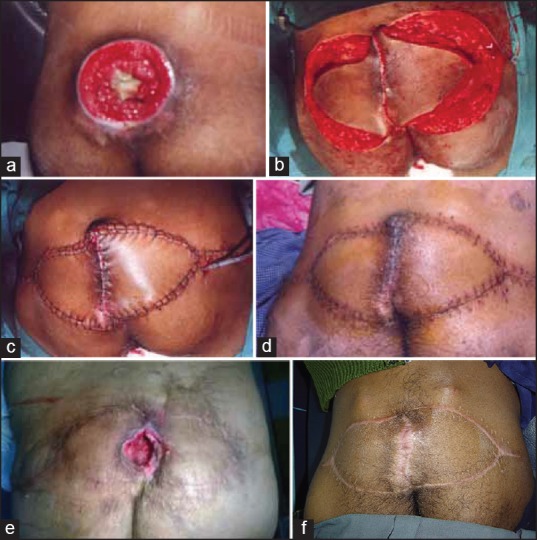
Sacral pressure sore (a), debridement and cover by local perforator based V-Y advancement flaps (b and c), 1-month post-operative (d), recurrence on the flap after 11 years (e) due to loss of family support and subsequent improper care. Another patient with the same flap after 16-year of follow-up (f) with a proper weight shifting and care showing stable coverage
Figure 5
Figure 5
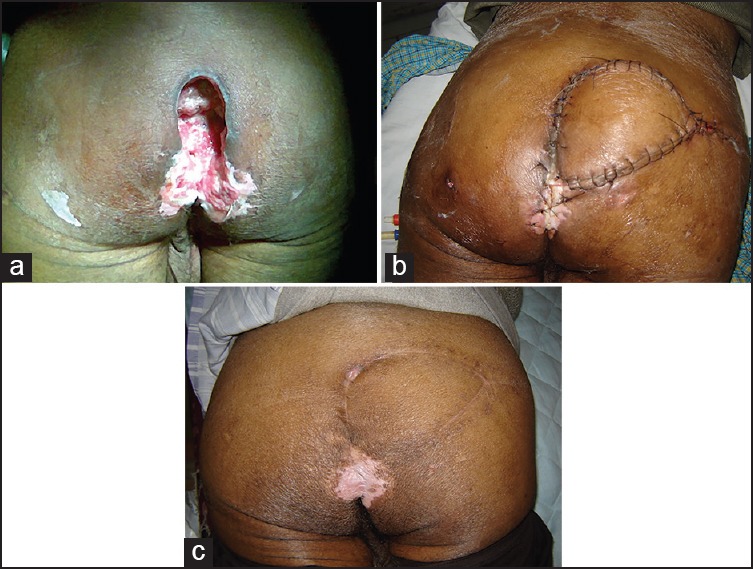
Grade four sacral pressure ulcer (a) managed by right-sided superior gluteal artery perforator flap (b), and 2-year follow-up (c)
Figure 6
Figure 6
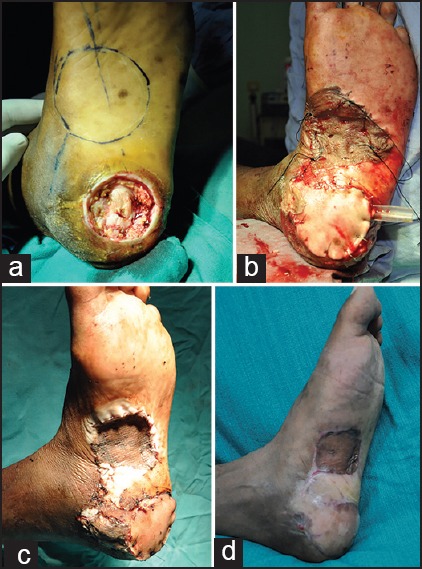
Medial planter flap for heel sore: A long-standing deep trophic ulcer of heel (a). The islanded medial planter flap was transposed to the defect and the resultant donor site was covered by split thickness skin graft (b). The 1-week (c) and 3-month (d) post-operative pictures showing stable coverage. Patient allowed full weight bearing from 6th week along with silicone footpad protection
Figure 7
Figure 7
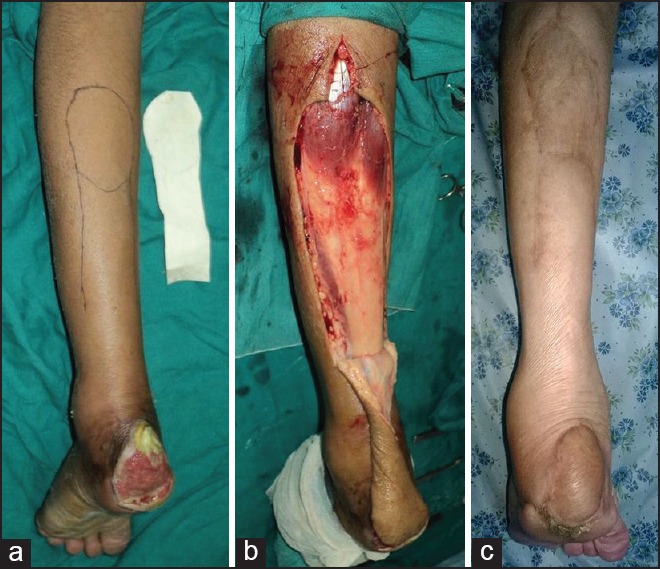
Reverse sural flap for posterior heel ulcer: A full thickness (Grade-4) acute pressure ulcer of posterior heel (a). The ulcer was sharply excised and covered with the reverse sural flap (b). The donor site and distal half of the island pedicle were covered with split skin graft in this one stage repair. At 36-months post-operative follow-up (c)
Figure 8
Figure 8
Variety of foot protective devices: Indigenous made (water filled and tied gloves) placed below the area needs pressure protection (a), It is inexpensive, easy to fabricate, ideal for domiciliary care. Varieties of foot protective devices are commercially available, which are made up of soft silicone elastomer to protect respective areas to protect from pressure likeadhesive pads (b), silicone sole (c) and toe separator (d). Image source: http://www.shop.mediuk.co.uk/protect-silicone-insole.html, http://www.sturdyfoot.com/Silicone-Bunion-Shield-Toe-Separators

References

    1. Gebhardt KS. Part 1. Causes of pressure ulcers. Nurs Times. 2002;98:4. - PubMed
    1. Gefen A. Reswick and Rogers pressure-time curve for pressure ulcer risk. Part 1. Nurs Stand. 2009;23:64. 66, 68. - PubMed
    1. Gefen A. Reswick and Rogers pressure-time curve for pressure ulcer risk. Part 2. Nurs Stand. 2009;23:40–4. - PubMed
    1. Callam MJ, Ruckley CV, Harper DR, Dale JJ. Chronic ulceration of the leg: Extent of the problem and provision of care. Br Med J (Clin Res Ed) 1985;290:1855–6. - PMC - PubMed
    1. Krouskop TA, Reddy NP, Spencer WA, Secor JW. Mechanisms of decubitus ulcer formation — An hypothesis. Med Hypotheses. 1978;4:37–9. - PubMed