. 2015 May 18;10(5):e0125132.
doi: 10.1371/journal.pone.0125132. eCollection 2015.

Fas Signaling Promotes Gastric Cancer Metastasis through STAT3-Dependent Upregulation of Fascin

Affiliations

Fas Signaling Promotes Gastric Cancer Metastasis through STAT3-Dependent Upregulation of Fascin

Yunshan Yang et al. PLoS One. .

Abstract

Background: Fas signaling-activated signal transducers and activators of transcription 3 (STAT3) is required for Fascin upregulation. As an actin-bundling protein, Fascin can mediate gastric cancer (GC) cell migration.

Methods: Gastric cancer AGS cells were treated with anti-Fas (5 μg/ml) for 2 h, in order to stimulate the activation of the Fas signaling. The in vitro migration of Fas signaling-activated AGS cells was assessed using Transwell chambers. The levels of Fascin and phosphorylated STAT3 were detected by Western blotting analyses. Nude mice were injected intravenously with AGS cells treated with anti-Fas or treated with STAT3 inhibitor without anti-Fas; tumor pulmonary metastases were measured. Fascin protein expression in tumor tissues was detected by immunohistochemistry. The Fas and Fascin mRNA levels in tumor tissues from patients with GC were measured by real-time PCR and their correlation was analyzed.

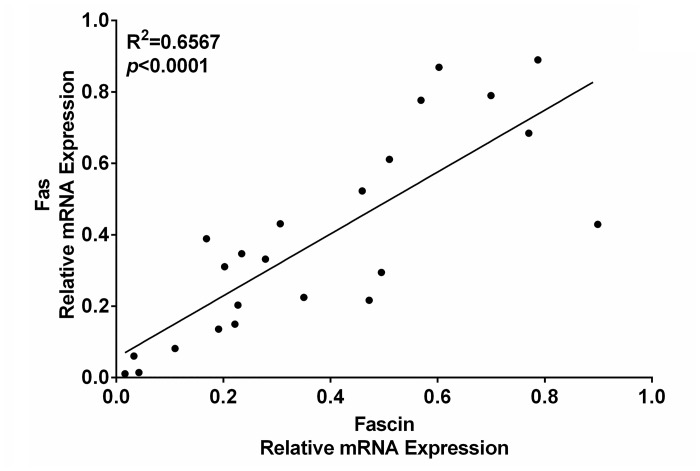
Results: The activation of Fas signaling promoted cell migration and resulted in STAT3-dependent Fascin upregulation in AGS cells. STAT3 enhanced Fascin levels in vivo. Fascin was the mediator of Fas signaling-induced AGS cell migration in vitro and in vivo. Furthermore, there was a positive correlation between Fas and Fascin mRNA levels in tumor tissues from GC patients.

Conclusions: Fas signaling promotes GC metastasis through the STAT3/Fascin pathway, which may provide a new target for GC therapy.


Conflict of interest statement

Competing Interests: The authors have declared that no competing interests exist.

Figures

Fig 1
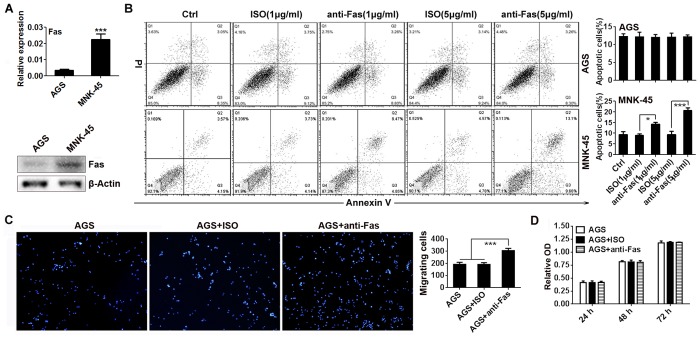
Fig 1. Activation of Fas signaling promotes the migration of GC cells.
(A) The Fas expression in AGS and MNK-45 cells were detected by real-time PCR (upper) and Western blot (down). (B) Susceptibility of AGS and MNK-45 cells to Fas-induced apoptosis was measured by staining with Annexin V and PI after both cells were stimulated with anti-Fas or ISO at the indicated concentrations for 24 h (left) and the apoptotic cells were statistically analyzed (right) (n = 3). (C) After stimulated with 5 μg/ml anti-Fas or ISO for 2 h, the AGS cells were collected and seeded into the top chamber. Forty-eight hours later, the number of cells on the bottom of the Transwell filter was imaged (left) and quantified (right) (n = 5). Magnification: 200×. (D) The proliferation of AGS cells was measured by CCK8 assay after stimulation with 5 μg/ml of anti-Fas or ISO in the indicated timepoint. Data are representative of three independent experiments. (*p <0.05, ***p <0.001)
Fig 2
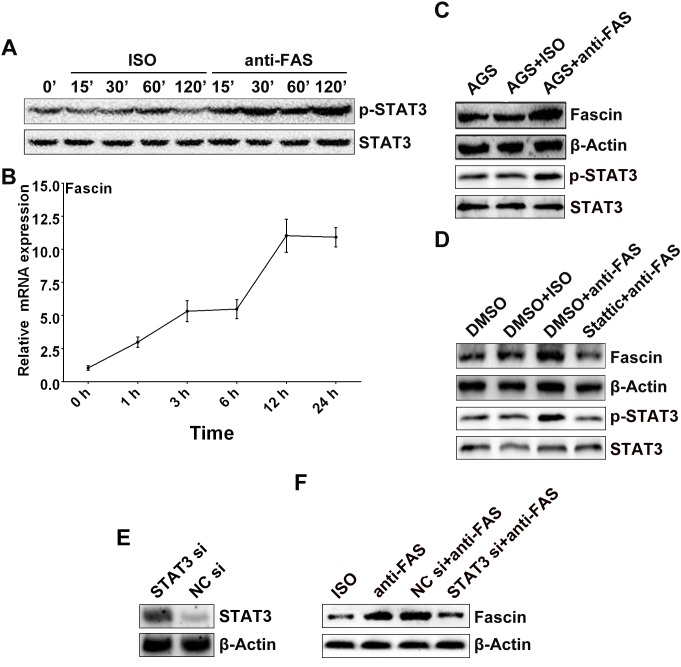
Fig 2. Activation of Fas signaling upregulated Fascin expression in AGS cells through activation of STAT3.
The AGS cells were stimulated with 5 μg/ml of anti-Fas in the indicated times. (A) The phosphorylated STAT3 was detected by Western blot. (B) The expression of Fascin mRNA was assayed by real-time PCR. (C) After stimulation with 5 μg/ml anti-Fas for 24 h, the protein level of phosphorylated STAT3 and Fascin in AGS cells was detected by Western blot. (D) The AGS cells were pre-treated with 10 μM of Stattic for 2 h and followed by 5 μg/ml of anti-Fas stimulation for 24 h; the protein level of phosphorylated STAT3 and Fascin was detected by Western blot. After transfection with STAT3 siRNA or NC siRNA for 36 h, (E) the STAT3 expression in the AGS cells was detected by Western blot; (F) the AGS cells were then stimulated with 5 μg/ml of anti-Fas for 2 h, and the Fascin expression in the cells was detected by Western blot. Data are representative of three independent experiments.
Fig 3
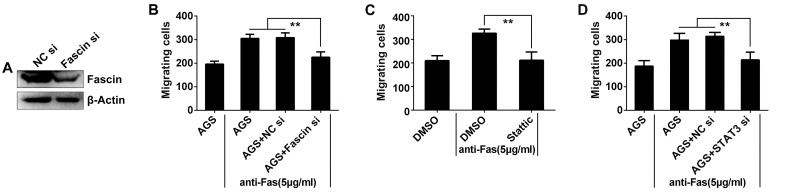
Fig 3. Fas signaling promoted AGS cell migration dependent on STAT3/Fascin pathway.
(A) AGS cells were transfected with Fascin siRNA or NC siRNA for 36 h, and Fascin expression in the cells was detected by Western blot. After (B) inhibition of Fascin expression by siRNA; or (C) treated with 10 μM Stattic for 2 h; or (D) inhibition of STAT3 expression by siRNA, and stimulated with 5 μg/ml of anti-Fas for 2 h, the number of AGS cells which migrated to the bottom of the Transwell filter was quantified (n = 5). Data are representative of three independent experiments. (**p <0.01)
Fig 4
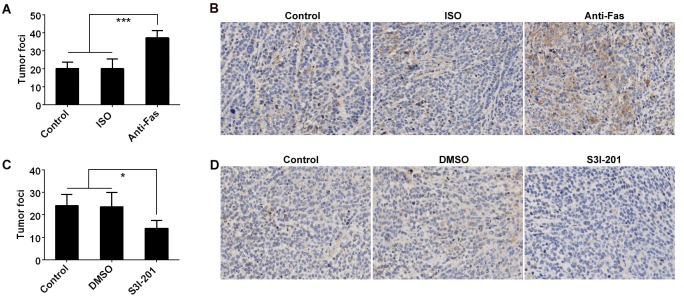
Fig 4. Fas signaling promotes AGS cell metastasis in vivo through STAT3/Fascin pathway.
2 × 10⁶ AGS tumor cells pre-stimulated with anti-Fas or ISO for 2 h were intravenously injected nude mice. (A) The number of lung tumor foci was counted (n = 5). (B) The expression of Fascin in tumor tissues from lung was detected by immunohistochemistry. 2 × 10⁶ AGS tumor cells were intravenously injected into nude mice and 24 h later, the mice received intravenous injection of S3I-201 at 5 mg/kg every 2 days for total 3 times. (C) The number of lung tumor foci was counted (n = 5). (D) The expression of Fascin in tumor tissues from lung was detected by immunohistochemistry (magnification: ×100). Data are representative of two independent experiments. (*p <0.05, ***p <0.001)
Fig 5
Fig 5. Correlation of the mRNA levels of Fas and Fascin in tumor tissues from GC patients.
Fas and Fascin mRNA expression was measured by real-time PCR and normalized to β-actin mRNA (n = 23). Positive correlation was obtained by Spearman correlation analysis.

References

    1. Jemal A, Bray F, Center MM, Ferlay J, Ward E, Forman D. Global cancer statistics. CA Cancer J Clin. 2011; 61: 69–90. 10.3322/caac.20107 - DOI - PubMed
    1. Sun W, Haller DG. Recent advances in the treatment of gastric cancer. Drugs. 2001; 61: 1545–1551. - PubMed
    1. Blander JM. A long-awaited merger of the pathways mediating host defence and programmed cell death. Nat Rev Immunol. 2014; 14: 601–618. 10.1038/nri3720 - DOI - PubMed
    1. Zhang J, Zhang D, Hua Z. FADD and its phosphorylation. IUBMB Life. 2004; 56: 395–401. - PubMed
    1. Symes JC, Kurin M, Fleshner NE, Medin JA. Fas-mediated killing of primary prostate cancer cells is increased by mitoxantrone and docetaxel. Mol Cancer Ther. 2008; 7: 3018–3028. 10.1158/1535-7163.MCT-08-0335 - DOI - PubMed

Publication types

MeSH terms