. 2015 May 20;11(5):e1004126.
doi: 10.1371/journal.pcbi.1004126. eCollection 2015 May.

Model-Free RNA Sequence and Structure Alignment Informed by SHAPE Probing Reveals a Conserved Alternate Secondary Structure for 16S rRNA

Affiliations

Model-Free RNA Sequence and Structure Alignment Informed by SHAPE Probing Reveals a Conserved Alternate Secondary Structure for 16S rRNA

Christopher A Lavender et al. PLoS Comput Biol. .

Abstract

Discovery and characterization of functional RNA structures remains challenging due to deficiencies in de novo secondary structure modeling. Here we describe a dynamic programming approach for model-free sequence comparison that incorporates high-throughput chemical probing data. Based on SHAPE probing data alone, ribosomal RNAs (rRNAs) from three diverse organisms--the eubacteria E. coli and C. difficile and the archeon H. volcanii--could be aligned with accuracies comparable to alignments based on actual sequence identity. When both base sequence identity and chemical probing reactivities were considered together, accuracies improved further. Derived sequence alignments and chemical probing data from protein-free RNAs were then used as pseudo-free energy constraints to model consensus secondary structures for the 16S and 23S rRNAs. There are critical differences between these experimentally-informed models and currently accepted models, including in the functionally important neck and decoding regions of the 16S rRNA. We infer that the 16S rRNA has evolved to undergo large-scale changes in base pairing as part of ribosome function. As high-quality RNA probing data become widely available, structurally-informed sequence alignment will become broadly useful for de novo motif and function discovery.


Conflict of interest statement

The authors have declared that no competing interests exist.

Figures
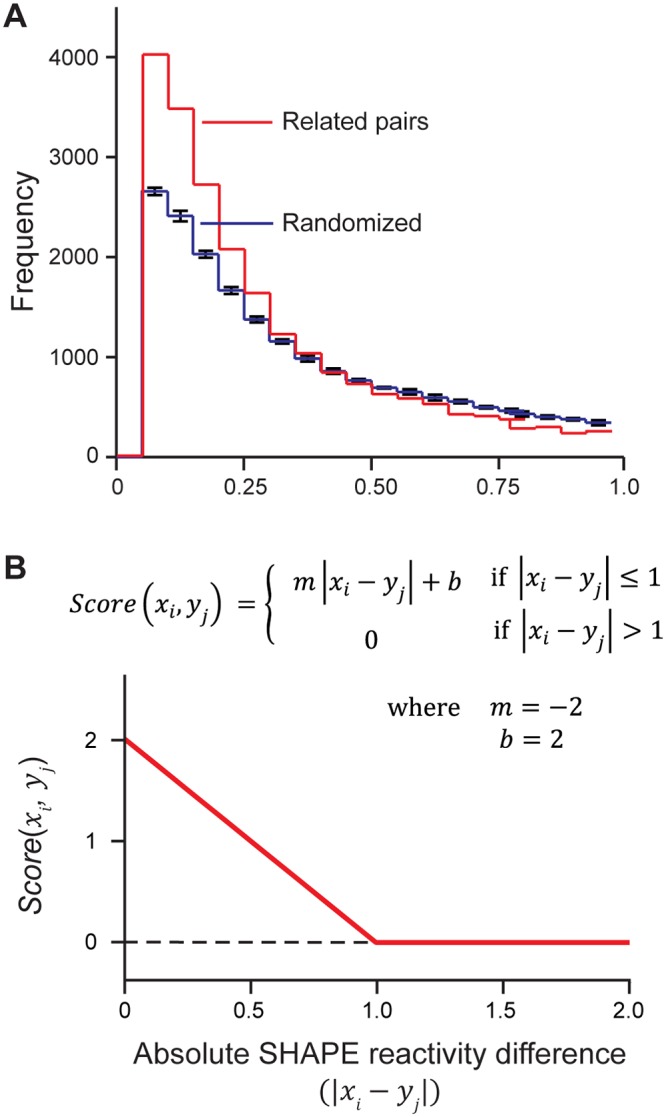
Fig 1
Fig 1. SHAPE-based scoring function for structurally-informed RNA sequence alignment.
(A) Histogram of the absolute differences in SHAPE reactivities for paired nucleotides in accepted alignments. Differences between related pairs are shown in red, and differences between randomized pairs are blue. Pairs were randomized in eight individual trials; average values are shown with standard deviations given as error bars. (B) Scoring function used to compare SHAPE values at positions i and j in sequences x and y, respectively.
Fig 2
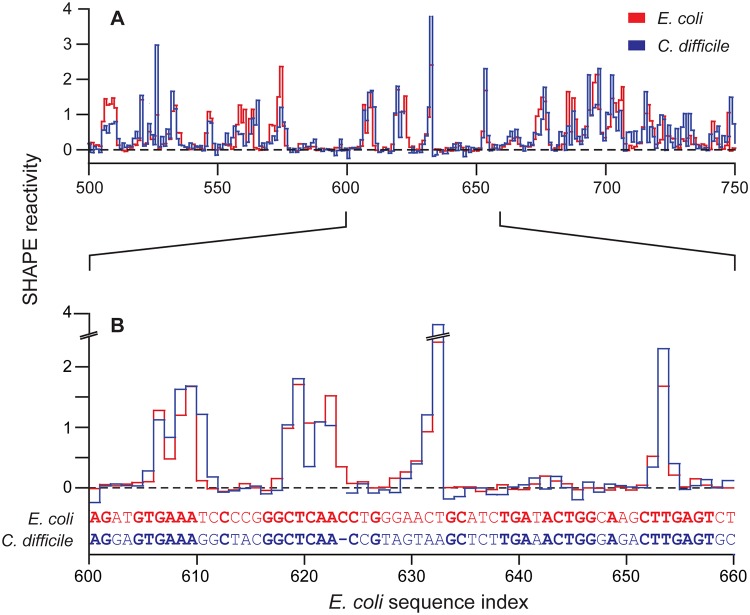
Fig 2. Representative global sequence alignment between E. coli and C. difficile 16S ribosomal RNAs using model-free SHAPE reactivities as the only constraint.
Alignment is shown as a function of E. coli sequence numbering. (A) Alignment of SHAPE reactivities across a 250-nucleotide window. (B) A 60-nucleotide subsection of this alignment, including primary sequences. Areas of sequence identity are emphasized in bold.
Fig 3
Fig 3. Secondary structure model for E. coli 16S rRNA.
This model was constrained by 16S rRNA consensus base pairs derived from SHAPE-based sequence alignment. Predicted pairs that exactly match the accepted covariation model [11] are shown with short black lines, and predicted pairs that match after modest local refolding are purple. Predicted pairs not in the covariation model are illustrated with blue lines. Covariation pairs not in the SHAPE-aligned structure are shown using red lines. E. coli SHAPE reactivities are shown by coloring of individual nucleotides (see scale). Areas with large-scale SHAPE-supported alternative folds are emphasized with cyan boxes. These areas (cyan) are illustrated on a structure model of the 16S ribosome [38] (bottom right) and cluster in the neck and decoding site. The inset is shown with an orientation that allows both h36 and the decoding site (h28 and h44) to be seen clearly.
Fig 4
Fig 4. Consensus alternate structures for helix 36 of E. coli 16S rRNA.
(A) SHAPE reactivities for aligned regions with consensus areas (RNAalifold) highlighted in gray. (B) Structures for the covariation and SHAPE-structure constrained models. Base pairs predicted in the first-step (RNAalifold) consensus are black, and base pairs predicted in the follow-up constrained (RNAfold) prediction are shown in gray.
Fig 5
Fig 5. Consensus alternate structures in the decoding site.
Helices 28 and 44 of the E. coli 16S rRNA are shown. (A) SHAPE reactivities for aligned regions. Consensus base pairs are highlighted in gray. (B) Structures for the covariation and SHAPE-structure constrained models. Base pairs in the RNAalifold consensus are shown in black, and base pairs predicted in the follow-up constrained RNAfold prediction are gray.

References

    1. Gesteland RF, Cech T, Atkins JF. The RNA World. 3rd ed Cold Spring Harbor, N.Y.: Cold Spring Harbor Laboratory Press; 2006.
    1. Michel F, Westhof E. Modelling of the three-dimensional architecture of group I catalytic introns based on comparative sequence analysis. J Mol Biol. 1990;216(3): 585–610. - PubMed
    1. Pollom E, Dang KK, Potter EL, Gorelick RJ, Burch CL, Weeks KM, et al. Comparison of SIV and HIV-1 genomic RNA structures reveals impact of sequence evolution on conserved and non-conserved structural motifs. PLoS Pathog. 2013;9(4): e1003294 10.1371/journal.ppat.1003294 - DOI - PMC - PubMed
    1. Deigan KE, Li TW, Mathews DH, Weeks KM. Accurate SHAPE-directed RNA structure determination. Proc Natl Acad Sci U S A. 2009;106(1): 97–102. 10.1073/pnas.0806929106 - DOI - PMC - PubMed
    1. Hofacker IL, Lorenz R. Predicting RNA structure: advances and limitations. Methods Mol Biol. 2014;1086: 1–19. 10.1007/978-1-62703-667-2_1 - DOI - PubMed

Publication types

MeSH terms