. 2015 May 18;10(5):e0127381.
doi: 10.1371/journal.pone.0127381. eCollection 2015.

Epidemiological Study of Mammary Tumors in Female Dogs Diagnosed during the Period 2002-2012: A Growing Animal Health Problem

Affiliations

Epidemiological Study of Mammary Tumors in Female Dogs Diagnosed during the Period 2002-2012: A Growing Animal Health Problem

Yaritza Salas et al. PLoS One. .

Abstract

Epidemiological studies enable us to analyze disease behavior, define risk factors and establish fundamental prognostic criteria, with the purpose of studying different types of diseases. The aim of this study was to determine the epidemiological characteristics of canine mammary tumors diagnosed during the period 2002-2012. The study was based on a retrospective study consisting of 1,917 biopsies of intact dogs that presented mammary gland lesions. Biopsies were sent to the Department of Pathology FMVZ-UNAM diagnostic service. The annual incidence of mammary tumors was 16.8%: 47.7% (benign) and 47.5% (malignant). The highest number of cases was epithelial, followed by mixed tumors. The most commonly diagnosed tumors were tubular adenoma, papillary adenoma, tubular carcinoma, papillary carcinoma, solid carcinoma, complex carcinoma and carcinosarcoma. Pure breeds accounted for 80% of submissions, and the Poodle, Cocker Spaniel and German Shepherd were consistently affected. Adult female dogs (9 to 12 years old) were most frequently involved, followed by 5- to 8-year-old females. Some association between breeds with histological types of malignant tumors was observed, but no association was found between breeds and BN. Mammary tumors in intact dogs had a high incidence. Benign and malignant tumors had similar frequencies, with an increase in malignant tumors in the past four years of the study. Epithelial tumors were more common, and the most affected were old adult females, purebreds and small-sized dogs. Mammary tumors in dogs are an important animal health problem that needs to be solved by improving veterinary oncology services in Mexico.


Conflict of interest statement

Competing Interests: The authors have declared that no competing interests exist.

Figures

Fig 1
Fig 1. Annual incidence of canine biopsies registered at the Department of Pathology, FMVZ-UNAM (2002–2012).
Fig 2
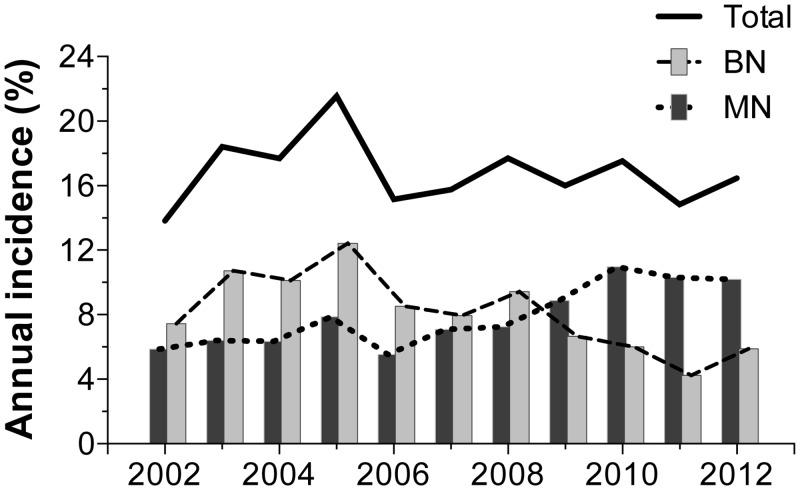
Fig 2. Relative incidence of mammary gland lesions according to biological behavior.
Fig 3
Fig 3. Total annual incidence of canine mammary tumors according to biological behavior.
Fig 4
Fig 4. Gaussian-fitted annual cumulative frequency of mammary tumors.
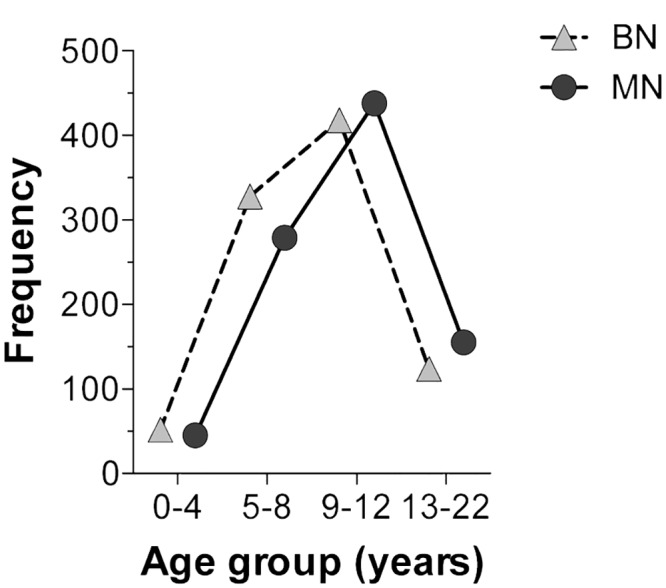
BN: Benign tumor; MN: Malignant tumor.
Fig 5
Fig 5. Time series of the number of benign or malignant cases of canine mammary tumors classified according to the tissue of origin: (a) Epithelial, (b) Mesenchymal or (c) Mixed tumor.
Fig 6
Fig 6. Relative frequency of benign or malignant canine mammary tumors according to the tissue of origin.
Fig 7
Fig 7. Relative frequency of the main morphological types of canine mammary tumors classified according to the tissue of origin: (a) benign and (b) malignant neoplasms.
Fig 8
Fig 8. Temporal changes in the frequency of the main morphological types: (a) benign and (b) malignant canine mammary tumors.
Fig 9
Fig 9. Times series showing the annual frequency allocation of the main morphological types: (a) benign and (b) MN in the epidemiological curves, formed with the 25th, 50th and 75th percentiles for the total frequency of mammary lesions.
Fig 10
Fig 10. Percentage of female dogs showing mammary tumors classified according to their breed and categorized by size group.
Fig 11
Fig 11. Age group distribution. Female dogs diagnosed with mammary lesions classified according to their size.
Fig 12
Fig 12. Age group distribution. Female dogs diagnosed with benign or malignant neoplasm.
Fig 13
Fig 13. Correspondence analysis of the pattern of association between breed, morphological type and tissue of origin, in relation to canine mammary tumors: (a) small-sized, (b) medium-sized, and (c) large-sized female dogs diagnosed with malignant neoplasm.
The association between variables is interpreted according to the distance that separates the adjacent categories of each variable. Thus, the lesser the distance, the greater the correspondence or association between groups of variables. Dim 1 and Dim 2 were defined as the main variance components within the multivariate analysis, accounting for 89–93% of the explanation of the total variation exhibited by the data.

References

    1. Moe L. Population-based incidence of mammary tumors in some dog breeds. J Reprod Fertil Suppl. 2001; (57): 439–443. - PubMed
    1. Schneider R, Dorn CR, Taylor DO. Factors influencing canine mammary cancer development and postsurgical survival. J Natl Cancer Inst. 1969; (43):1249–61. - PubMed
    1. Wey N, Gutberlet K, Khon B. Mamma tumore bei der huding: Hormolle abhangigkeit unter besonderer berucksichtigung von 17 ß ostradiol und progesteron. Kleintierpraxis. 2000; (45):19–31.
    1. Goldschmidt M, Peña L, Rasotto R. Classification and grading of canine mammary tumors. Vet Pathol. 2011; (48):117–131. 10.1177/0300985810393258 - DOI - PubMed
    1. Klopfleisch R, Lenze D, Hummel M, Gruber A. Metastatic canine mammary carcinomas can be identified by a gene expression profile that partly overlaps with human breast cancer profiles. BMC Cancer. 2010; (10):618 10.1186/1471-2407-10-618 - DOI - PMC - PubMed

LinkOut - more resources