


Polymorphisms of the Ovine BMPR-IB, BMP-15 and FSHR and Their Associations with Litter Size in Two Chinese Indigenous Sheep Breeds
- PMID: 25993301
- PMCID: PMC4463706
- DOI: 10.3390/ijms160511385
Polymorphisms of the Ovine BMPR-IB, BMP-15 and FSHR and Their Associations with Litter Size in Two Chinese Indigenous Sheep Breeds
Abstract
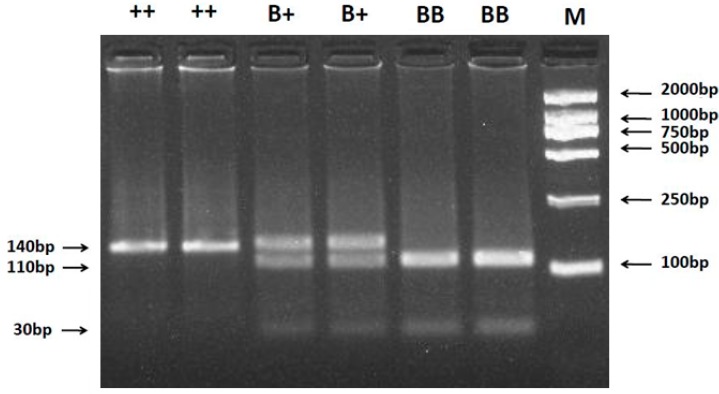
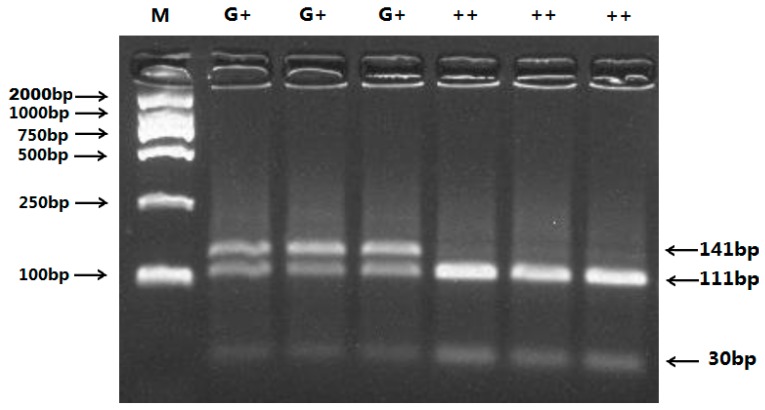
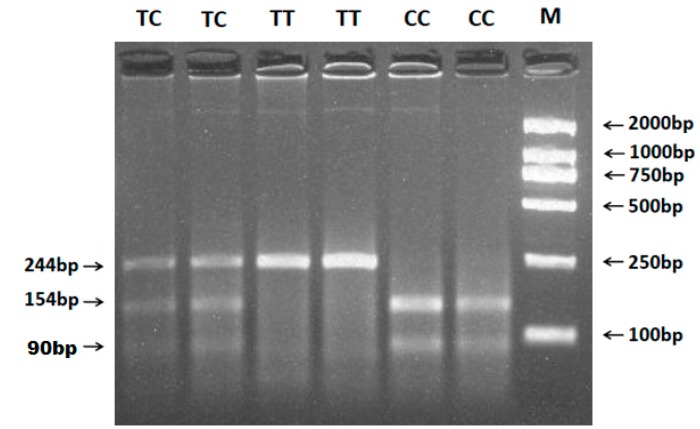
The Small Tailed Han sheep and Hu sheep are two prolific local sheep in China. In this study, the polymorphisms of BMPR-IB (Bone morphogenetic protein receptor IB), BMP-15 (Bone morphogenetic protein 15) and FSHR (follicle stimulating hormone receptor) were investigated to check whether they are associated with litter size in Small Tailed Han sheep and Hu sheep. Consequently, three polymorphisms, FecB mutation in BMPR-IB (c.746A>G), FecG mutation in BMP-15 (c.718C>T) and the mutation (g. 47C>T) in FSHR were found in the above two sheep breeds with a total number of 1630 individuals. The single marker association analysis showed that the three mutations were significantly associated with litter size. The ewes with genotype FecBB/FecBB and FecBB/FecB+ had 0.78 and 0.58 more lambs (p < 0.01) than those with genotype FecB+/FecB+, respectively. The heterozygous Han and Hu ewes with FecXG/FecX+ genotype showed 0.30 (p = 0.05) more lambs than those with the FecX+/FecX+ genotype. For FSHR gene, the ewes with genotype CC had 0.52 (p < 0.01) and 0.75 (p < 0.01) more lambs than those with genotypes TC and TT, respectively. Combined effect analyses indicated an extremely significant interaction (p < 0.01) between the random combinations of BMPR-IB, BMP-15 and FSHR genes on litter size. In addition, the Han and Hu ewes with BB/G+/CC genotype harbor the highest litter size among ewes analyzed in current study. In conclusion, BMPR-IB, BMP-15 and FSHR polymorphisms could be used as genetic markers in multi-gene pyramiding for improving litter size in sheep husbandry.
Keywords: BMP-15 gene; BMPR-IB gene; FSHR gene; Hu sheep; Small Tailed Han sheep; litter size.
Figures
References
-
- Wilson T., Wu X.Y., Juengel J.L., Ross I.K., Lumsden J.M., Lord E.A., Dodds K.G., Walling G.A., McEwan J.C., OʼConnell A.R., et al. Highly prolific Booroola sheep have a mutation in the intracellular kinase domain of bone morphogenetic protein IB receptor (ALK-6) that is expressed in both oocytes and granulosa cells. Biol. Reprod. 2001;64:1225–1235. doi: 10.1095/biolreprod64.4.1225. - DOI - PubMed
-
- Mulsant P., Lecerf F., Fabre S., Schibler L., Monget P., Lanneluc I., Pisselet C., Riquet J., Monniaux D., Callebaut I., et al. Mutation in bone morphogenetic protein receptor-IB is associated with increased ovulation rate in Booroola Merino ewes. Proc. Natl. Acad. Sci. USA. 2001;98:5104–5109. doi: 10.1073/pnas.091577598. - DOI - PMC - PubMed
-
- Galloway S.M., McNatty K.P., Cambridge L.M., Laitinen M.P., Juengel J.L., Jokiranta T.S., McLaren R.J., Luiro K., Dodds K.G., Montgomery G.W., et al. Mutations in an oocyte-derived growth factor gene (BMP-15) cause increased ovulation rate and infertility in a dosage-sensitive manner. Nat. Genet. 2000;25:279–283. doi: 10.1038/77033. - DOI - PubMed
-
- Crawford J.L., Heath D.A., Reader K.L., Quirke L.D., Hudson N.L., Juengel J.L., McNatty K.P. Oocytes in sheep homozygous for a mutation in bone morphogenetic protein receptor 1B express lower mRNA levels of bone morphogenetic protein 15 but not growth differentiation factor 9. Reproduction. 2011;142:53–61. doi: 10.1530/REP-10-0485. - DOI - PubMed
Publication types
MeSH terms
Substances
LinkOut - more resources
Full Text Sources
Other Literature Sources
