Multicenter Study
. 2015 Oct;88(4):754-63.
doi: 10.1038/ki.2015.151. Epub 2015 May 20.

Sequencing rare and common APOL1 coding variants to determine kidney disease risk

Affiliations
Multicenter Study

Sequencing rare and common APOL1 coding variants to determine kidney disease risk

Sophie Limou et al. Kidney Int. 2015 Oct.

Abstract

A third of African Americans with sporadic focal segmental glomerulosclerosis (FSGS) or HIV-associated nephropathy (HIVAN) do not carry APOL1 renal risk genotypes. This raises the possibility that other APOL1 variants may contribute to kidney disease. To address this question, we sequenced all APOL1 exons in 1437 Americans of African and European descent, including 464 patients with biopsy-proven FSGS/HIVAN. Testing for association with 33 common and rare variants with FSGS/HIVAN revealed no association independent of strong recessive G1 and G2 effects. Seeking additional variants that might have been under selection by pathogens and could represent candidates for kidney disease risk, we also sequenced an additional 1112 individuals representing 53 global populations. Except for G1 and G2, none of the 7 common codon-altering variants showed evidence of selection or could restore lysis against trypanosomes causing human African trypanosomiasis. Thus, only APOL1 G1 and G2 confer renal risk, and other common and rare APOL1 missense variants, including the archaic G3 haplotype, do not contribute to sporadic FSGS and HIVAN in the US population. Hence, in most potential clinical or screening applications, our study suggests that sequencing APOL1 exons is unlikely to bring additional information compared to genotyping only APOL1 G1 and G2 risk alleles.


Figures
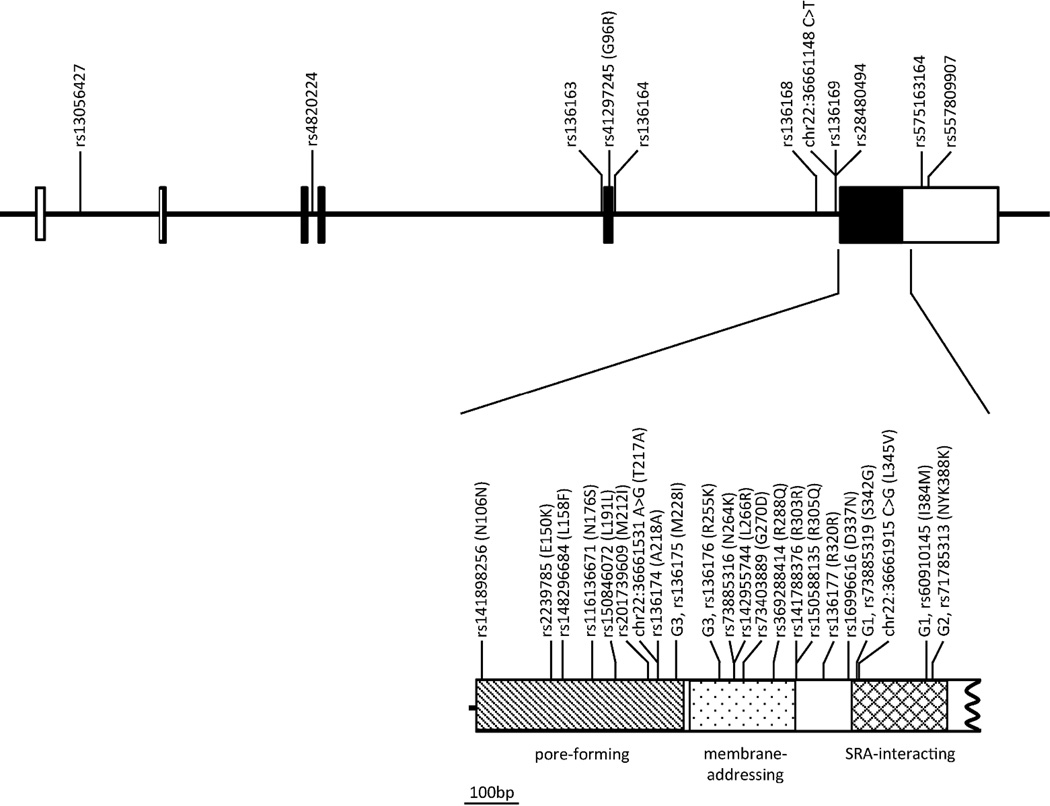
Figure 1
Figure 1. Genetic map of the targeted APOL1 regions in the NIH FSGS cohort
The different functional domains composing the APOL1 protein are coded as follows: hatching for the pore-forming (p.M60-W235), dot for the membrane-addressing (p.A238-P304), and tartan for the SRA-interacting (p.A339-L398) domains. When no rs number is available in dbSNP (build 137), the chromosome position is indicated based on the GRCh37 human genome version. The amino-acid positions refer to isoform a (NP_003652, 398aa). The G1, G2 and G3 variants are labeled. For the sake of clarity, we truncated the last exon and did not represent the full 3’UTR.
Figure 2
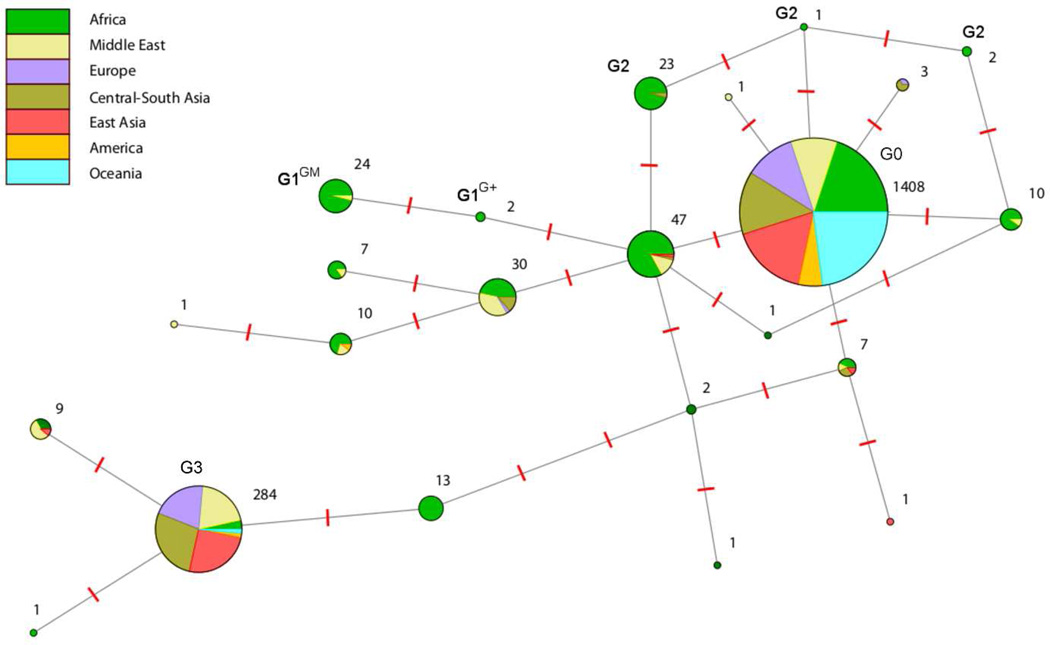
Figure 2. Phylogenetic network for the HGDP APOL1 haplotypes
Each pie chart represents a haplotype, with the area of the circle a function of the number of haplotypes found in our continental populations (stated next each pie chart). The large separation of G3 from other common haplotypes –indicated by the high number of mutation events (red dashes between two haplotypes)– is consistent with the hypothesis that it was inherited from introgression of archaic populations into modern humans; this is further supported by the fact that it is common in Eurasia but rare in Africa. Correspondingly, G0 plausibly represents the common haplotype in modern humans, common in all continental groups.
Figure 3
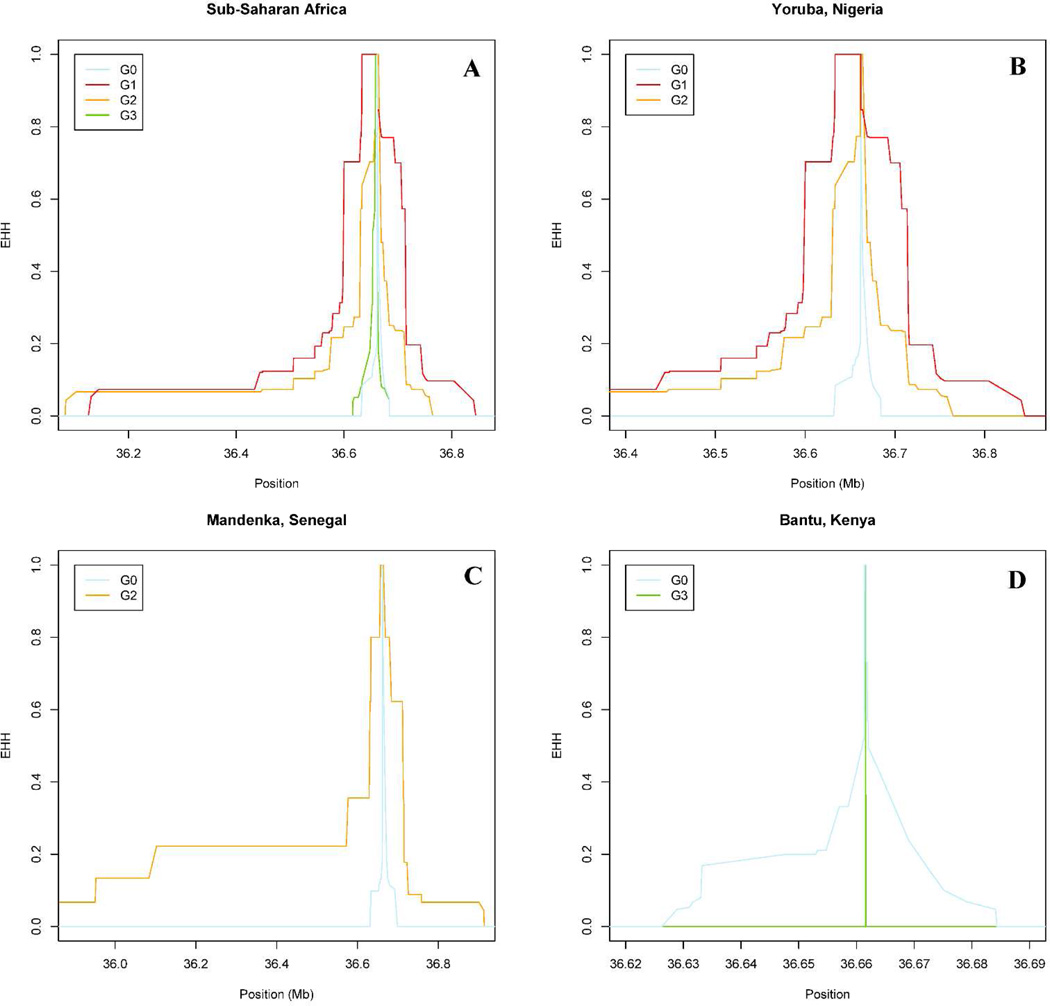
Figure 3. EHH plots for APOL1 haplotypes in Sub-Saharan Africa (A), Yoruba from Nigeria (B), Mandenka from Senegal (C) and Bantu from Kenya (D)
The genome coordinates refer to the GRCh37 human genome version. APOL1 G1 (red) and to a lesser extent G2 (orange) alleles showed an enlarged LD pattern in Sub-Saharan Africa and in Yoruba populations and G2 also exhibited an extended LD pattern in Mandenkas compared to G0 (light blue), suggesting a recent positive selection in West Africa. On the contrary, APOL1 G3 allele (green) did not show conclusive evidence of long LD pattern in the Bantu population.
Figure 4
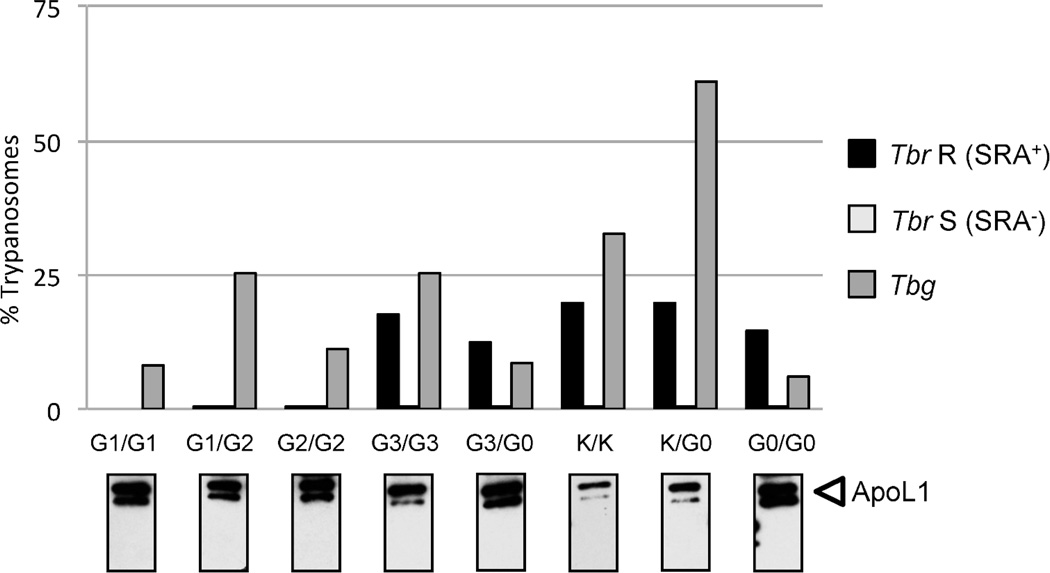
Figure 4. Trypanolytic activity for diverse APOL1 isoforms
The results are expressed in percent of control growth in fetal calf serum for the following Trypanosoma brucei clones: T.b. rhodesiense SRA+ resistant clone (Tbr R) in black, T.b. rhodesiense SRA sensitive clone (Tbr S) in light gray, and T.b. gambiense (Tbg) in dark grey. Below each individual bar chart, the anti-APOL1 Western blot results confirm the presence of non-degraded APOL1 protein in the plasma sample. We tested the following APOL1 isoforms: G1 in homozygous state (bar chart 1) and heterozygous state with G2 (bar chart 2), G2 (bar chart 3), G3 (bar charts 4 and 5), rs2239785-A; p.150K (K, bar charts 6 and 7), and G0 or WT homozygous (bar chart 8). The only rs73885316-A; p.K264-containing sample was also homozygous for p.150K: the results are therefore similar to bar chart 6. Each bar chart is representative of several experiments. While none of the tested plasma killed T.b. gambiense, all of them killed T.b. rhodesiense devoid of SRA (Tbr S), our positive control. Only plasma from individuals carrying G1 or G2 variants could overcome the SRA-driven inhibition and kill T.b. rhodesiense R.

References

    1. Coresh J, Selvin E, Stevens LA, et al. Prevalence of chronic kidney disease in the United States. JAMA. 2007;298(17):2038–2047. - PubMed
    1. Kopp JB, Winkler C. HIV-associated nephropathy in African Americans. Kidney Int Suppl. 2003;(83):S43–S49. - PubMed
    1. System USRD. Annual Data Report: Atlas of of Chronic Kidney Disease and End-Stage Renal Disease in the United States. Bethesda National Institutes of Health, National Institute of Diabetes and Digestive and Kidney Diseases; 2011.
    1. Toto RD. Proteinuria and hypertensive nephrosclerosis in African Americans. Kidney Int Suppl. 2004;(92):S102–S104. - PubMed
    1. Kitiyakara C, Eggers P, Kopp JB. Twenty-one-year trend in ESRD due to focal segmental glomerulosclerosis in the United States. Am J Kidney Dis. 2004;44(5):815–825. - PubMed

Publication types

MeSH terms