


Two key genomic regions harbour QTLs for salinity tolerance in ICCV 2 × JG 11 derived chickpea (Cicer arietinum L.) recombinant inbred lines
- PMID: 25994494
- PMCID: PMC4440540
- DOI: 10.1186/s12870-015-0491-8
Two key genomic regions harbour QTLs for salinity tolerance in ICCV 2 × JG 11 derived chickpea (Cicer arietinum L.) recombinant inbred lines
Abstract
Background: Although chickpea (Cicer arietinum L.), an important food legume crop, is sensitive to salinity, considerable variation for salinity tolerance exists in the germplasm. To improve any existing cultivar, it is important to understand the genetic and physiological mechanisms underlying this tolerance.
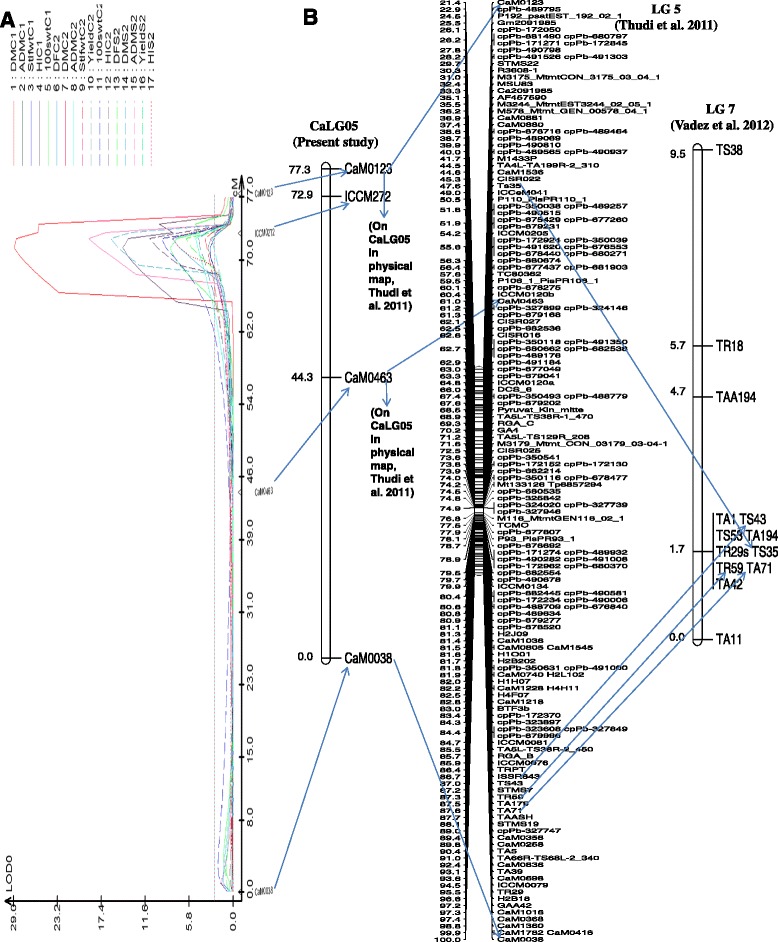
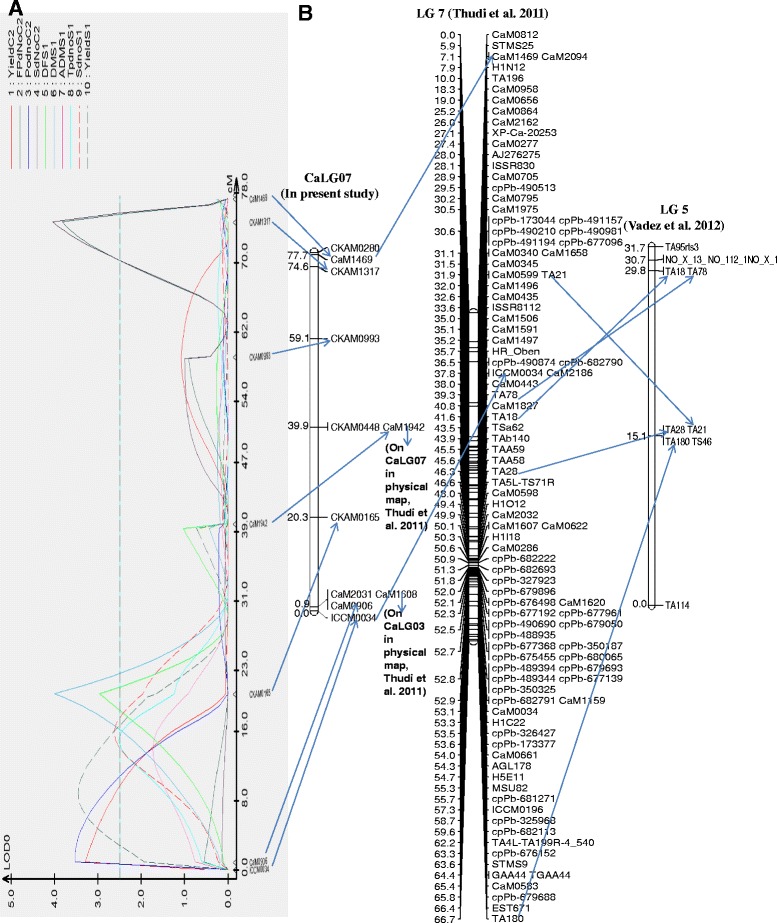
Results: In the present study, 188 recombinant inbred lines (RILs) derived from the cross ICCV 2 × JG 11 were used to assess yield and related traits in a soil with 0 mM NaCl (control) and 80 mM NaCl (salinity) over two consecutive years. Salinity significantly (P < 0.05) affected almost all traits across years and yield reduction was in large part related to a reduction in seed number but also a reduction in above ground biomass. A genetic map was constructed using 56 polymorphic markers (28 simple sequence repeats; SSRs and 28 single nucleotide polymorphisms; SNPs). The QTL analysis revealed two key genomic regions on CaLG05 (28.6 cM) and on CaLG07 (19.4 cM), that harboured QTLs for six and five different salinity tolerance associated traits, respectively, and imparting either higher plant vigour (on CaLG05) or higher reproductive success (on CaLG07). Two major QTLs for yield in the salinity treatment (explaining 12 and 17% of the phenotypic variation) were identified within the two key genomic regions. Comparison with already published chickpea genetic maps showed that these regions conferred salinity tolerance across two other populations and the markers can be deployed for enhancing salinity tolerance in chickpea. Based on the gene ontology annotation, forty eight putative candidate genes responsive to salinity stress were found on CaLG05 (31 genes) and CaLG07 (17 genes) in a distance of 11.1 Mb and 8.2 Mb on chickpea reference genome. Most of the genes were known to be involved in achieving osmoregulation under stress conditions.
Conclusion: Identification of putative candidate genes further strengthens the idea of using CaLG05 and CaLG07 genomic regions for marker assisted breeding (MAB). Further fine mapping of these key genomic regions may lead to novel gene identification for salinity stress tolerance in chickpea.
Figures
References
-
- FAOSTAT. FAOSTAT database. Available at http://faostat3.fao.org/faostat-gateway/go/to/download/Q/QC/E (2013). Accessed 12 Augt 2014.
-
- Samineni S, Siddique KHM, Gaur PM, Colmer TD. Salt sensitivity of the vegetative and reproductive stages in chickpea (Cicer arietinum L.): Podding is a particularly sensitive stage. Environ Exp Bot. 2011;71:260–8. doi: 10.1016/j.envexpbot.2010.12.014. - DOI
-
- Vadez V, Krishnamurthy L, Serraj R, Gaur PM, Upadhyaya HD, Hoisington DA, et al. Large variation in salinity tolerance in chickpea is explained by differences in sensitivity at the reproductive stage. Field Crop Res. 2007;104:123–9. doi: 10.1016/j.fcr.2007.05.014. - DOI
Publication types
MeSH terms
Substances
LinkOut - more resources
Full Text Sources
Other Literature Sources
Miscellaneous
