. 2015 Aug;6(4):441-7.
doi: 10.1007/s13244-015-0396-y. Epub 2015 May 21.

Imaging patients with renal colic-consider ultrasound first

Affiliations

Imaging patients with renal colic-consider ultrasound first

Carlos Nicolau et al. Insights Imaging. 2015 Aug.

Abstract

Renal colic is a common disease in Europe and a common cause of visit to the Emergency Department. Clinical diagnosis is usually confirmed by imaging modalities. Unenhanced computed tomography (CT) is considered the best diagnostic test due to its excellent accuracy detecting ureteral stones. However, ultrasound (US) should be considered as the primary imaging technique. It is a reproducible, non-invasive and non-expensive imaging technique, achieving accurate diagnosis in most cases without the need for radiation. Diagnosis is based on the presence of ureteral stones, but indirect findings such as the asymmetry or absence of ureteric jet, an increase of the resistive index or a colour Doppler twinkling artefact may help to suggest the diagnosis when the stone is not identified.

Main messages: • Renal colic diagnosis is usually confirmed by imaging modalities. • Imaging diagnosis of renal colic is based on the detection of ureteral stones. • CT is the most accurate imaging technique to identify ureteral stones. • US allows correct diagnosis in most cases without using radiation. • US should be used as the first imaging modality in patients with renal colic.


Figures
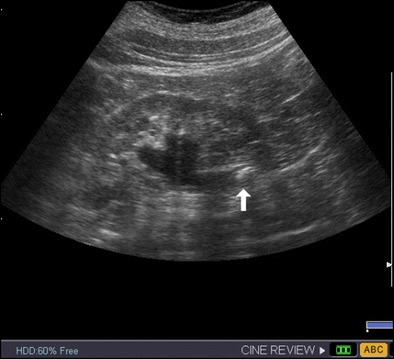
Fig. 1
Fig. 1
Left proximal ureteral stone (arrow) producing hydronephrosis
Fig. 2
Fig. 2
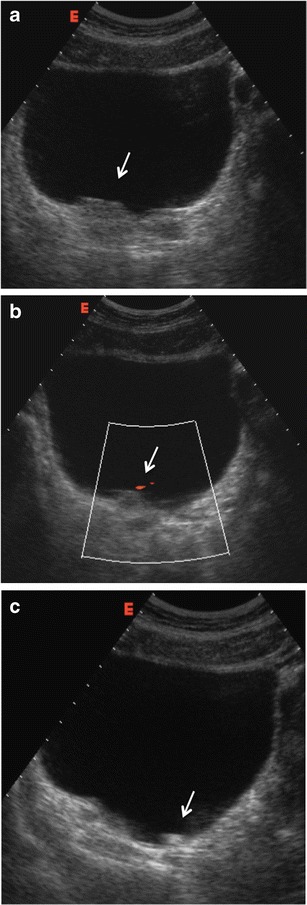
Patient with right renal colic. a US image show an oedematous UVJ (arrow). b Colour Doppler shows the presence of a small ureteral jet confirming the patency of the ureter (arrow). c A small stone that moves according to patient decubitus is identified at the urinary bladder (arrow)
Fig. 3
Fig. 3
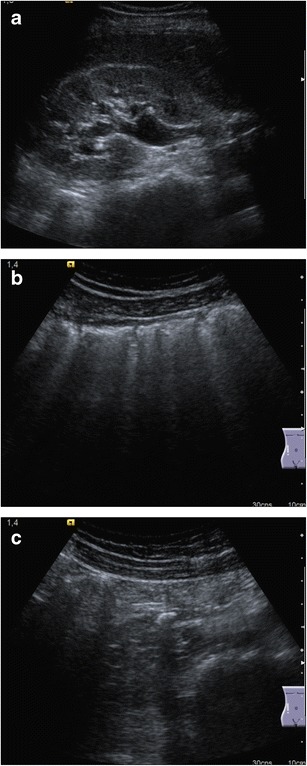
a Right kidney hydronephrosis with ureteral dilatation. b Interposition of bowel loops that hampers the identification of the ureter. c Correct visualisation of a midureteral stone was obtained after compressing and displacing the bowel loops
Fig. 4
Fig. 4
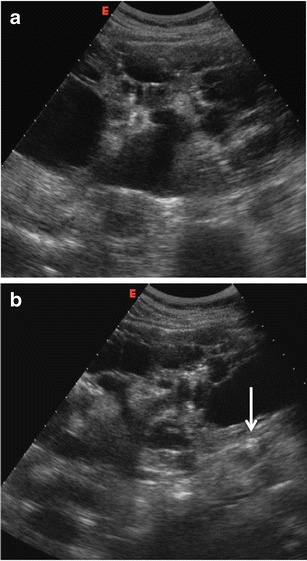
Patient with known congenital polycystic kidney disease and mild renal impairment with flank pain and acute renal insufficiency. a Right kidney with multiple cysts and mild dilatation of the pelvis; b minimal dilatation of the ureter due to a small stone (arrow) at the upper third of the ureter

References

    1. Johri N, Cooper B, Robertson W, et al. An update and practical guide to renal stone management. Nephron Clin Pract. 2010;116:c159–c171. doi: 10.1159/000317196. - DOI - PubMed
    1. Teichman JMH. Clinical practice. Acute renal colic from ureteral calculus. N Engl J Med. 2004;350:684–693. doi: 10.1056/NEJMcp030813. - DOI - PubMed
    1. Fulgham PF, Assimos DG, Pearle MS, Preminger GM. Clinical effectiveness protocols for imaging in the management of ureteral calculous disease: AUA technology assessment. J Urol. 2013;189:1203–1213. doi: 10.1016/j.juro.2012.10.031. - DOI - PubMed
    1. Coursey CA, Casalino DD, Remer EM, et al. ACR Appropriateness Criteria® acute onset flank pain—suspicion of stone disease. Ultrasound Q. 2012;28:227–233. doi: 10.1097/RUQ.0b013e3182625974. - DOI - PubMed
    1. Lindqvist K, Hellström M, Holmberg G, et al. Immediate versus deferred radiological investigation after acute renal colic: a prospective randomized study. Scand J Urol Nephrol. 2006;40:119–124. doi: 10.1080/00365590600688203. - DOI - PubMed

LinkOut - more resources