


The Role of Information Provision in Economic Evaluations of Newborn Bloodspot Screening: A Systematic Review
- PMID: 25995075
- PMCID: PMC4751163
- DOI: 10.1007/s40258-015-0177-2
The Role of Information Provision in Economic Evaluations of Newborn Bloodspot Screening: A Systematic Review
Abstract
Background: The extent to which economic evaluations have included the healthcare resource and outcome-related implications of information provision in national newborn bloodspot screening programmes (NBSPs) is not currently known.
Objectives: To identify if, and how, information provision has been incorporated into published economic evaluations of NBSPs.
Methods: A systematic review of economic evaluations of NBSPs (up to November 2014) was conducted. Three electronic databases were searched (Ovid: Medline, Embase, CINAHL) using an electronic search strategy combining a published economic search filter with terms related to national NBSPs and screening-related technologies. These electronic searches were supplemented by searching the NHS Economic Evaluations Database (NHS EED) and hand-searching identified study reference lists. The results were tabulated and summarised as part of a narrative synthesis.
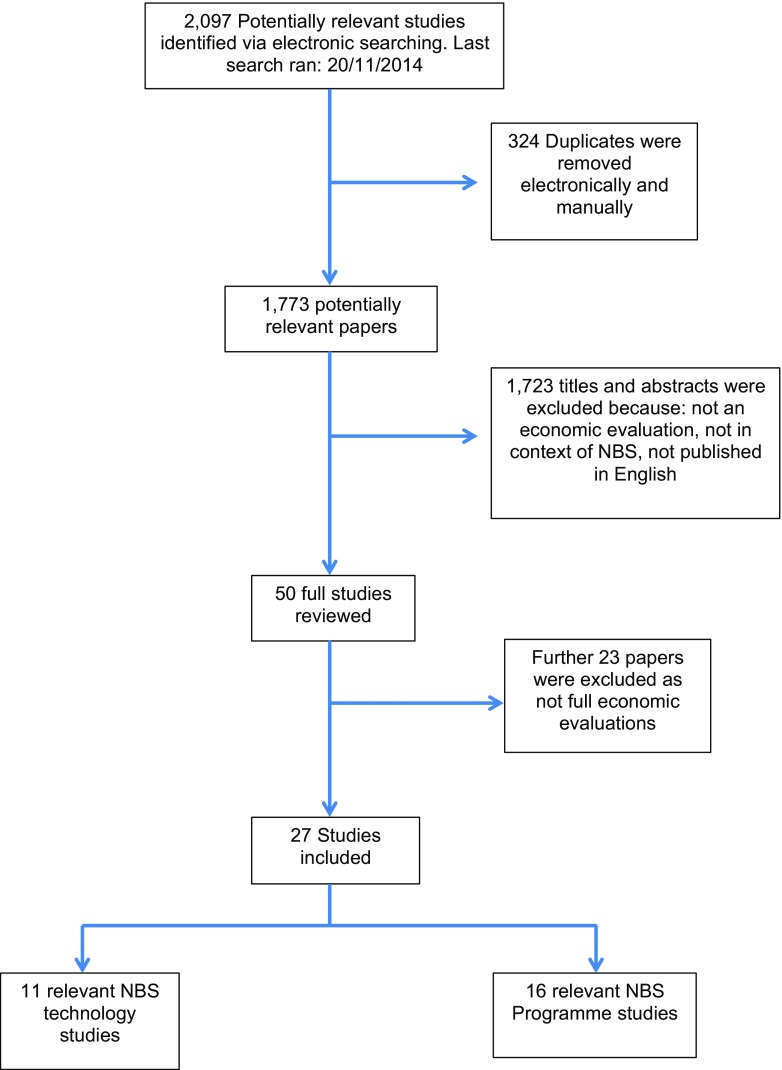
Results: A total of 27 economic evaluations [screening-related technologies (n = 11) and NBSPs (n = 16)] were identified. The majority of economic evaluations did not quantify the impact of information provision in terms of healthcare costs or outcomes. Five studies did include an estimate of the time cost associated with information provision. Four studies included a value to reflect the disutility associated with parental anxiety caused by false-positive results, which was used as a proxy for the impact of imperfect information.
Conclusion: A limited evidence base currently quantifies the impact of information provision on the healthcare costs and impact on the users of NBSPs; the parents of newborns. We suggest that economic evaluations of expanded NBSPs need to take account of information provision otherwise the impact on healthcare costs and the outcomes for newborns and their parents may be underestimated.
Figures
References
-
- Centre for Disease Control Ten great public health achievements—United States, 2001–2010. Morb Mortal Wkl Rep. 2011;60:619–623. - PubMed
-
- Guthrie R, Susi A. A simple phenylalanine method for detecting phenylketonuria in large populations of newborn infants. Pediatrics. 1963;32(3):338–343. - PubMed
-
- Sweetman L. Newborn screening by tandem mass spectrometry (MS-MS) Clin Chem. 1996;42:345–346. - PubMed
-
- Pandor A, Eastham J, Chilcott J, Paisley S, Beverley C. Economics of tandem mass spectrometry screening of neonatal inherited disorders. Int J Technol Assess. 2006;3:321–326. - PubMed
-
- Public Health England. Introducing newborn blood spot screening for parents. 2013. http://newbornbloodspot.screening.nhs.uk/public. Accessed 5 Nov 2014.
Publication types
MeSH terms
Grants and funding
LinkOut - more resources
Full Text Sources
Other Literature Sources
Medical
