


Low Albumin Levels, More Than Morbid Obesity, Are Associated With Complications After TKA
- PMID: 25995174
- PMCID: PMC4562915
- DOI: 10.1007/s11999-015-4333-7
Low Albumin Levels, More Than Morbid Obesity, Are Associated With Complications After TKA
Abstract
Background: Morbid obesity and malnutrition are thought to be associated with more frequent perioperative complications after TKA. However, morbid obesity and malnutrition often are co-occurring conditions. Therefore it is important to understand whether morbid obesity, malnutrition, or both are independently associated with more frequent perioperative complications. In addition, assessing the magnitude of an increase in complications and whether these complications are major or minor is important for both conditions.
Questions/purposes: We asked: (1) Is morbid obesity independently associated with more frequent major perioperative complications after TKA? (2) Are major perioperative complications after TKA more prevalent among patients with a low serum albumin?
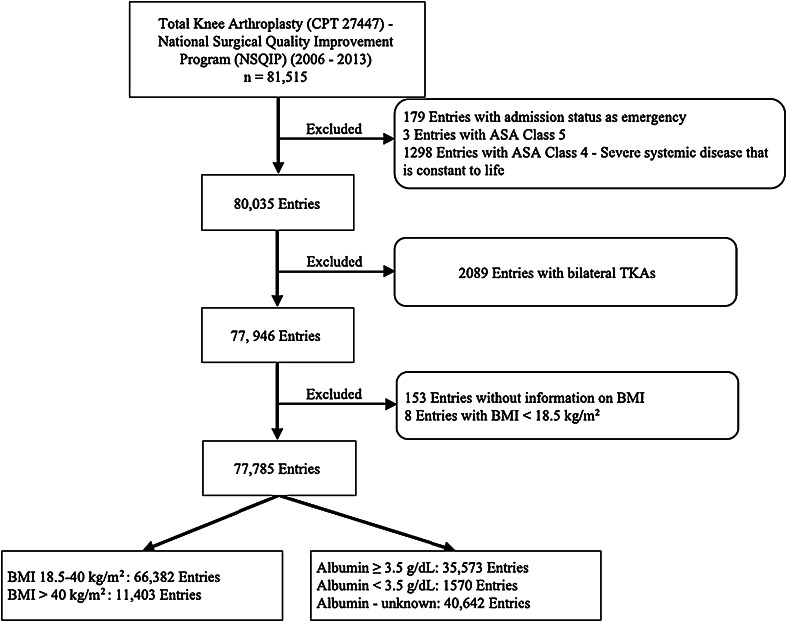
Methods: The National Surgical Quality Improvement Program (NSQIP) database was analyzed from 2006 to 2013. Patients were grouped as morbidly obese (BMI ≥ 40 kg/m(2)) or nonmorbidly obese (BMI ≥ 18.5 kg/m(2) to < 40 kg/m(2)), or by low serum albumin (serum albumin level < 3.5 mg/dL) or normal serum albumin (serum albumin level ≥ 3.5 mg/dL). The study cohort included 77,785 patients, including 35,573 patients with a serum albumin level of 3.5 g/dL or greater and 1570 patients with a serum albumin level less than 3.5 g/dL. Therefore, serum albumin levels were available for only 37,173 of the 77,785 of the patients (48%). There were 66,382 patients with a BMI between 18.5 kg/m(2) and 40 kg/m(2) and 11,403 patients with a BMI greater than 40 kg/m(2). Data were recorded on patient mortality along with 21 complications reported in the NSQIP. We also developed three composite complication variables to represent risk of any infections, cardiac or pulmonary complications, and any major complications. For each complication, multivariate logistic regression analysis was performed. Independent variables included patient age, sex, race, BMI, American Society of Anesthesiologists classification, year of surgery, and Charlson comorbidity index score.
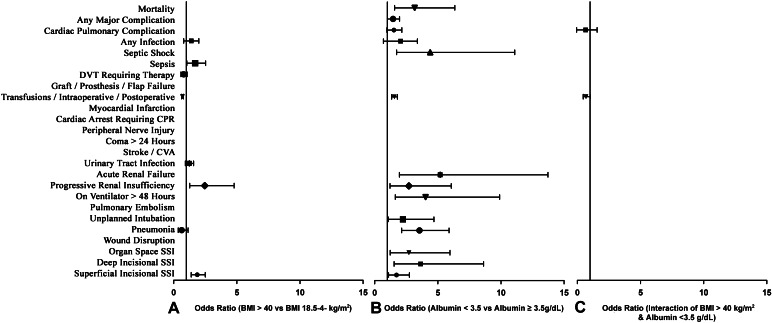
Results: Mortality was not increased in the morbidly obese group (0.14% vs 0.14%; p = 0.942). Patients who were morbidly obese were more likely to have progressive renal insufficiency (0.30% vs 0.10%; odds ratio [OR], 2.47; 95% CI, 1.27-4.29; p < 0.001), superficial infection (1.07% vs 0.55%; OR, 1.87; 95% CI, 1.39-2.51; p < 0.001), and sepsis (0.36% vs 0.23%; OR, 1.70; 95% CI, 1.04-2.53; p = 0.034) compared with patients who were not morbidly obese. Patients who were morbidly obese were less likely to require blood transfusion (8.68% vs 12.06%; OR, 0.70; 95% CI, 0.63-0.77; p < 0.001) compared with patients who were not morbidly obese. Morbid obesity was not associated with any of the other 21 perioperative complications recorded in the NSQIP database. With respect to the composite complication variables, patients who were morbidly obese had an increased risk of any infection (3.31% vs 2.41%; OR, 1.38; 95% CI, 1.16-1.64; p < 0.001) but not for cardiopulmonary or any major complication. The group with low serum albumin had higher mortality than the group with normal serum albumin (0.64% vs 0.15%; OR, 3.17; 95% CI, 1.58-6.35; p = 0.001). Patients in the low serum albumin group were more likely to have a superficial surgical site infection (1.27% vs 0.64%; OR, 1.27; 95% CI, 1.09-2.75; p = 0.020); deep surgical site infection (0.38% vs 0.12%; OR, 3.64; 95% CI, 1.54-8.63; p = 0.003); organ space surgical site infection (0.45% vs 0.15%; OR, 2.71; 95% CI, 1.23-5.97; p = 0.013); pneumonia (1.21 vs 0.29%; OR, 3.55; 95% CI, 2.14-5.89; p < 0.001); require unplanned intubation (0.51% vs 0.17%, OR, 2.24; 95% CI, 1.07-4.69; p = 0.033); and remain on a ventilator more than 48 hours (0.38% vs 0.07%; OR, 4.03; 95% CI, 1.64-9.90; p = 0.002). They are more likely to have progressive renal insufficiency (0.45 % vs 0.12%; OR, 2.71; 95% CI, 1.21-6.07; p = 0.015); acute renal failure (0.32% vs 0.06%; OR, 5.19; 95% CI, 1.96-13.73; p = 0.001); cardiac arrest requiring cardiopulmonary resuscitation (0.19 % vs 0.12%; OR, 3.74; 95% CI, 1.50-9.28; p = 0.005); and septic shock (0.38% vs 0.08%; OR, 4.4; 95% CI, 1.74-11.09; p = 0.002). Patients in the low serum albumin group also were more likely to require blood transfusion (17.8% vs 12.4%; OR, 1.56; 95% CI, 1.35-1.81; p < 0.001). In addition, among the three composite complication variables, any infection (5.0% vs 2.4%; OR, 2.0; 95% CI, 1.53-2.61; p < 0.001) and any major complication (2.4% vs 1.3%; OR, 1.41; 95% CI, 1.00-1.97; p = 0.050) were more prevalent among the patients with low serum albumin. There was no difference for cardiopulmonary complications.
Conclusions: Morbid obesity is not independently associated with the majority of perioperative complications measured by the NSQIP and was associated only with increases in progressive renal insufficiency, superficial surgical site infection, and sepsis among the 21 perioperative variables measured. However, low serum albumin was associated with increased mortality and multiple additional major perioperative complications after TKA. Low serum albumin, more so than morbid obesity, is associated with major perioperative complications. This is an important finding, as low serum albumin may be more modifiable than morbid obesity in patients who are immobile or have advanced knee osteoarthritis.
Level of evidence: Level III, prognostic study.
Figures
Comment in
-
CORR Insights: Low Albumin Levels, More Than Morbid Obesity, Are Associated With Complications After TKA.Clin Orthop Relat Res. 2015 Oct;473(10):3173-5. doi: 10.1007/s11999-015-4384-9. Epub 2015 Jun 5. Clin Orthop Relat Res. 2015. PMID: 26043716 Free PMC article. No abstract available.
-
Letter to the Editor: Low Albumin Levels, More Than Morbid Obesity, Are Associated With Complications After TKA.Clin Orthop Relat Res. 2016 Feb;474(2):600-1. doi: 10.1007/s11999-015-4661-7. Epub 2015 Dec 7. Clin Orthop Relat Res. 2016. PMID: 26642787 Free PMC article. No abstract available.
-
Reply to the Letter to the Editor: Low Albumin Levels, More Than Morbid Obesity, Are Associated With Complications After TKA.Clin Orthop Relat Res. 2016 Feb;474(2):602-3. doi: 10.1007/s11999-015-4662-6. Epub 2015 Dec 15. Clin Orthop Relat Res. 2016. PMID: 26671041 Free PMC article. No abstract available.
References
-
- Aggarwal VK, Tischler EH, Lautenbach C, Williams GR, Jr, Abboud JA, Altena M, Bradbury TL, Calhoun JH, Dennis DA, Del Gaizo DJ, Font-Vizcarra L, Huotari K, Kates SL, Koo KH, Mabry TM, Moucha CS, Palacio JC, Peel TN, Poolman RN, Robb WJ, 3rd, Salvagno R, Seyler T, Skaliczki G, Vasarhelyi EM, Watters WC., 3rd Mitigation and education. J Arthroplasty. 2014;29(2 suppl):19–25. doi: 10.1016/j.arth.2013.09.028. - DOI - PubMed
-
- American College of Surgeons; ACS NSQIP®. Welcome to the ACS NSQIP. Available at: http://site.acsnsqip.org. Accessed April 13, 2015.
-
- Campos AC, Meguid MM. A critical appraisal of the usefulness of perioperative nutritional support. Am J Clin Nutr. 1992;55:117–130. - PubMed
Publication types
MeSH terms
Substances
LinkOut - more resources
Full Text Sources
Other Literature Sources
Medical
Research Materials
