. 2015 Sep 15;21(18):4133-42.
doi: 10.1158/1078-0432.CCR-15-0269. Epub 2015 May 20.

Antiandrogens Inhibit ABCB1 Efflux and ATPase Activity and Reverse Docetaxel Resistance in Advanced Prostate Cancer

Affiliations

Antiandrogens Inhibit ABCB1 Efflux and ATPase Activity and Reverse Docetaxel Resistance in Advanced Prostate Cancer

Yezi Zhu et al. Clin Cancer Res. .

Abstract

Purpose: Previous studies show that inhibition of ABCB1 expression overcomes acquired docetaxel resistance in C4-2B-TaxR cells. In this study, we examined whether antiandrogens, such as bicalutamide and enzalutamide, could inhibit ABCB1 activity and overcome resistance to docetaxel.

Experimental design: ABCB1 efflux activity was determined using a rhodamine efflux assay. ABCB1 ATPase activity was determined by Pgp-Glo assay systems. The effects of the antiandrogens bicalutamide and enzalutamide on docetaxel sensitivity were determined by cell growth assays and tumor growth in vivo.

Results: We found that bicalutamide and enzalutamide inhibit ABCB1 ATP-binding cassette transporter activity through blocking ABCB1 efflux activity. Bicalutamide inhibited ABCB1 efflux activity by 40%, whereas enzalutamide inhibited ABCB1 efflux activity by approximately 60%. Both bicalutamide and enzalutamide inhibit ABCB1 ATPase activity. In addition, bicalutamide and enzalutamide inhibit ABCB1 efflux activity and desensitize docetaxel-resistant and androgen receptor (AR)-negative DU145 cells. Combination of bicalutamide with docetaxel had a significant antitumor effect in both AR-positive and AR-negative docetaxel-resistant xenograft models, suggesting that bicalutamide desensitizes docetaxel-resistant cells to docetaxel treatment independent of AR status.

Conclusions: We identified a novel mechanism of action for antiandrogens such as bicalutamide and enzalutamide as inhibitors of ABCB1 efflux and ATPase activity. Bicalutamide and enzalutamide desensitize docetaxel-resistant prostate cancer cells to docetaxel treatment independent of AR status. These studies may lead to the development of combinational therapies with bicalutamide/enzalutamide and docetaxel as effective regimens to treat advanced prostate cancer independent of AR status, and possibly other types of cancer.


Conflict of interest statement

Potential conflicts of interest: None

Figures
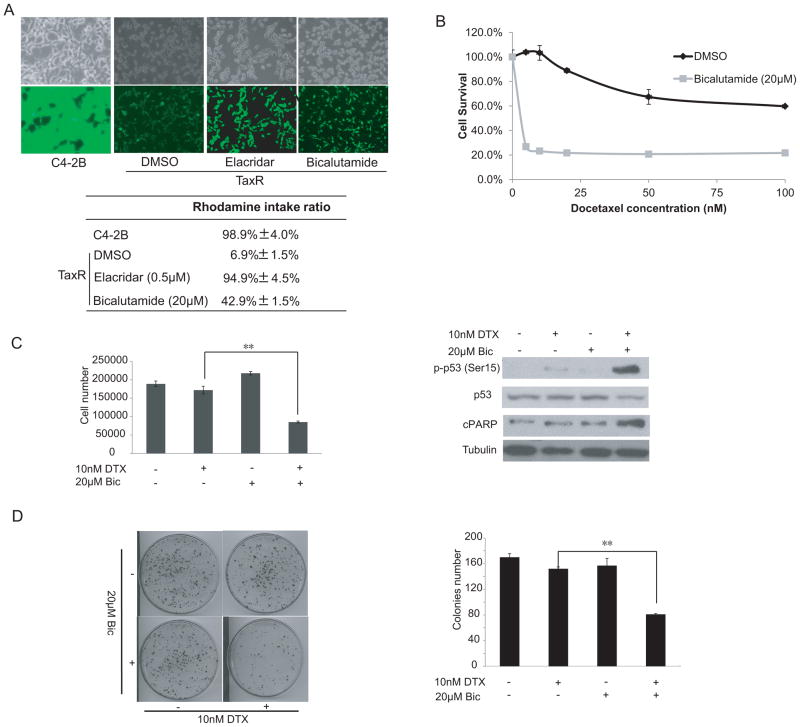
Figure 1
Figure 1
Bicalutamide reverses docetaxel resistance of TaxR cells. (A) C4-2B and TaxR cells were seeded in 6-well plates at a density of 2×10⁵ cells per well. TaxR cells were treated with 0.5 μM elacridar or 20 μM bicalutamide for 24 hrs. Cells were incubated with 1 μg/mL Rhodamine 123 for another 4 hrs. The cells were then washed 3 times with 1×PBS. Fluorescence was detected at an excitation wavelength of 480 nm and an emission wavelength of 534 nm. Top panel, fluorescent and phase contrast pictures were shown. Lower panel, rhodamine intake ratio. (B) TaxR cells were plated in 12-well plates and treated with increasing concentrations of docetaxel in the presence or absence of 20 μM bicalutamide. Cell number was counted after 24 hrs of treatment. (C) TaxR cells were treated with either 20 μmol/L bicalutamide or 10 nM docetaxel. After 24 hrs of treatment, cell number was counted (left panel). Whole-cell extracts were analyzed by Western blot using specific antibodies as indicated (right panel). (D) TaxR cells were treated with 10 nM docetaxel in the presence or absence of 20 μM bicalutamide. After 6 hrs of treatment, 1,000 cells were plated in 100 mm dishes in media containing complete FBS. The number of colonies was counted after 3 weeks and the results are presented as means ± SD of 2 experiments performed in duplicate. **, P < 0.01..
Figure 2
Figure 2
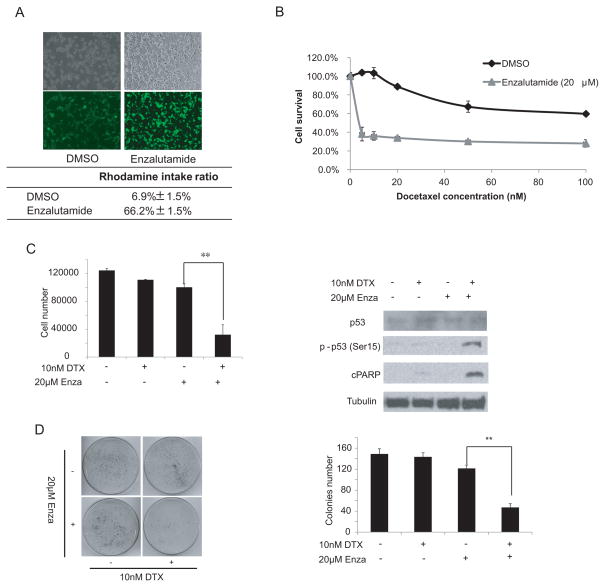
Enzalutamide reverses docetaxel resistance of TaxR cells. (A) TaxR cells were treated with either 20 μmol/L enzalutamide or with 10 nM docetaxel for 24 hrs. Cells were incubated with 1 μg/mL Rhodamine 123 for another 4 hrs. The cells were then washed three times with 1×PBS. Fluorescence was detected at an excitation wavelength of 480 nm and an emission wavelength of 534 nm. Fluorescent and phase contrast pictures are shown. Lower panel is the rhodamine intake ratio. (B) TaxR cells were plated in 12-well plates and treated with increasing concentrations of docetaxel in the presence or absence of 20 μM enzalutamide. Cell number was counted after 24 hrs of treatment. (C) TaxR cells were treated with either 20 μmol/L enzalutamide or with 10 nM docetaxel. After 24 hrs of treatment, the cell number was counted (left panel). Whole-cell extracts were analyzed by Western blot using specific antibodies as indicated (right panel). (D) TaxR cells were treated with 10 nM docetaxel in the presence or absence of 20 μM enzalutamide. After 6 hrs of treatment, 1,000 cells were plated in 100 mm dishes in media containing complete FBS. The number of colonies was counted after 3 weeks. Results are presented as means ± SD of 2 experiments performed in duplicate. **, P < 0.01.
Figure 3
Figure 3
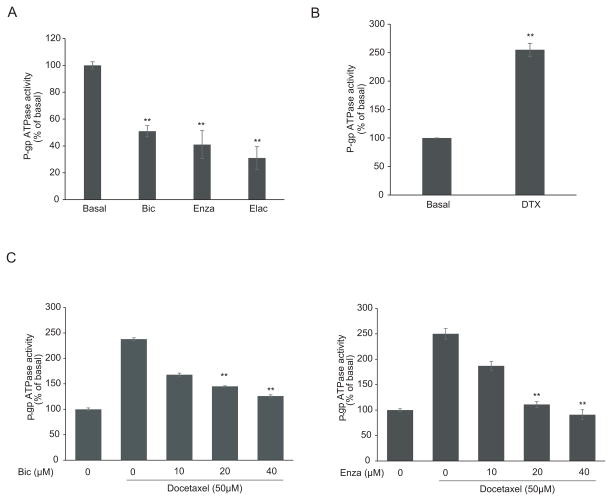
Effects of bicalutamide and enzalutamide on ABCB1 ATPase activity. ABCB1 ATPase activity in response to 40 μM bicalutamide and 40 μM enzalutamide and 2.5 μM elacridar (A) or 50 μM docetaxel (B) (C) Effects of bicalutamide (10, 20 and 40 μM) and enzalutamide (10, 20 and 40 μM) on 50 μM docetaxel-induced ABCB1 ATPase activity. The value was normalized to the basal P-gp ATPase activity as described in Materials and Methods. **, P < 0.01.
Figure 4
Figure 4
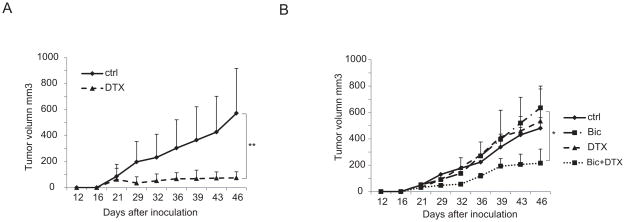
Combination treatment with bicalutamide and docetaxel overcomes docetaxel resistance. Six to eight week-old SCID mice were inoculated s.c. with 4×10⁶ C4-2B or TaxR cells on the flank. (A) Mice carrying C4-2B tumors were divided into two groups to receive either vehicle or docetaxel (10mg/kg body weight, i.p.) once a week. (B) Mice carrying TaxR tumors were divided into four groups and treated with vehicle, docetaxel (10 mg/kg body weight, i.p., one day a week) or bicalutamide (25 mg/kg body weight, esophageal gavaging, 5 days a week) alone or a combination of docetaxel (10 mg/kg body weight, i.p., one day a week )+ bicalutamide (25 mg/kg body weight, esophageal gavaging, 5 days a week). Tumor sizes were measured twice a week. *, P < 0.05. **, P < 0.01. DTX, docetaxel, Bic, bicalutamide.
Figure 5
Figure 5
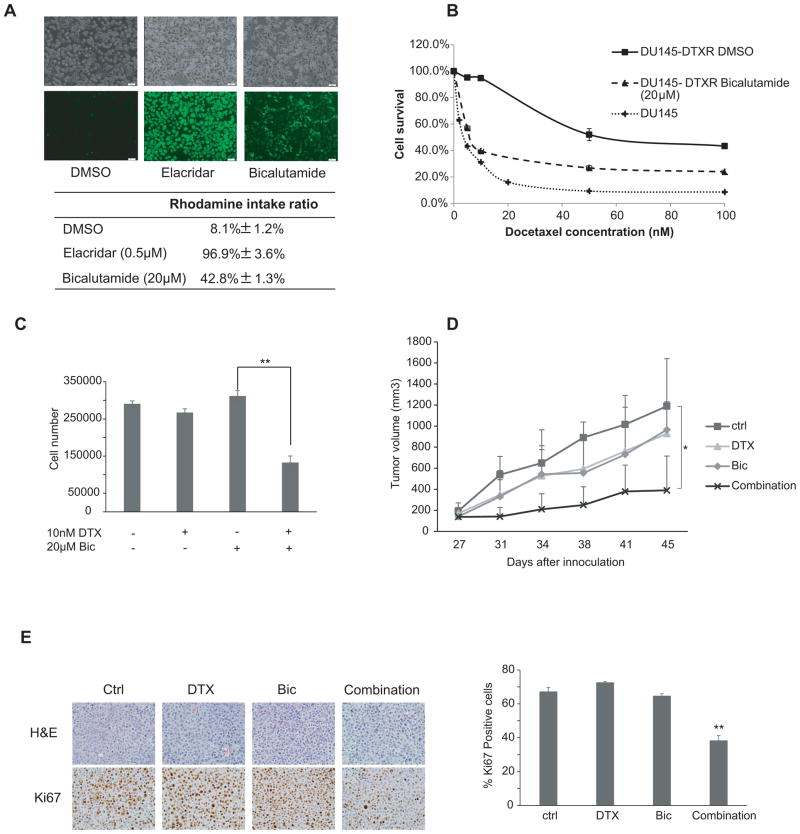
Bicalutamide reverses docetaxel resistance in DU145-DTXR cells. (A) DU145-DTXR cells were treated with 0.5 μM elacridar or 20μM bicalutamide for 24 hrs. Cells were incubated with 1 μg/mL Rhodamine 123 for another 4 hrs. The cells were then washed 3 times with 1×PBS. Fluorescence was detected at an excitation wavelength of 480 nm and an emission wavelength of 534 nm. Top panel, fluorescent and phase contrast pictures were shown. Lower panel, rhodamine intake ratio. (B) DU145 and DU145-DTXR cells were plated in 12-well plates. DU145 were treated with different concentrations of docetaxel as indicated. DU145-DTXR cells were treated with different concentrations of docetaxel as indicated in the presence or absence of 20 μM bicalutamide. Cell number was counted after 24 hrs of treatment. (C) DU145-DTXR cells were plated in 12-well plates and treated with 10nM docetaxel in the presence or absence of 20 μM bicalutamide. Cell number was counted after 24 hrs of treatment. (D) Six to eight week-old SCID mice were inoculated s.c. with 4×10⁶ DU145-DTXR cells subcutaneously. Mice carrying tumors were divided into four groups and treated with vehicle, docetaxel (10 mg/kg body weight, i.p., one day a week) or bicalutamide (25 mg/kg body weight, esophageal gavaging, 5 days a week) alone or a combination of docetaxel (10 mg/kg body weight, i.p., one day a week )+ bicalutamide (25 mg/kg body weight, esophageal gavaging, 5 days a week). Tumor sizes were measured twice a week. (E) Ki67 was analyzed in tumor tissues by IHC staining and quantified as described in Materials and Methods. *, P < 0.05. **, P < 0.01.

Comment in

References

    1. Trapman J, Cleutjens KB. Androgen-regulated gene expression in prostate cancer. Semin Cancer Biol. 1997;8:29–36. - PubMed
    1. Dutt SS, Gao AC. Molecular mechanisms of castration-resistant prostate cancer progression. Future Oncology. 2009;5:1403–13. - PMC - PubMed
    1. Harris WP, Mostaghel EA, Nelson PS, Montgomery B. Androgen deprivation therapy: progress in understanding mechanisms of resistance and optimizing androgen depletion. Nat Clin Pract Urol. 2009;6:76–85. - PMC - PubMed
    1. Fitzpatrick JM, de Wit R. Taxane Mechanisms of Action: Potential Implications for Treatment Sequencing in Metastatic Castration-resistant Prostate Cancer. European Urology - PubMed
    1. Herbst RS, Khuri FR. Mode of action of docetaxel – a basis for combination with novel anticancer agents. Cancer Treatment Reviews. 2003;29:407–15. - PubMed

Publication types

MeSH terms