


Characteristics of Korean patients with suspected Creutzfeldt-Jakob disease with 14-3-3 protein in cerebrospinal fluid: Preliminary study of the Korean Creutzfeldt-Jakob disease active surveillance program
- PMID: 25996401
- PMCID: PMC4601202
- DOI: 10.1080/19336896.2015.1022020
Characteristics of Korean patients with suspected Creutzfeldt-Jakob disease with 14-3-3 protein in cerebrospinal fluid: Preliminary study of the Korean Creutzfeldt-Jakob disease active surveillance program
Abstract
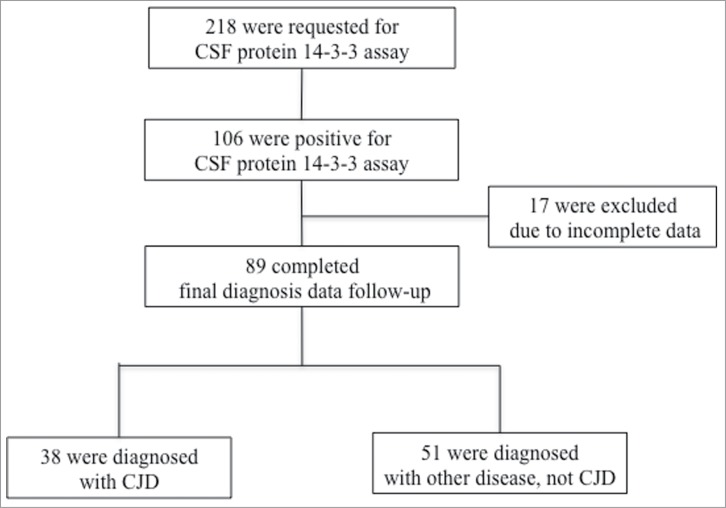
Although Korea had a national surveillance system for Creutzfeldt-Jakob disease (CJD), it was mainly dependent on attending physician's reports. Thus, little prospective data about the epidemiology, characteristics, and final diagnoses of suspected patients were available. We have established a nationwide network for the active surveillance of patients with suspected CJD. When the requested cerebrospinal fluid (CSF) samples tested positive for 14-3-3 protein, we investigated the clinical characteristics of the corresponding patients and followed them until their final diagnoses were confirmed. A total of 218 samples were requested for CSF assays from May 2010 to August 2012, and 106 (48.6%) were positive for 14-3-3 protein. In 89 patients with complete clinical data, 38 (42.7%) were diagnosed with probable CJD and the estimated annual occurrence of CJD was 16.3 persons-per-year. The most common diagnoses of the remainder were central nervous system infection and any-cause encephalopathy. Non-CJD subjects showed worse initial consciousness levels than CJD patients. This preliminary study showed that the number of reported cases of CJD and the true positivity rates of CSF 14-3-3 protein assays were both low in Korea. An active surveillance system is urgently needed to provide the latest nationwide epidemiological data of CJD.
Keywords: 14-3-3 proteins; CJD, Creutzfeldt-Jakob disease; CSF, cerebrospinal fluid; Creutzfeldt-Jakob disease; K-CDC, Korean Center for Disease Control; WHO, World Health Organization; cerebrospinal fluid; surveillance.
Figures
References
-
- Brandel J-P, Salomon D, Capek I, Vaillant V, Alpérovitch A. Epidemiological surveillance of Creutzfeldt-Jakob in France. Rev Neurol (Paris) 2009; 165:684–93; PMID:19467685; http://dx.doi.org/10.1016/j.neurol.2009.04.006 - DOI - PubMed
-
- Gao C, Shi Q, Tian C, Chen C, Han J, Zhou W, Zhang BY, Jiang HY, Zhang J, Dong XP. The epidemiological, clinical, and laboratory features of sporadic Creutzfeldt-Jakob disease patients in China: surveillance data from 2006 to 2010. PLoS One 2011; 6:e24231; PMID:21904617; http://dx.doi.org/10.1371/journal.pone.0024231 - DOI - PMC - PubMed
-
- Sanjo N, Mizusawa H. Prion disease - the characteristics and diagnostic points in Japan. Clin Neurol 2010; 50:287–300; PMID:20535976 - PubMed
-
- Begue C, Martinetto H, Schultz M, Rojas E, Romero C, D'Giano C, Sevlever G, Somoza M, Taratuto AL. Creutzfeldt-Jakob disease surveillance in Argentina, 1997–2008. Neuroepidemiology 2011; 37:193–202; PMID:22067221; http://dx.doi.org/10.1159/000331907 - DOI - PubMed
-
- Choi SI JB, Kim YS. Development of policy and strategy for the control of Creutzfeldt-Jakob Disease in Korea. Korean J Epidemiol 2005; 27:81–9
Publication types
MeSH terms
Substances
LinkOut - more resources
Full Text Sources
Other Literature Sources
Medical
