Review
. 2015 May 19;4(2):256-68.
doi: 10.3390/pathogens4020256.

Aichi virus 1: environmental occurrence and behavior

Affiliations
Review

Aichi virus 1: environmental occurrence and behavior

Masaaki Kitajima et al. Pathogens. .

Abstract

Aichi virus 1 (AiV-1), belonging to the genus Kobuvirus in the family Picornaviridae, has been proposed as a causative agent of human gastroenteritis potentially transmitted by fecal-oral routes through contaminated food or water. AiV-1 is globally distributed and has been detected in various types of environmental samples, such as sewage, river water, groundwater, and shellfish. Recent environmental studies revealed that this virus could be detected in higher frequency and greater abundance than other human enteric viruses. These findings suggest that AiV-1 could potentially be an appropriate indicator of viral contamination in the environment because of its high prevalence in water environments as well as structural and genetic similarity with some of the other important enteric viruses. Further studies on the occurrence and fate of AiV-1 in environments, even in combination with clinical studies of many regions, are needed for a better understanding of their epidemiology, temporal and geographical distribution, environmental stability, and potential health risks to humans.

Keywords: Aichivirus; kobuvirus; occurrence; qPCR; surface waters; wastewater treatment.


Figures
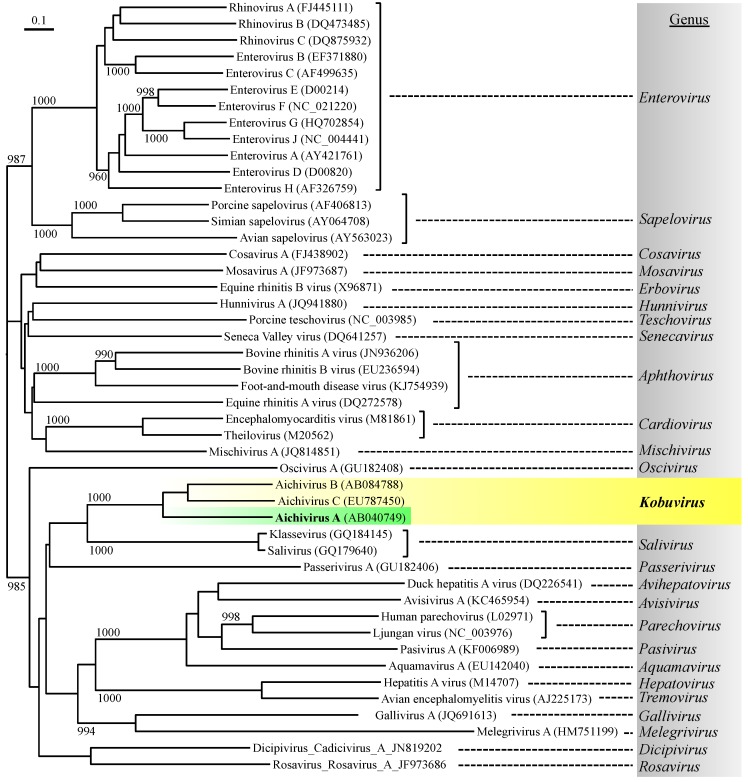
Figure 1
Figure 1
Phylogenetic relationship of Aichi virus 1 with representative species from each picornavirus genus, based on amino acid similarity of the P1 (viral structural proteins) region using the neighbor-joining method. The numbers on each branch indicate the bootstrap values obtained from a bootstrap analysis with 1000 replicates, and the scale represents amino acid substitutions per site.
Figure 2
Figure 2
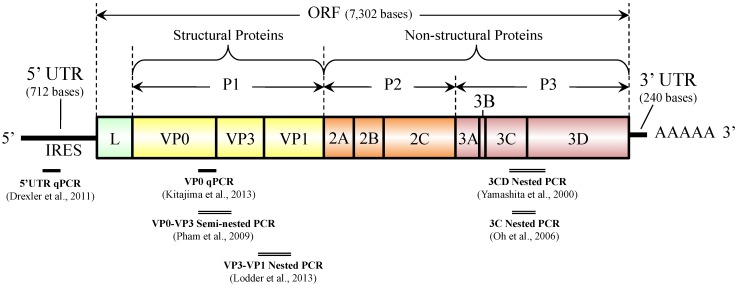
Genome organization of Aichi virus 1 and target locations of diagnostic PCR assays.

References

    1. Tapparel C., Siegrist F., Petty T.J., Kaiser L. Picornavirus and enterovirus diversity with associated human diseases. Infect. Genet. Evol. 2013;14:282–293. doi: 10.1016/j.meegid.2012.10.016. - DOI - PubMed
    1. Reuter G., Boros A., Pankovics P. Kobuviruses—A comprehensive review. Rev. Med. Virol. 2011;21:32–41. doi: 10.1002/rmv.677. - DOI - PubMed
    1. Adams M.J., King A.M.Q., Carstens E.B. Ratification vote on taxonomic proposals to the International Committee on Taxonomy of Viruses (2013) Arch. Virol. 2013;158:2023–2030. doi: 10.1007/s00705-013-1688-5. - DOI - PubMed
    1. Yamashita T., Kobayashi S., Sakae K., Nakata S., Chiba S., Ishihara Y., Isomura S. Isolation of cytopathic small round viruses with BS-C-1 cells from patients with gastroenteritis. J. Infect. Dis. 1991;164:954–957. doi: 10.1093/infdis/164.5.954. - DOI - PubMed
    1. Kapoor A., Simmonds P., Dubovi E.J., Qaisar N., Henriquez J.A., Medina J., Shields S., Lipkin W.I. Characterization of a canine homolog of human Aichivirus. J. Virol. 2011;85:11520–11525. doi: 10.1128/JVI.05317-11. - DOI - PMC - PubMed

LinkOut - more resources