A colourful clock
- PMID: 25996907
- PMCID: PMC4440787
- DOI: 10.1371/journal.pbio.1002160
A colourful clock
Abstract
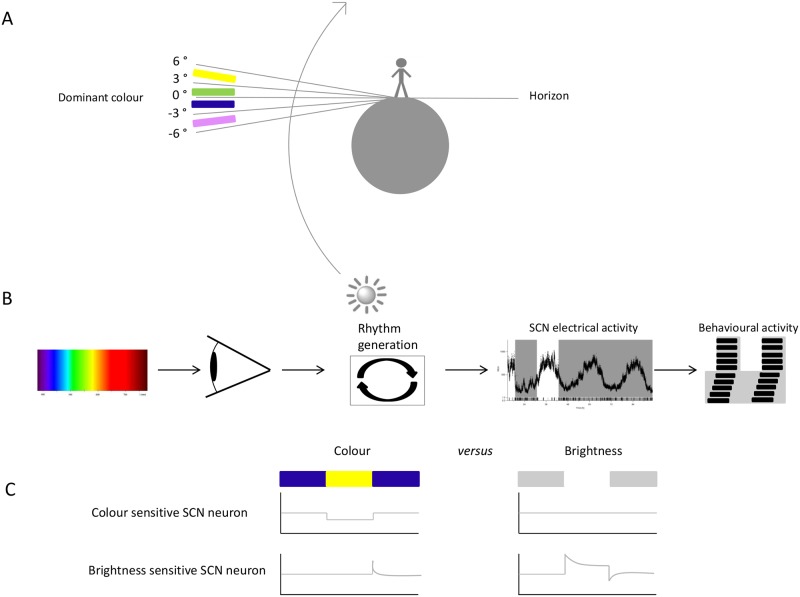
Circadian rhythms are an essential property of life on Earth. In mammals, these rhythms are coordinated by a small set of neurons, located in the suprachiasmatic nuclei (SCN). The environmental light/dark cycle synchronizes (entrains) the SCN via a distinct pathway, originating in a subset of photosensitive retinal ganglion cells (pRGCs) that utilize the photopigment melanopsin (OPN4). The pRGCs are also innervated by rods and cones and, so, are both endogenously and exogenously light sensitive. Accumulating evidence has shown that the circadian system is sensitive to ultraviolet (UV), blue, and green wavelengths of light. However, it was unclear whether colour perception itself can help entrain the SCN. By utilizing both behavioural and electrophysiological recording techniques, Walmsley and colleagues show that multiple photic channels interact and enhance the capacity of the SCN to synchronize to the environmental cycle. Thus, entrainment of the circadian system combines both environmental irradiance and colour information to ensure that internal and external time are appropriately aligned.
Conflict of interest statement
The authors have declared that no competing interests exist.
Figures
References
-
- Freedman MS, Lucas RJ, Soni B, von Schantz M, Munoz M, et al. (1999) Regulation of mammalian circadian behavior by non-rod, non-cone, ocular photoreceptors. Science 284: 502–504. - PubMed
MeSH terms
LinkOut - more resources
Full Text Sources
Other Literature Sources