doi: 10.1371/journal.pntd.0003701.
eCollection 2015 May.
Snakebites and scorpion stings in the Brazilian Amazon: identifying research priorities for a largely neglected problem
Affiliations
- PMID: 25996940
- PMCID: PMC4440781
- DOI: 10.1371/journal.pntd.0003701
Item in Clipboard
Snakebites and scorpion stings in the Brazilian Amazon: identifying research priorities for a largely neglected problem
PLoS Negl Trop Dis.
.
No abstract available
Conflict of interest statement
The authors have declared that no competing interests exist.
Figures
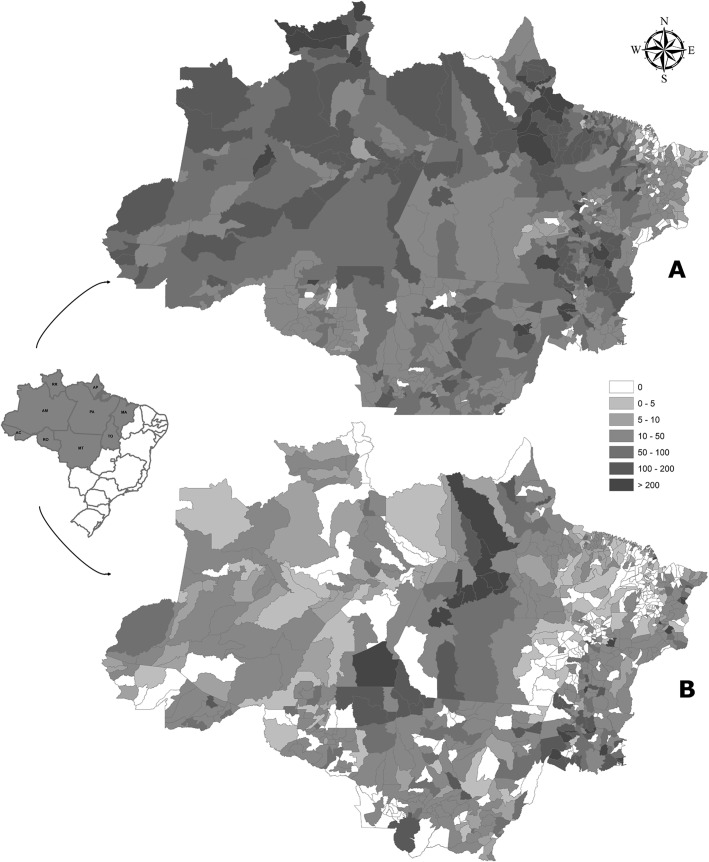
Maps were created using incidence per 100,000 inhabitants. A) Snakebites are largely distributed in the Amazonian states, with several counties presenting incidences higher than 100 cases per 100,000 inhabitants, especially in Northern Roraima, Eastern Pará, and Amapá, and in unevenly distributed municipalities across all states. B) Large scorpion sting hot spots are observed in the Western Pará state and Southeastern Amazonas. Several other counties present incidences higher than 100 cases per 100,000 inhabitants in the states of Mato Grosso, Tocantins, and Maranhão.
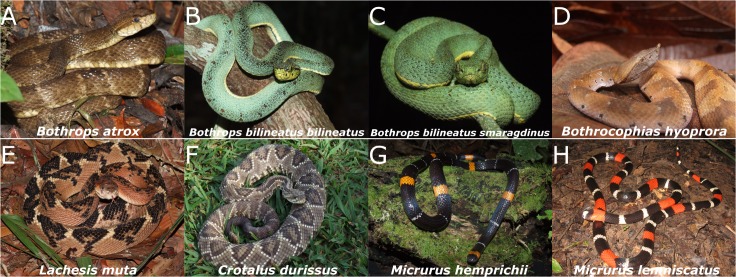
Pictures of the eight main snake species responsible for bites in the Brazilian Amazon region are shown (A–H). Bothrops atrox (A) is implicated in most of the human snakebites registered in the Brazilian Amazon region (80%–90%), followed by Lachesis muta (E).
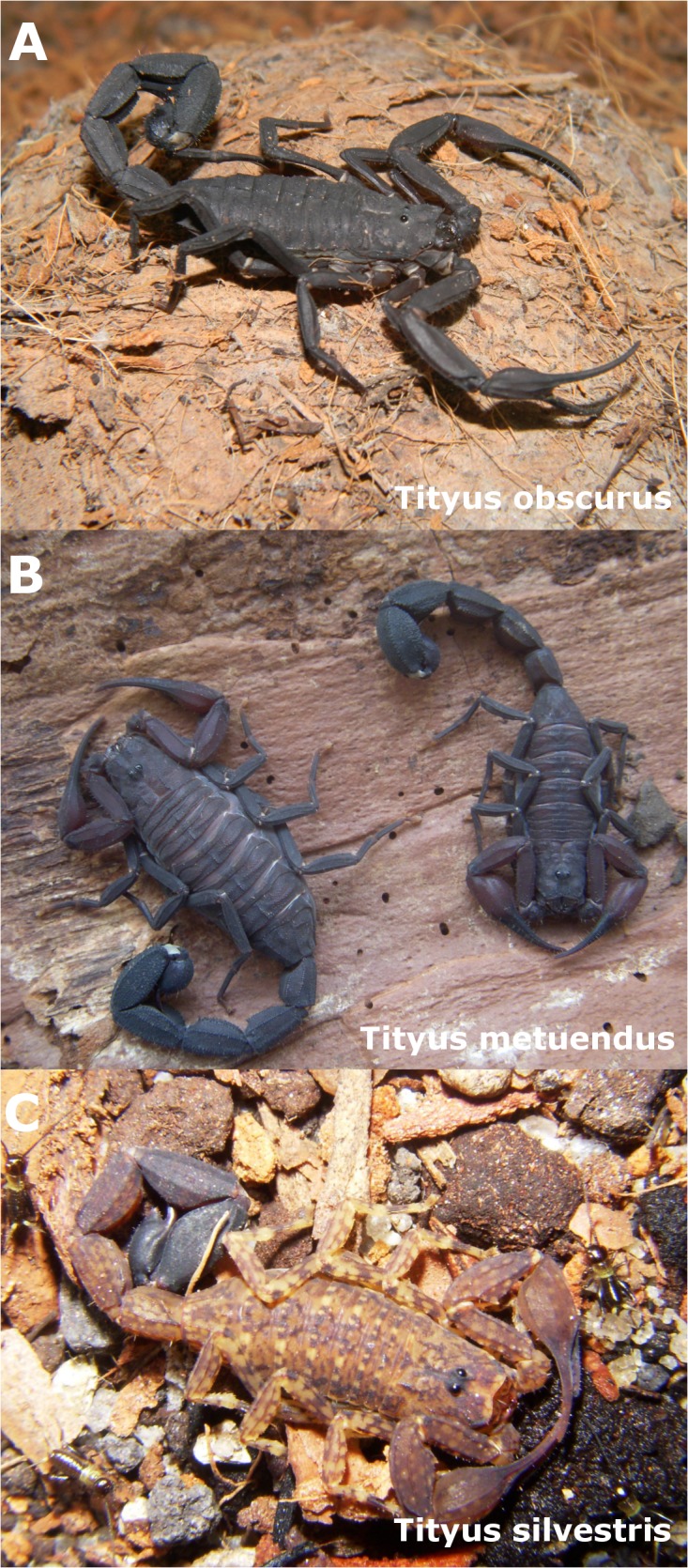
A) Female specimen of Tityus obscurus, the major species responsible for scorpion stings in the State of Pará. B) A male and a female Tityus metuendus, a species largely distributed in the Central and Western Amazon, especially in the Amazonas, Roraima, and Acre states. C) A male specimen of Tityus silvestris, a species found in the Southern Amazon.
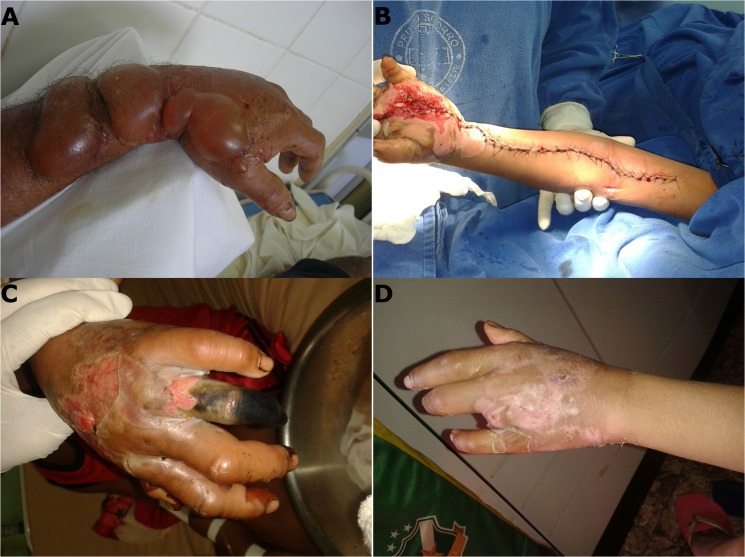
A) Envenoming on hand; this patient arrived 12 hours after the bite at the Hospital Municipal de Belterra, Pará, with swelling and serohaemorrhagic blisters on left upper limb and incoagulable blood. B) Severe envenoming on left hand; this patient arrived 24 hours after the bite at the Fundação de Medicina Tropical Dr. Heitor Vieira Dourado, Manaus, Amazonas, presenting compartmental syndrome in the left upper limb, requiring fasciotomy. C) Envenoming on left hand, patient arrived 24 hours after the bite at the Fundação de Medicina Tropical Dr. Heitor Vieira Dourado, Manaus, Amazonas, with an extensive area of edema and necrosis in the left upper limb and gangrene of the fourth finger. D) The same patient shown in C, after amputation of the fourth finger (in the healing phase).
References
-
- World Health Organization; (2007) Rabies and envenomings: a neglected public health issue: report of a Consultative Meeting Geneva: World Health Organization; p 32.
-
- Brazilian Ministry of Health (2014) Sistema de Informação de Agravos de Notificação—SINAN. Brasília: Brazilian Ministry of Health; 10.1111/famp.12079 - DOI
-
- Brazilian Ministry of Health (2009) Caderno 14-Acidentes por Animais Peçonhentos Guia de vigilância epidemiológica. Brasília: Brazilian Ministry of Health; p 23 10.1016/j.smrv.2014.10.006 - DOI
Publication types
LinkOut - more resources
Full Text Sources
Other Literature Sources