


Defining and predicting short-term alcohol use changes during a smoking cessation attempt
- PMID: 25997014
- PMCID: PMC4457735
- DOI: 10.1016/j.addbeh.2015.04.004
Defining and predicting short-term alcohol use changes during a smoking cessation attempt
Abstract
Introduction: Alcohol and nicotine are commonly used substances in the U.S., with significant impacts on health. Using both substances concurrently impacts quit attempts. While studies have sought to examine changes in alcohol use co-occurring with tobacco cessation, results have not been consistent. Understanding these changes has clinical implications. The objective of this study is to identify changes in alcohol consumption that occur following tobacco cessation, as well as predictors of alcohol use patterns following a smoking cessation attempt.
Methods: A secondary analysis of a randomized, placebo-controlled trial evaluating the efficacy of five tobacco cessation pharmacotherapies. Participants (N=1301) reported their smoking and alcohol consumption daily for two weeks prior to, and two weeks after, the target quit date (TQD).
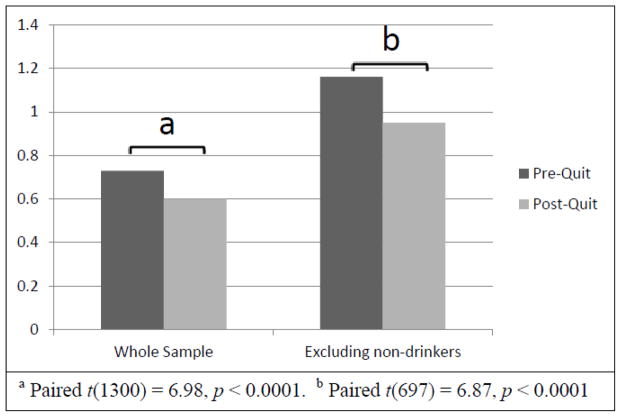
Results: Generally, alcohol use decreased post-TQD. Smokers who reported less pre-quit alcohol use, as well as smokers who were female, non-white, and had a history of alcohol dependence tended to use less alcohol post-quit. Pre- and post-quit alcohol use were more strongly related among men and among those without a history of alcohol dependence.
Conclusions: For most smokers alcohol use decreased following smoking cessation. These results suggest that the expectation should be of decreased alcohol use post cessation. However, attention may be warranted for those who drink higher amounts of alcohol pre-cessation because they may be more likely to drink more in the post-quit period which may influence smoking cessation success.
Keywords: Alcohol use; Smoking cessation; Tobacco use.
Published by Elsevier Ltd.
Conflict of interest statement
Author DJ has received research support from Nabi Biopharmaceuticals and Pfizer. Authors KB, MP, MF report no current or recent (five year) potential conflicts. Author SS has received research support as a co-investigator on an investigator-initiated research project funded by Pfizer, Inc. in the past five years.
Figures
References
-
- U.S. Department of Health and Human Services. The Health Consequences of Smoking-50 Years of Progress: A Report of the Surgeon General. Vol. 2014. Atlanta GA: U.S. Department of Health and Human Services, Centers for Disease Control and Prevention, National Center fo rChronic Disease Prevention and Health Promotion, Office on Smoking and Health; 2014. Printed with corrections, January 2014.
-
- Centers for Disease Control and Prevention. [Accessed August 2013];Adult Cigarette Smoking in the United States: Current Estimate. 2014 Available at: http://www.cdc.gov/tobacco/data_statistics/fact_sheets/adult_data/cig_sm....
-
- Grant BF, et al. Nicotine dependence and psychiatric disorders in the United States: results from the national epidemiologic survey on alcohol and related conditions. Arch Gen Psychiatry. 2004;61(11):1107–15. - PubMed
-
- Centers for Disease Control and Prevention. [Accessed August 2013];Alcohol and Public Health: Alcohol-Related Disease Impact (ARDI) 2010 Available at: http://apps.nccd.cdc.gov/DACH_ARDI/default/default.aspx.
-
- Murphy SL, Xu J, Kochanek KD. Deaths: final data for 2010. Natl Vital Stat Rep. 2013;61(4):1–117. - PubMed
Publication types
MeSH terms
Grants and funding
LinkOut - more resources
Full Text Sources
Other Literature Sources
Medical
