Review
. 2015 Sep;14(5):369-79.
doi: 10.1093/bfgp/elv020. Epub 2015 May 20.

Human inversions and their functional consequences

Review

Human inversions and their functional consequences

Marta Puig et al. Brief Funct Genomics. 2015 Sep.

Abstract

Polymorphic inversions are a type of structural variants that are difficult to analyze owing to their balanced nature and the location of breakpoints within complex repeated regions. So far, only a handful of inversions have been studied in detail in humans and current knowledge about their possible functional effects is still limited. However, inversions have been related to phenotypic changes and adaptation in multiple species. In this review, we summarize the evidences of the functional impact of inversions in the human genome. First, given that inversions have been shown to inhibit recombination in heterokaryotes, chromosomes displaying different orientation are expected to evolve independently and this may lead to distinct gene-expression patterns. Second, inversions have a role as disease-causing mutations both by directly affecting gene structure or regulation in different ways, and by predisposing to other secondary arrangements in the offspring of inversion carriers. Finally, several inversions show signals of being selected during human evolution. These findings illustrate the potential of inversions to have phenotypic consequences also in humans and emphasize the importance of their inclusion in genome-wide association studies.

Keywords: disease; evolution; gene expression; human genome; inversions; phenotypic effects.


Figures

Figure 1.
Figure 1.
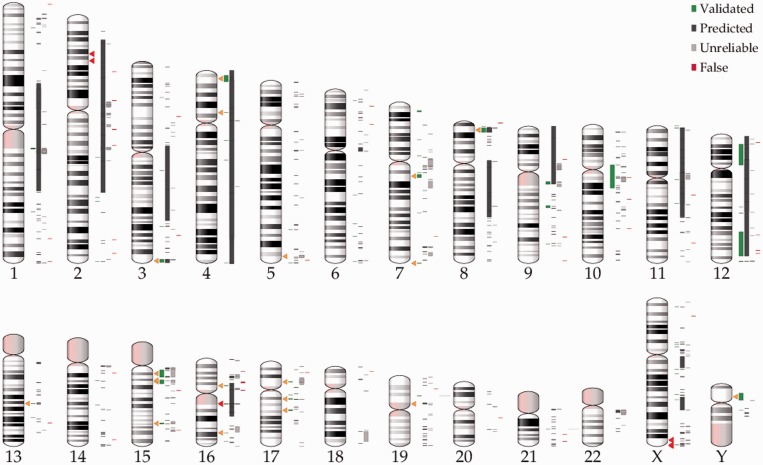
Distribution of inversion polymorphisms in the human genome. The chromosomal positions of the 1092 inversions reported in InvFEST [39] are indicated to the right of each ideogram (with the status of inversions according to InvFEST represented in the same order as shown in the legend; see main text for details). Triangles mark the position of individual inversions discussed in the main text, with 5 pathogenic inversions in dark and 21 polymorphic inversions in light color. Please note that while triangle marks indicate the center of the inversion, some big inversions span several megabases, specially the pathogenic inversion in chromosome 16, which inverts almost the whole chromosome. (A colour version of this figure is available online at: http://bfg.oxfordjournals.org)
Figure 2
Figure 2
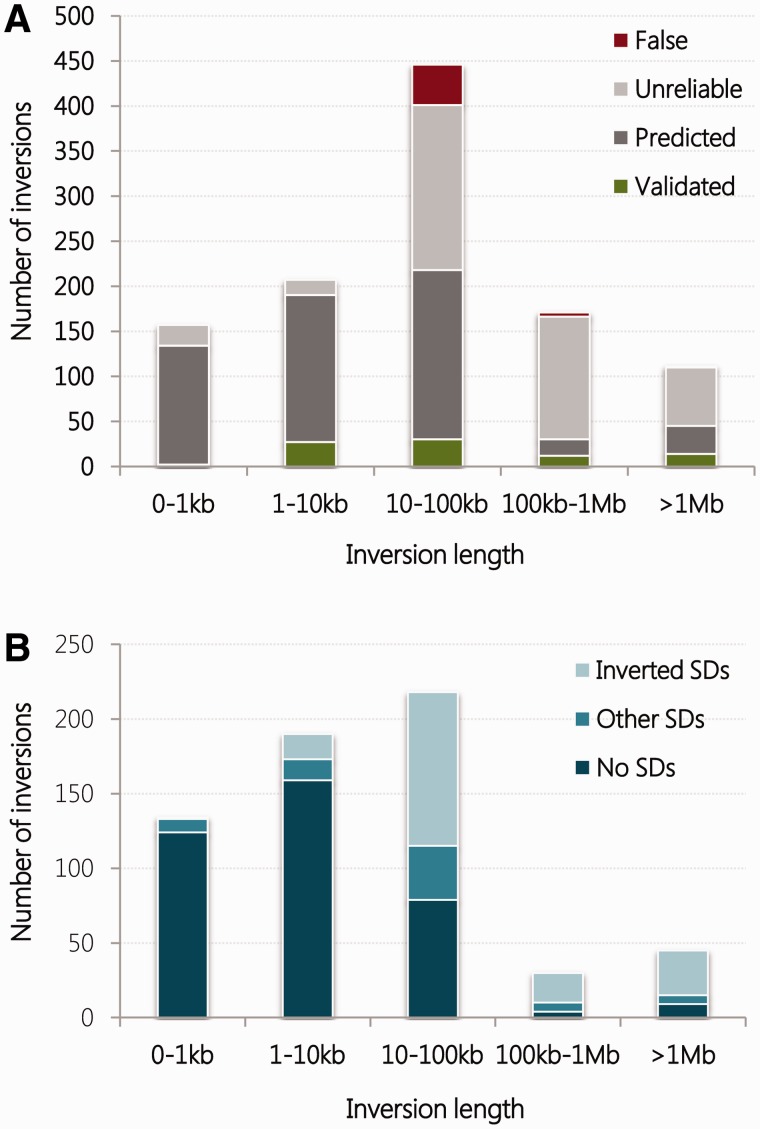
Size distribution of human polymorphic inversions. (A) The size distribution of inversions in InvFEST [39] shows that the majority of inversions reported to date are <100 kb long, and that while inversions <10 kb long are mostly reliable, more than half of >10 kb inversions might be false positives. (B) If unreliable or false predictions are discarded, the majority of <10 kb inversions have simple breakpoints, while the majority of the remaining inversions are flanked and appear to be mediated by SDs. (A colour version of this figure is available online at: http://bfg.oxfordjournals.org)
Figure 3
Figure 3
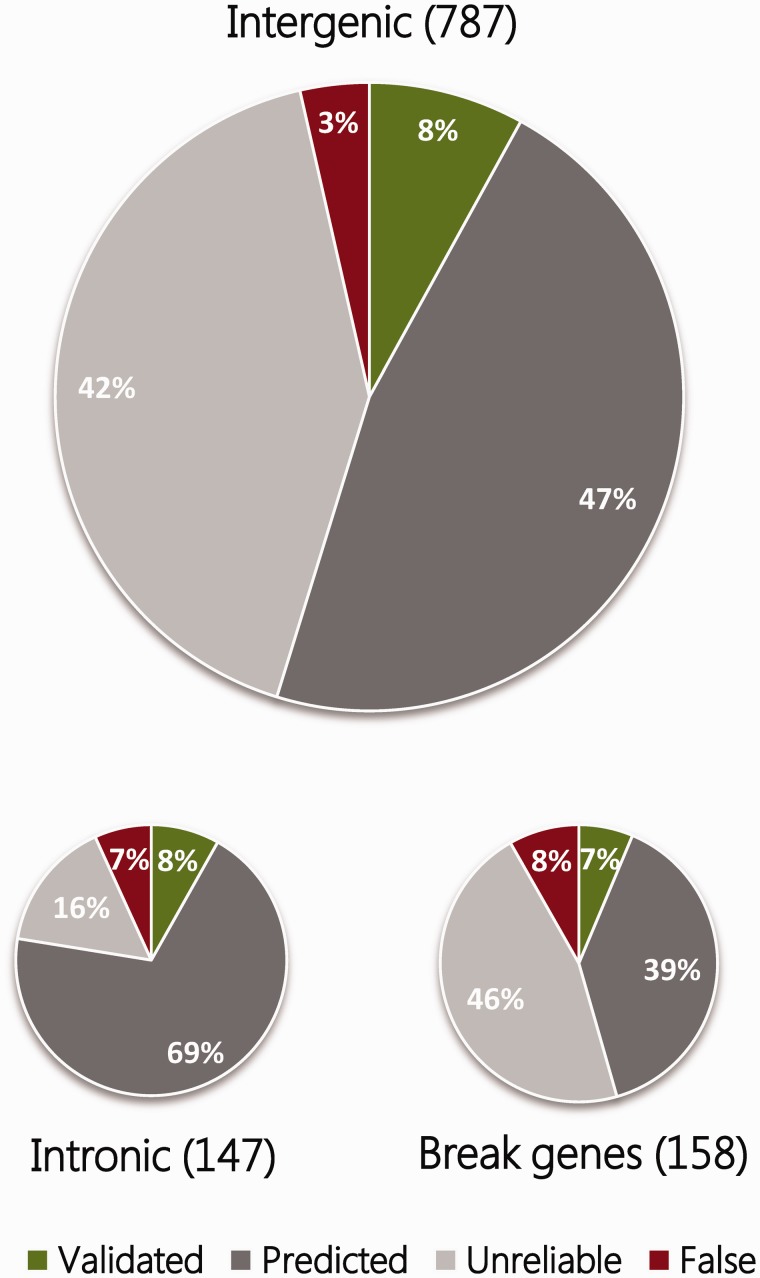
Classification of inversions according to their overlap with gene regions. The 1092 inversions reported in InvFEST [39] are classified into three main categories: (i) Intergenic, which do not disrupt any genic sequence, even though they might invert complete genes; (ii) Intronic, which are completely included within the intron of a gene; and (iii) Break genes, which are inversions that disrupt genes, either at their ends or inverting any internal exons. Colors indicate the status of inversions as shown in the legend, and illustrate that more than half of inversions that disrupt genic sequences might be false positives. (A colour version of this figure is available online at: http://bfg.oxfordjournals.org)
Figure 4
Figure 4
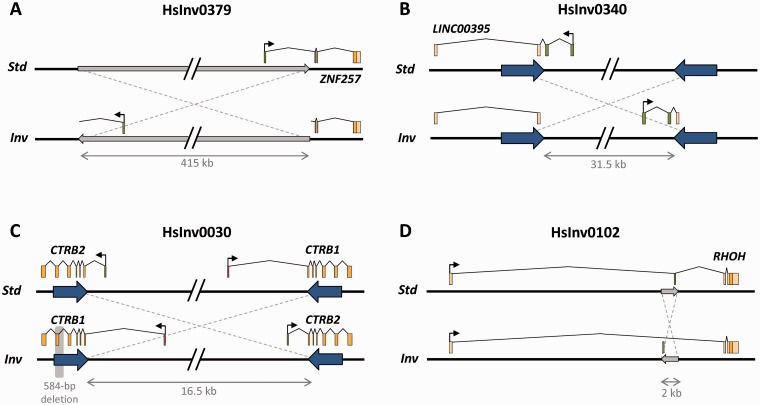
Examples of genes affected by polymorphic inversion breakpoints. (A) Disruption of the protein-coding sequence of gene ZNF257 by one inversion breakpoint of HsInv0379 located in the first intron of the gene [39]. (B) Disruption of a long non-coding RNA gene of unknown function by HsInv0340 [49]. (C) Exchange of CRTB1 and CRTB2 first exons by inversion HsInv0030 generated between inverted repeats overlapping the two genes [11, 36]. (D) Change of orientation of an alternatively spliced exon of gene RHOH by inversion HsInv0102, which no longer can be included in the transcript in the inverted orientation (S. Villatoro and M. Cáceres, unpublished results). Exons are depicted as light boxes with different shades indicating coding and non-coding parts of the transcripts and an arrow showing the direction of transcription. Exons affected by the inversion are represented as dark boxes. The minimum size of the inverted region is indicated below and in those inversions without inverted repeats at the breakpoints (large arrows); it is represented as a narrow gray arrow. In HsInv0030, a polymorphic deletion that removes one exon of CTRB1 in some inverted chromosomes is shaded in gray. (A colour version of this figure is available online at: http://bfg.oxfordjournals.org)

References

    1. Sturtevant AH. Genetic factors affecting the strength of linkage in Drosophila. Proc Natl Acad Sci USA 1917;3:555–8. - PMC - PubMed
    1. Dobzhansky TG. Genetics of the Evolutionary Process. New York: Columbia University Press, 1970.
    1. Krimbas CB, Powell JR. Drosophila Inversion Polymorphism. Boca Raton: CRC Press, 1992.
    1. Tuzun E, Sharp AJ, Bailey JA, et al. Fine-scale structural variation of the human genome. Nat Genet 2005;37:727–32. - PubMed
    1. Korbel JO, Urban AE, Affourtit JP, et al. Paired-end mapping reveals extensive structural variation in the human genome. Science 2007;318:420–6. - PMC - PubMed

Publication types

LinkOut - more resources