


Public health guidelines for physical activity: is there an app for that? A review of android and apple app stores
- PMID: 25998158
- PMCID: PMC4456485
- DOI: 10.2196/mhealth.4003
Public health guidelines for physical activity: is there an app for that? A review of android and apple app stores
Abstract
Background: Physical activity participation is an important behavior for modifying lifestyle-related disease risk. Mobile health apps for chronic disease management and prevention are being developed at a rapid rate. However, it is unclear whether these apps are evidence-based. Current public health recommendations for physical activity participation for adults highlight the importance of engaging in 150 minutes weekly of purposeful exercise, and muscle strengthening activities on at least 2 days of the week.
Objective: The aims of the present review were to (1) identify available evidence-based physical activity apps, and (2) identify technological features that could be leveraged to improve health outcomes.
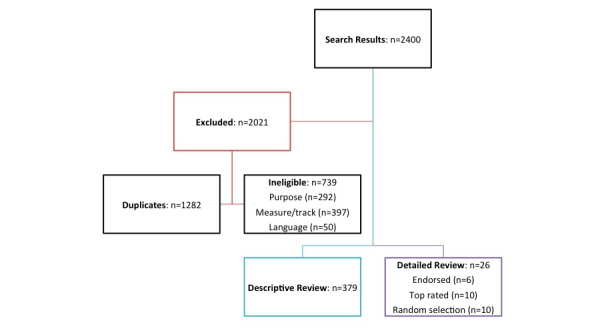
Methods: iTunes and Google Play mobile app stores were searched using keyword and category searching during a single day (February 18, 2014) for physical activity apps available in English. The description pages of eligible apps were reviewed by 4 independent reviewers for evidence-based content, technological, and descriptive features. An a priori subset of apps was downloaded for further review (n=6 affiliated with a non-commercial agency; n=10 top rated; n=10 random selection), and developers were contacted for information regarding evidence-informed content.
Results: The initial search yielded 2400 apps, of which 379 apps (n=206 iTunes; n=173 Google Play) were eligible. Primary results demonstrated no apps (n=0) adhering to evidence-based guidelines for aerobic physical activity, and 7 out of 379 implementing evidence-based guidelines for resistance training physical activity. Technological features of apps included social networking (n=207), pairing with a peripheral health device (n=61), and measuring additional health parameters (n=139). Secondary results revealed 1 app that referenced physical activity guidelines (150 minutes/weekly of exercise), and demonstrated that apps were based on various physical activity reports (n=4) or personal expertise (n=2).
Conclusions: The present study demonstrated a shortage of evidence-based physical activity apps. This gap underscores the need for development of evidence-informed mobile apps. Results highlight the opportunity to develop evidence-informed mobile apps that can be used clinically to enhance health outcomes.
Keywords: Exercise; Mobile applications; Public Health.
Conflict of interest statement
Conflicts of Interest: None declared.
Figures

References
-
- Mathers C, Loncar D. Projections of global mortality and burden of disease from 2002 to 2030. PLoS Med. 2006 Nov;3(11):e442. doi: 10.1371/journal.pmed.0030442. http://dx.plos.org/10.1371/journal.pmed.0030442 - DOI - DOI - PMC - PubMed
-
- WHO . Adherence to long-term therapies: Evidence for action. Geneva: World Health Organization; 2003. [2015-05-15]. 6YYDoEg60 http://whqlibdoc.who.int/publications/2003/9241545992.pdf.
-
- WHO . Noncommunicable disease country profiles. Geneva: World Health Organization; 2011. [2015-05-15]. 6YYDzGji2 http://www.who.int/nmh/publications/ncd_profiles2011/en/
-
- Centers for Disease Control and Prevention. 2011. [2014-10-31]. Physical activity and health http://www.cdc.gov/physicalactivity/everyone/health/
-
- WHO . Global health recommendations on physical activity for health. Geneva: World Health Organization; 2010. [2015-05-15]. 6YYFyzDel http://whqlibdoc.who.int/publications/2010/9789241599979_eng.pdf. - PubMed
Publication types
LinkOut - more resources
Full Text Sources
Other Literature Sources
Miscellaneous
