


Evaluating diabetes health policies using natural experiments: the natural experiments for translation in diabetes study
- PMID: 25998925
- PMCID: PMC5210173
- DOI: 10.1016/j.amepre.2014.12.010
Evaluating diabetes health policies using natural experiments: the natural experiments for translation in diabetes study
Abstract
The high prevalence and costs of type 2 diabetes makes it a rapidly evolving focus of policy action. Health systems, employers, community organizations, and public agencies have increasingly looked to translate the benefits of promising research interventions into innovative policies intended to prevent or control diabetes. Though guided by research, these health policies provide no guarantee of effectiveness and may have opportunity costs or unintended consequences. Natural experiments use pragmatic and available data sources to compare specific policies to other policy alternatives or predictions of what would likely have happened in the absence of any intervention. The Natural Experiments for Translation in Diabetes (NEXT-D) Study is a network of academic, community, industry, and policy partners, collaborating to advance the methods and practice of natural experimental research, with a shared aim of identifying and prioritizing the best policies to prevent and control diabetes. This manuscript describes the NEXT-D Study group's multi-sector natural experiments in areas of diabetes prevention or control as case examples to illustrate the selection, design, analysis, and challenges inherent to natural experimental study approaches to inform development or evaluation of health policies.
Copyright © 2015 American Journal of Preventive Medicine. All rights reserved.
Figures
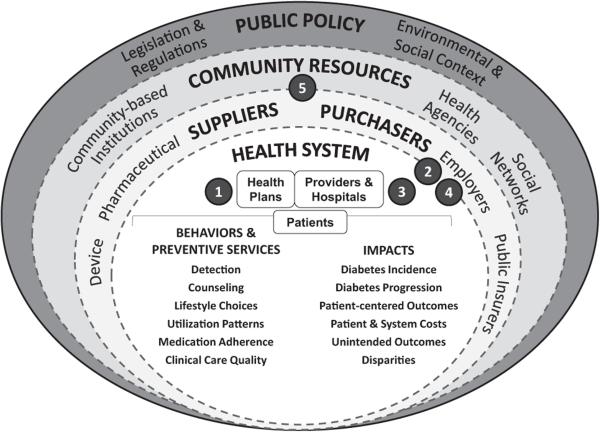
Kaiser Permanente Northern California evaluation of health plan detection, outreach, and incentives for preventive care.
University of California Los Angeles evaluation of a disease specific health plan for patients with prediabetes or diabetes offered by employers to reduce costs of care.
New York St. Luke's Roosevelt Hospital Center evaluation of the use of an electronic medical record system for diabetes risk detection and prevention in community health centers and other outpatient clinics.
Harvard University evaluation of the effects on diabetes outcomes of employer-mandated switching to a high deductible health plan.
Northwestern University evaluation of the reach, adoption, implementation, effectiveness, and costs of a commercial health payer policy to support diabetes prevention programs delivered in communities.
References
-
- CDC. National diabetes statistical report: estimates of diabetes and its burden in the United States, 2014. DHHS; CDC; Atlanta, GA: 2014. http://www.cdc.gov/diabetes/pubs/statsreport14/national-diabetes-report-....
-
- CDC. National Diabetes Prevention Program. CDC; Atlanta, GA: 2012. www.cdc.gov/diabetes/prevention/index.htm.
-
- Fendrick AM. Value-based insurance design for diabetes mellitus: approaches to optimal pharmacoeconomic implementation. Am J Manag Care. 2010;16((11) (suppl)):S314–S322. - PubMed
-
- Deakin T, McShane CE, Cade JE, Williams RD. Group based training for self-management strategies in people with type 2 diabetes mellitus. Cochrane Database Syst Rev. 2005;(2):CD003417. - PubMed
-
- Norris SL, Lau J, Smith SJ, Schmid CH, Engelgau MM. Self-management education for adults with type 2 diabetes: a meta-analysis of the effect on glycemic control. Diabetes Care. 2002;25(7):1159–1171. http://dx.doi.org/10.2337/diacare.25.7.1159. - DOI - PubMed
Publication types
MeSH terms
Grants and funding
LinkOut - more resources
Full Text Sources
Other Literature Sources
Medical
