


Review
doi: 10.4103/1008-682X.154308.
Behavioral mechanisms of mammalian sperm guidance
Affiliations
- PMID: 25999361
- PMCID: PMC4492055
- DOI: 10.4103/1008-682X.154308
Item in Clipboard
Review
Behavioral mechanisms of mammalian sperm guidance
Asian J Androl.
2015 Jul-Aug.
Abstract
In mammals, sperm guidance in the oviduct appears essential for successful sperm arrival at the oocyte. Hitherto, three different potential sperm guidance mechanisms have been recognized: thermotaxis, rheotaxis, and chemotaxis, each of them using specific stimuli - a temperature gradient, fluid flow, and a chemoattractant gradient, respectively. Here, we review sperm behavioral in these mechanisms and indicate commonalities and differences between them.
Figures
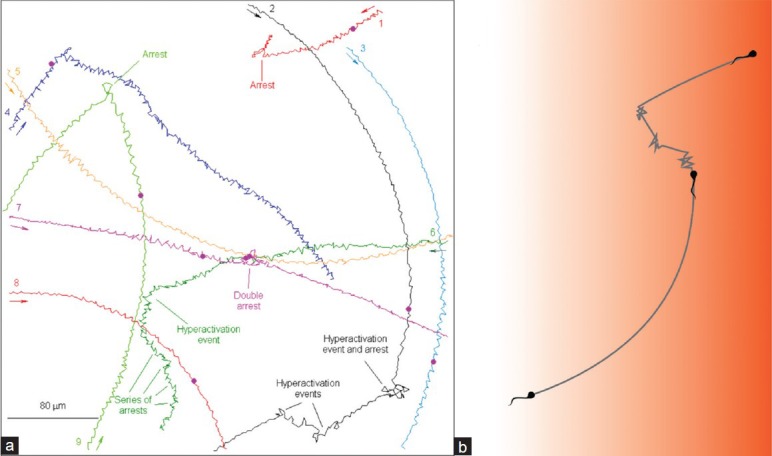
Mammalian sperm chemotaxis. (a) Tracks showing different types of responses to photorelease of the chemoattractant progesterone from its caged compound. The arrows indicate the direction of swimming. The purple dot indicates the time of the flash. (b) A model for the behavior of human spermatozoa in a spatial chemoattractant gradient. The intensity of the background color represents the chemoattractant concentration (Taken with permission from Armon and Eisenbach26).
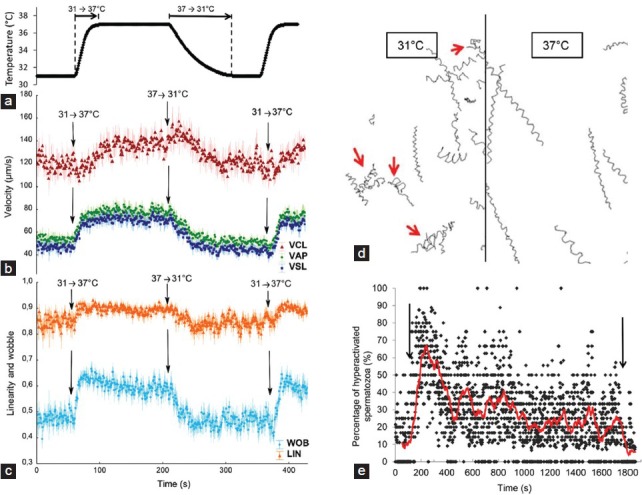
Behavioral response of human spermatozoa to temporal temperature changes. Spermatozoa were exposed to the indicated temperature changes and their motility and trajectories were recorded and analyzed. The figure shows the motility parameters curvilinear velocity (VCL), average pass velocity (VAP), straight-line velocity (VSL), linearity (LIN), wobble (WOB), percentage of hyperactivated spermatozoa and example of sperm trajectories. (a) Heating and cooling thermogram of the microscope's heating stage. (b) Temperature-jump stimulated changes in average velocity parameters. (c) Temperature-jump stimulated changes in the calculated values of linearity and wobble. (d) Representative sperm trajectories at 31°C just prior to temperature shift and at 37°C just after the temperature shift. Red arrows indicate hyperactivation events. (e) Temperature-jump stimulated changes in the percentage of hyperactivated spermatozoa (Taken with permission from Boryshpolets et al.28).
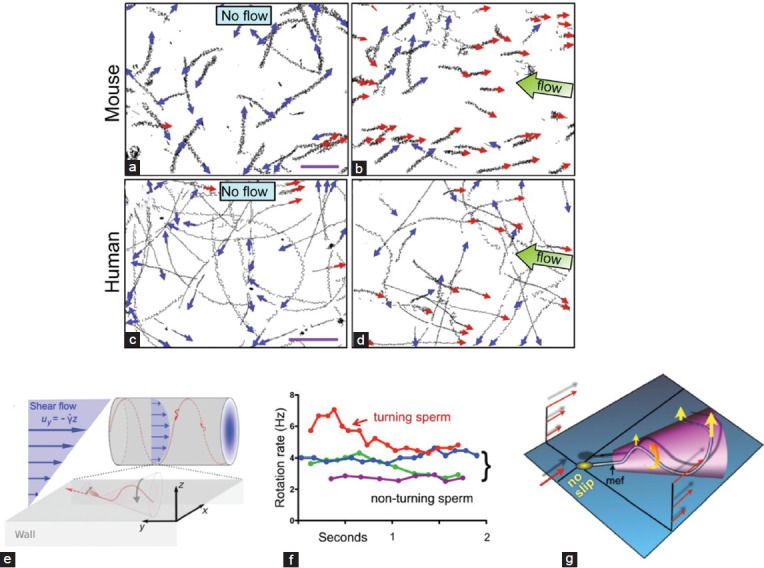
Mammalian sperm rheotaxis. (a and b) Trajectories of mouse spermatozoa in fluid flow (for 3 and 4 s, respectively), analyzed by CASA. Scale bars represent 200 μm. (c and d) Trajectories of human spermatozoa in fluid flow (5 s), analyzed by CASA. Scale bars represent 100 μm. (e) Schematic representation (not drawn to scale) describing the conical envelope of the flagellar beat that holds the spermatozoa close to the surface. The vertical flow gradient exerts a torque that turns the spermatozoa against the flow, but is counteracted by a torque from the chirality of the flagellar wave, resulting in a mean diagonal upstream motion. (f) Rotation rate of individual turning spermatozoa over time. Red line indicates a turning spermatozoon; other lines indicate sperm swimming in a straight line against fluid flow. (g) Fluid flow (red arrows) reorients a spermatozoon (yellow arrows) into the flow to reduce shear as the spermatozoon rotates (orange arrow) and propels itself upstream. Rotation maps out a three-dimensional cone shape in space, which orients spermatozoa consistently into the flow (positive rheotaxis). Tangential forces on the anterior part of the flagellum produce a clockwise force (as seen from above) whereas those on the posterior part provoke a counterclockwise force (Panels a–d, f and g are taken with permission from Miki and Clapham. Panel e is taken with permission from Kantsler et al.29).
References
-
- Harper MJ. Sperm and egg transport. In: Austin CR, Short RV, editors. Germ Cells and Fertilization. Vol. 1. Cambridge, UK: Cambridge University Press; 1982. pp. 102–27.
-
- Suarez SS, Pacey AA. Sperm transport in the female reproductive tract. Hum Reprod Update. 2006;12:23–37. - PubMed
-
- Chang MC. Fertilizing capacity of spermatozoa deposited into the Fallopian tubes. Nature. 1951;168:697–8. - PubMed
-
- Austin CR. The capacitation of the mammalian sperm. Nature. 1952;170:326. - PubMed
Publication types
MeSH terms
LinkOut - more resources
Full Text Sources
