


From ATP to PTP and Back: A Dual Function for the Mitochondrial ATP Synthase
- PMID: 25999424
- PMCID: PMC4443805
- DOI: 10.1161/CIRCRESAHA.115.306557
From ATP to PTP and Back: A Dual Function for the Mitochondrial ATP Synthase
Abstract
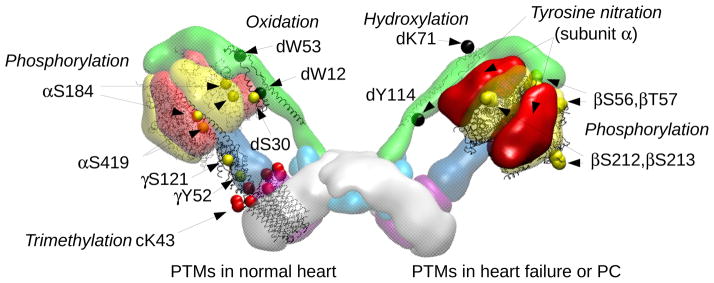
Mitochondria not only play a fundamental role in heart physiology but are also key effectors of dysfunction and death. This dual role assumes a new meaning after recent advances on the nature and regulation of the permeability transition pore, an inner membrane channel whose opening requires matrix Ca(2+) and is modulated by many effectors including reactive oxygen species, matrix cyclophilin D, Pi (inorganic phosphate), and matrix pH. The recent demonstration that the F-ATP synthase can reversibly undergo a Ca(2+)-dependent transition to form a channel that mediates the permeability transition opens new perspectives to the field. These findings demand a reassessment of the modifications of F-ATP synthase that take place in the heart under pathological conditions and of their potential role in determining the transition of F-ATP synthase from and energy-conserving into an energy-dissipating device.
Keywords: Ca(2+)-Mg(2+)-ATPase; mitochondria; permeability transition pore.
© 2015 American Heart Association, Inc.
Figures
References
Publication types
MeSH terms
Substances
Grants and funding
LinkOut - more resources
Full Text Sources
Research Materials
Miscellaneous
