


Automaticity of walking: functional significance, mechanisms, measurement and rehabilitation strategies
- PMID: 25999838
- PMCID: PMC4419715
- DOI: 10.3389/fnhum.2015.00246
Automaticity of walking: functional significance, mechanisms, measurement and rehabilitation strategies
Abstract
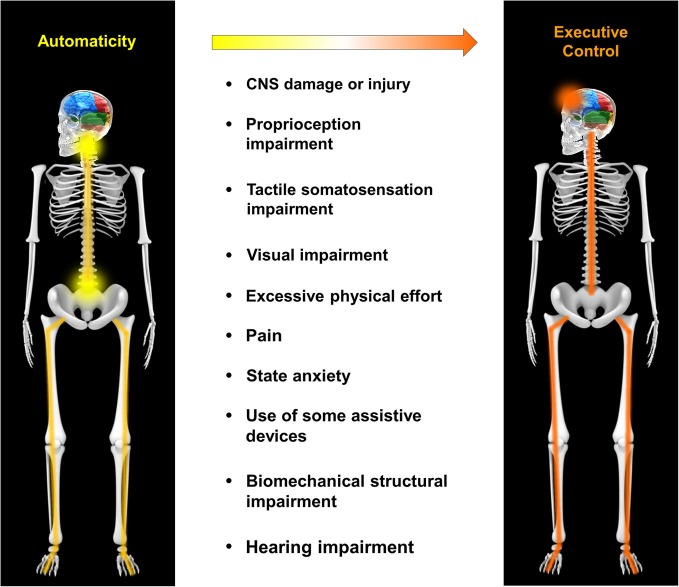
Automaticity is a hallmark feature of walking in adults who are healthy and well-functioning. In the context of walking, "automaticity" refers to the ability of the nervous system to successfully control typical steady state walking with minimal use of attention-demanding executive control resources. Converging lines of evidence indicate that walking deficits and disorders are characterized in part by a shift in the locomotor control strategy from healthy automaticity to compensatory executive control. This is potentially detrimental to walking performance, as an executive control strategy is not optimized for locomotor control. Furthermore, it places excessive demands on a limited pool of executive reserves. The result is compromised ability to perform basic and complex walking tasks and heightened risk for adverse mobility outcomes including falls. Strategies for rehabilitation of automaticity are not well defined, which is due to both a lack of systematic research into the causes of impaired automaticity and to a lack of robust neurophysiological assessments by which to gauge automaticity. These gaps in knowledge are concerning given the serious functional implications of compromised automaticity. Therefore, the objective of this article is to advance the science of automaticity of walking by consolidating evidence and identifying gaps in knowledge regarding: (a) functional significance of automaticity; (b) neurophysiology of automaticity;
Keywords: automaticity; dual task; executive control; motor control; near infrared spectroscopy; rehabilitation; walking.
(c) measurement of automaticity; (d) mechanistic factors that compromise automaticity; and (e) strategies for rehabilitation of automaticity.
Figures
References
Publication types
Grants and funding
LinkOut - more resources
Full Text Sources
Other Literature Sources
Medical
