. 2015 May 5:6:515.
doi: 10.3389/fpsyg.2015.00515. eCollection 2015.

Impulsive people have a compulsion for immediate gratification-certain or uncertain

Affiliations

Impulsive people have a compulsion for immediate gratification-certain or uncertain

Wojciech Białaszek et al. Front Psychol. .

Abstract

Impulsivity has been defined as choosing the smaller more immediate reward over a larger more delayed reward. The purpose of this research was to gain a deeper understanding of the mental processes involved in the decision making. We examined participants' rates of delay discounting and probability discounting to determine their correlation with time-probability trade-offs. To establish the time-probability trade-off rate, participants adjusted a risky, immediate payoff to a delayed, certain payoff. In effect, this yielded a probability equivalent of waiting time. We found a strong, positive correlation between delay discount rates and the time-probability trade-offs. This means that impulsive people have a compulsion for immediate gratification, independent of whether the immediate reward is certain or uncertain. Thus, they seem not to be concerned with risk but rather with time.

Keywords: delay discounting; impulsivity; magnitude effect; probability discounting; sign effect; time-probability trade-off.


Figures
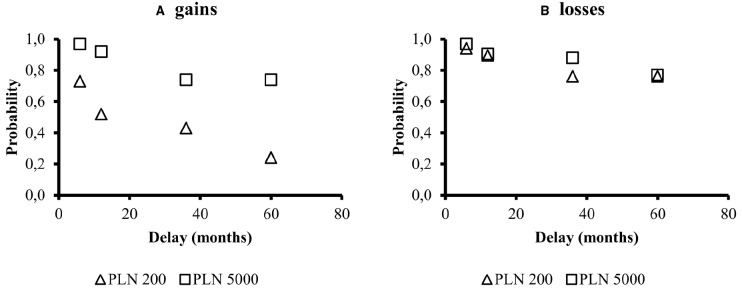
FIGURE 1
FIGURE 1
Median indifference points for various magnitudes (PLN 200 and PLN 5000) and signs of an outcomes (panel A: gains panel B: losses) in the time-probability trade-off [p(t)]. The indifference points represent an equilibrium between delay and probability: the subjective value of a delay is expressed as probability of outcome occurrence.
FIGURE 2
FIGURE 2
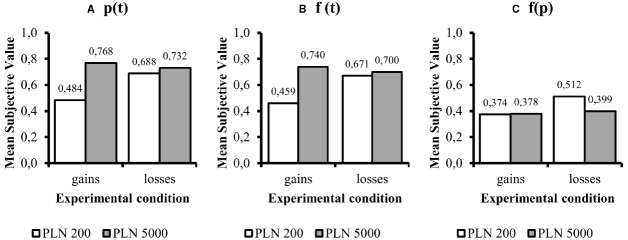
Mean subjective value expressed as averaged indifference points. All data are expressed as proportions. In case of time-probability trade-off the means can be interpreted in terms of probability, and in f(t) and f(p) conditions as a proportion of immediate/certain subjective value to larger later/certain reward. The panels refer to (standard deviations are presented in order gain PLN 200, gain PLN 5000, loss PLN 200, loss PLN 5000): (A) p(t)—probability-time trade-off (SDs respectively: 0.245, 0.205, 0.301, 0.254); (B) f(t)—delay discounting (SDs respectively: 0.236, 0.250, 0.289, 0.288); (C) f(p)—probability discounting conditions (SDs respectively: 0.181, 0.196, 0.225, 0.253).

References

    1. Baker F., Johnson M. W., Bickel W. K. (2003). Delay discounting in current and never-before cigarette smokers: similarities and differences across commodity, sign, and magnitude. J. Abnorm. Psychol. 112, 382. 10.1037/0021-843X.112.3.382 - DOI - PubMed
    1. Du W., Green L., Myerson J. (2002). Cross-cultural comparisons of discounting delayed and probabilistic rewards. Psychol. Rec. 52, 479–492.
    1. Estle S. J., Green L., Myerson J., Holt D. D. (2006). Differential effects of amount on temporal and probability discounting of gains and losses. Mem. Cogn. 34, 914–928. 10.3758/BF03193437 - DOI - PubMed
    1. Estle S. J., Green L., Myerson J., Holt D. D. (2007). Discounting of monetary and directly consumable rewards. Psychol. Sci. 18, 58–63. 10.1111/j.1467-9280.2007.01849.x - DOI - PubMed
    1. Green L., Myerson J. (2004). A discounting framework for choice with delayed and probabilistic rewards. Psychol. Bull. 130, 769. 10.1037/0033-2909.130.5.769 - DOI - PMC - PubMed