Review
. 2015 May 5:6:409.
doi: 10.3389/fmicb.2015.00409. eCollection 2015.

Data-driven integration of genome-scale regulatory and metabolic network models

Affiliations
Review

Data-driven integration of genome-scale regulatory and metabolic network models

Saheed Imam et al. Front Microbiol. .

Abstract

Microbes are diverse and extremely versatile organisms that play vital roles in all ecological niches. Understanding and harnessing microbial systems will be key to the sustainability of our planet. One approach to improving our knowledge of microbial processes is through data-driven and mechanism-informed computational modeling. Individual models of biological networks (such as metabolism, transcription, and signaling) have played pivotal roles in driving microbial research through the years. These networks, however, are highly interconnected and function in concert-a fact that has led to the development of a variety of approaches aimed at simulating the integrated functions of two or more network types. Though the task of integrating these different models is fraught with new challenges, the large amounts of high-throughput data sets being generated, and algorithms being developed, means that the time is at hand for concerted efforts to build integrated regulatory-metabolic networks in a data-driven fashion. In this perspective, we review current approaches for constructing integrated regulatory-metabolic models and outline new strategies for future development of these network models for any microbial system.

Keywords: constraint-based modeling; flux balance analysis; metabolic networks; metabolism; network integration; regulation; signaling; transcriptional networks.


Figures
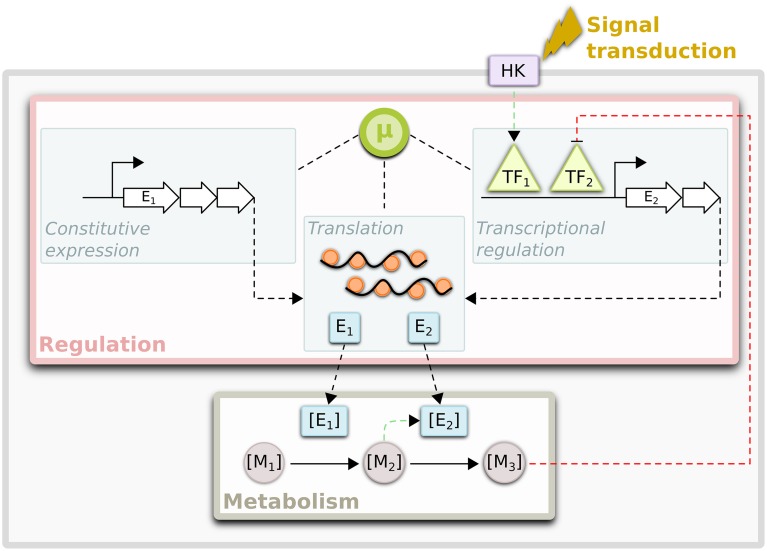
Figure 1
Figure 1
Interconnections between regulation and metabolism. Regulation of flux through metabolic networks is achieved by the control of enzyme levels ([E]) and/or activities. Enzyme levels can be controlled transcriptionally via specific regulation of transcription factors (TFs) or via global mechanisms, which depend on factors such as growth rate (μ). The expression levels of constitutively expressed genes may be solely under control of these global mechanisms. In addition, growth rate also has a significant impact on translation rates. The activities of TFs can be modulated by specific metabolites ([M]) or via post-translational modifications by histidine kinases (HK) that sense environmental cues, among other mechanisms. Enzyme activities can also be modulated via post-translational (allosteric) interactions with metabolites. All these networks are dynamic and in constant communication with one another to determine metabolic state of a cell.
Figure 2
Figure 2
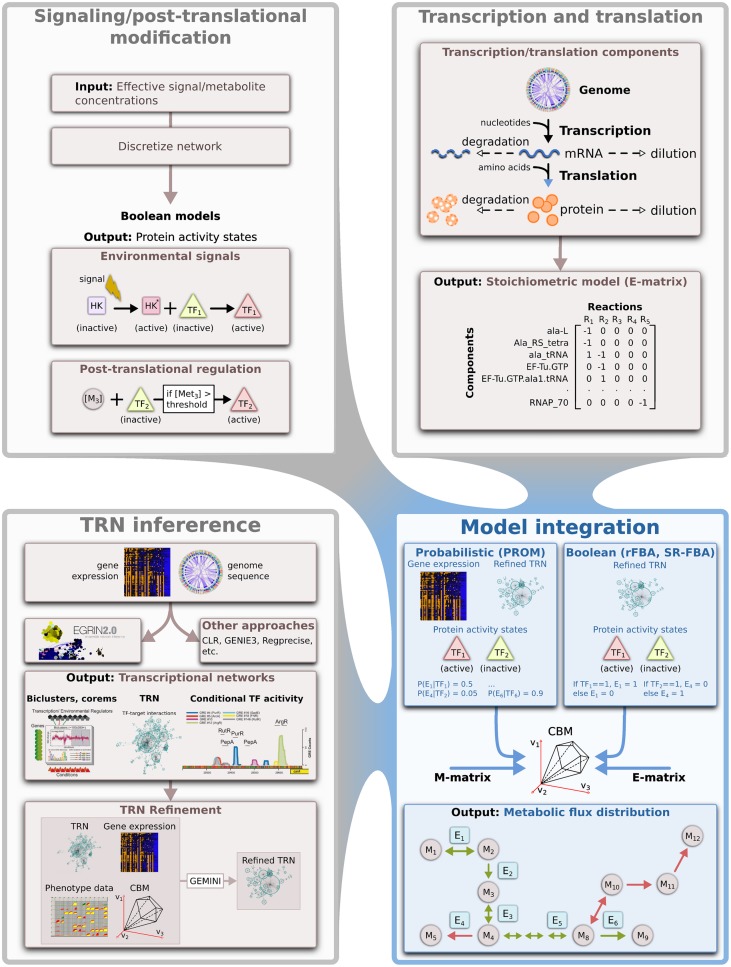
Modeling and integrating of different biological networks. An overview of the approaches used to model disparate biological processes and the computational techniques that could be used for integrating some of these network models. HK, histidine kinase; M, metabolite; E, enzyme; TF, transcription factor; TRN, transcriptional regulatory network.

References

    1. Agren R., Liu L., Shoaie S., Vongsangnak W., Nookaew I., Nielsen J. (2013). The RAVEN toolbox and its use for generating a genome-scale metabolic model for Penicillium chrysogenum. PLoS Comput. Biol. 9:e1002980. 10.1371/journal.pcbi.1002980 - DOI - PMC - PubMed
    1. Aldridge S., Watt S., Quail M. A., Rayner T., Lukk M., Bimson M. F., et al. (2013). AHT-ChIP-seq: a completely automated robotic protocol for high-throughput chromatin immunoprecipitation. Genome Biol. 14:R124. 10.1186/gb-2013-14-11-r124 - DOI - PMC - PubMed
    1. Alper H., Jin Y. S., Moxley J. F., Stephanopoulos G. (2005). Identifying gene targets for the metabolic engineering of lycopene biosynthesis in Escherichia coli. Metab. Eng. 7, 155–164. 10.1016/j.ymben.2004.12.003 - DOI - PubMed
    1. Bakker B. M., Van Eunen K., Jeneson J. A., Van Riel N. A., Bruggeman F. J., Teusink B. (2010). Systems biology from micro-organisms to human metabolic diseases: the role of detailed kinetic models. Biochem. Soc. Trans. 38, 1294–1301. 10.1042/BST0381294 - DOI - PMC - PubMed
    1. Barua D., Kim J., Reed J. L. (2010). An automated phenotype-driven approach (GeneForce) for refining metabolic and regulatory models. PLoS Comput. Biol. 6:e1000970. 10.1371/journal.pcbi.1000970 - DOI - PMC - PubMed

LinkOut - more resources