Review
. 2011 Mar 23;2(1):5-20.
doi: 10.1007/s13317-011-0018-8. eCollection 2011 May.

Myositis-specific autoantibodies: detection and clinical associations

Affiliations
Review

Myositis-specific autoantibodies: detection and clinical associations

Sander H J van Dooren et al. Auto Immun Highlights. .

Abstract

In recent years, the detection and characterization of (novel) autoantibodies is becoming increasingly important for the early diagnosis of autoimmune diseases. The idiopathic inflammatory myopathies (IIM, also indicated with myositis) are a group of systemic autoimmune disorders that involve inflammation and weakness of skeletal muscles. One of the hallmarks is the infiltration of inflammatory cells in muscle tissues. A number of myositis-specific autoantibodies have been identified and these may be associated with distinct IIM subclasses and clinical symptoms. Here, we review all myositis-specific autoantibodies identified today as well as their target proteins, together with their clinical associations in IIM patients. Post-translational modifications that might be associated with the generation of autoantibodies and the development of the disease are discussed as well. In addition, we describe well established autoantibody detection techniques that are currently being used in diagnostic laboratories, as well as novel multiplexed methods. The latter techniques provide great opportunities for the simultaneous detection of distinct autoantibodies, but may also contribute to the identification of novel autoantibody profiles, which may have additional diagnostic and prognostic value. The ongoing characterization of novel autoantibody specificities emphasizes the complexity of processes involved in the development of such autoimmune diseases.

Keywords: Autoantibody detection; Autoantigen; IIM; Multiplex assays; Myositis-specific autoantibodies; Post-translational modification.


Figures

Fig. 1
Fig. 1
Immunoprecipitation assay with myositis-specific autoantibodies. Polypeptides immunoprecipitated from 35S-methionine-labelled K562 cell extracts by antibodies from patient sera were separated by SDS–polyacrylamide gelelectrophoresis and visualized by autoradiography. Sera used for immunoprecipitation included serum from a healthy individual (NS), anti-Jo-1, anti-PL-12, anti-PL-7, anti-EJ, anti-KS, anti-OJ, anti-Zo, anti-SRP, anti-Mi-2, anti-SAE, anti-p155/140, anti-p140 (reproduced from [6], by permission of The British Society for Rheumatology)
Fig. 2
Fig. 2
Schematic representation of the solid surface-based autoantigen array. Autoantigenic molecules are immobilized at defined positions on a solid surface. Binding of autoantibodies in patient sera to the immobilized autoantigens can be detected via fluorescently labelled secondary antibodies
Fig. 3
Fig. 3
Schematic representation of a addressable-bead autoantigen immunoassay. Purified autoantigens are coupled to differentially labelled microbeads that can be detected by illumination with a laser. Patient sera can be incubated with mixtures of beads each coated with a different autoantigen. One laser is used to identify the specific antigen coupled to each bead based upon the fluorescent properties of the bead, and a second laser is used to determine the binding of autoantibodies to the beads after incubation with secondary antibodies conjugated to a distinct fluorophore
Fig. 4
Fig. 4
Line-blot for autoantibody detection in IIM sera. Strips (vertical) containing a series of recombinant IIM-related autoantigens were incubated with seven IIM patient sera (1–7) and a control serum (8). Antibody binding was visualized using the protocol provided by the manufacturer. The strips were incubated with sera containing the following autoantibodies (1) anti-PL12, (2) anti-EJ, (3) anti-PL7, (4) anti-SRP and anti-Mi-2, (5) anti-Jo-1, (6) anti-PM-Scl75 and anti-PM-Scl100, (7) anti-Ku
Fig. 5
Fig. 5
Aminoacylation of tRNA by histidyl-tRNA synthetase. The HisRS, as well as other aaRSs, catalyze the ATP-dependent esterification reaction that is needed to couple an amino acid to its cognate tRNA. Subsequently, the aminoacylated-tRNA can be used in translation. AMP adenosine monophosphate, ATP adenosine triphosphate, PPi inorganic phosphate
Fig. 6
Fig. 6
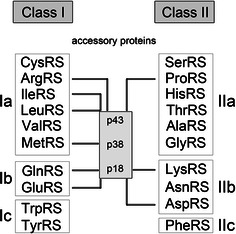
Classification of aminoacyl-tRNA synthetases. AaRSs are (sub)classified according to the chemical specificity of the reaction they catalyze and on the presence of conserved domains in their amino acid sequences (Class I and II, and subclasses a, b, and c). The aaRS that are associated with the multisynthetase complex (MSC) are connected to the three MSC accessory proteins (p43, p38, and p18) via bold lines
Fig. 7
Fig. 7
Predicted model of chromatin remodeling by the Mi-2/NuRD complex. The core subunits of the Mi-2/NuRD complex are suggested to be involved in modifying the chromatin structure, which can result in the initiation and/or maintenance of gene repression
Fig. 8
Fig. 8
SRP mediates translocation of nascent, signal peptide-containing proteins: a schematic structure of SRP, b mechanism of protein translocation mediated by SRP. First, SRP binds to the N-terminal signal peptide of the growing peptide chain which results in elongation arrest (1). Subsequently, the ribosome/SRP complex is targeted to the SRP receptor (SR) at the ER membrane by specific sequences in the SRP proteins (2). Docking of the complex to the membrane bound translocon releases the signal peptide from the SRP complex and enables translation to continue (3). The SRP dissociates and is recycled for additional translocation events (4)

References

    1. Mammen AL. Dermatomyositis and polymyositis: clinical presentation, autoantibodies, and pathogenesis. Ann N Y Acad Sci. 2010;1184:134–153. - PubMed
    1. Walker UA. Imaging tools for the clinical assessment of idiopathic inflammatory myositis. Curr Opin Rheumatol. 2008;20:656–661. - PubMed
    1. Tozzoli R. Recent advances in diagnostic technologies and their impact in autoimmune diseases. Autoimmun Rev. 2007;6:334–340. - PubMed
    1. Sharp V, Utz PJ. Technology insight: can autoantibody profiling improve clinical practice? Nat Clin Pract Rheumatol. 2007;3:96–103. - PubMed
    1. Betteridge Z, Gunawardena H, North J, et al. Anti-synthetase syndrome: a new autoantibody to phenylalanyl transfer RNA synthetase (anti-Zo) associated with polymyositis and interstitial pneumonia. Rheumatology (Oxford) 2007;46:1005–1008. - PubMed

LinkOut - more resources