


Innate Immune Responses to Nanoparticle Exposure in the Lung
- PMID: 26000239
- PMCID: PMC4437698
- DOI: 10.7178/jeit.23
Innate Immune Responses to Nanoparticle Exposure in the Lung
Abstract
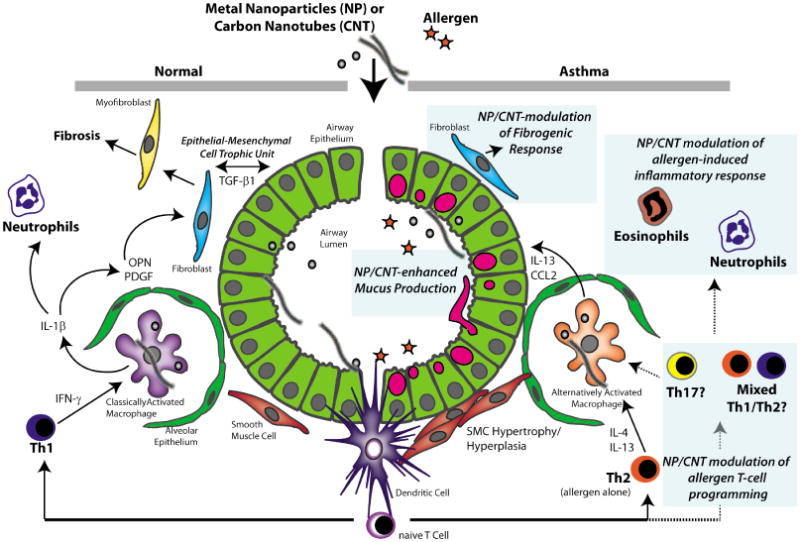
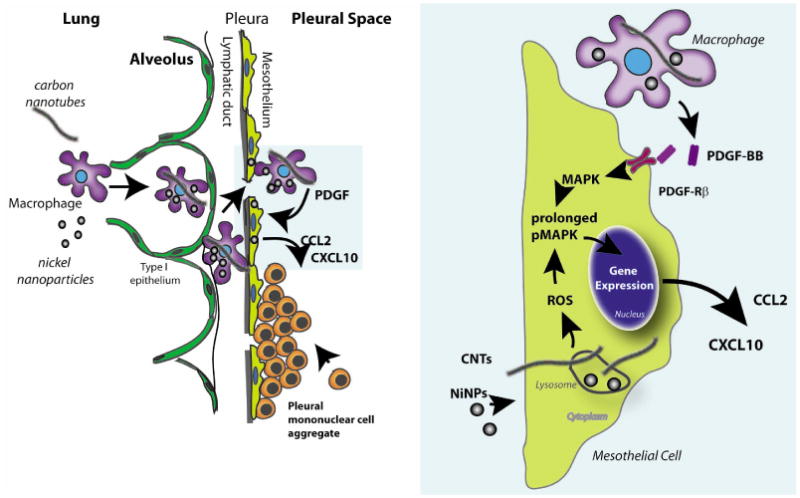
The nanotechnology revolution offers enormous societal and economic benefits for innovation in the fields of engineering, electronics, and medicine. Nevertheless, evidence from rodent studies show that biopersistent engineered nanomaterials (ENMs) stimulate immune, inflammatory, and fibroproliferative responses in the lung, suggesting possible risks for lung diseases or systemic immune disorders as a consequence of occupational, environmental, or consumer exposure. Due to their nanoscale dimensions and increased surface area per unit mass, ENMs have a much greater potential to reach the distal regions of the lung and generate ROS. High aspect ratio ENMs (e.g., nanotubes, nanofibers) activate inflammasomes in macrophages, triggering IL-1β release and neutrophilic infiltration into the lungs. Moreover, some ENMs alter allergen-induced eosinophilic inflammation by immunostimulation, immunosuppression, or modulating the balance between Th1, Th2, and Th17 cells, thereby influencing the nature of the inflammatory response. ENMs also migrate from the lungs across epithelial, endothelial, or mesothelial barriers to stimulate or suppress systemic immune responses.
Keywords: asthma; innate immunity; lung; nanoparticles.
Figures
References
-
- Hussain S, Vanoirbeek JA, Hoet PH. Interactions of nanomaterials with the immune system. Wiley Interdiscip Rev Nanomed Nanobiotechnol. 2012;4(2):169–83. - PubMed
-
- Dobrovolskaia MA, McNeil SE. Immunological properties of engineered nanomaterials. Nat Nanotechnol. 2007;2(8):469–78. - PubMed
-
- Ma-Hock L, Treumann S, Strauss V, et al. Inhalation toxicity of multiwall carbon nanotubes in rats exposed for 3 months. Toxicol Sci. 2009;112(2):468–81. - PubMed
Grants and funding
LinkOut - more resources
Full Text Sources
Other Literature Sources