


Predictors of disability worsening in clinically isolated syndrome
- PMID: 26000321
- PMCID: PMC4435703
- DOI: 10.1002/acn3.187
Predictors of disability worsening in clinically isolated syndrome
Abstract
Objective: To assess demographic, clinical, magnetic resonance imaging, and treatment exposure predictors of time to 3 or 12-month confirmed disability worsening in clinically isolated syndrome (CIS) and early multiple sclerosis (MS).
Methods: We utilized the MSBase Incident Study (MSBasis), a prospective cohort study of outcome after CIS. Predictors of time to first 3 and 12-month confirmed expanded disability status scale worsening were analyzed using Cox proportional hazards regression.
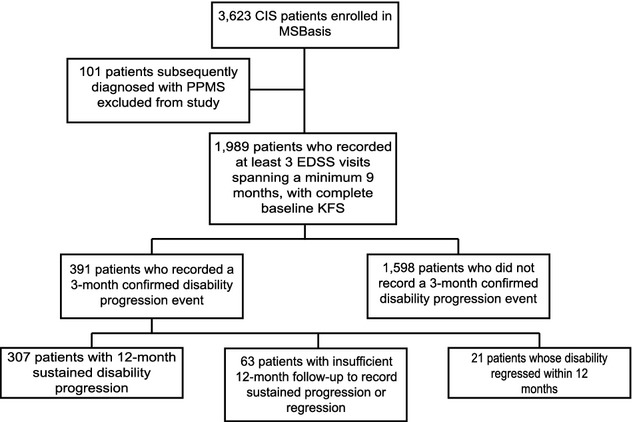
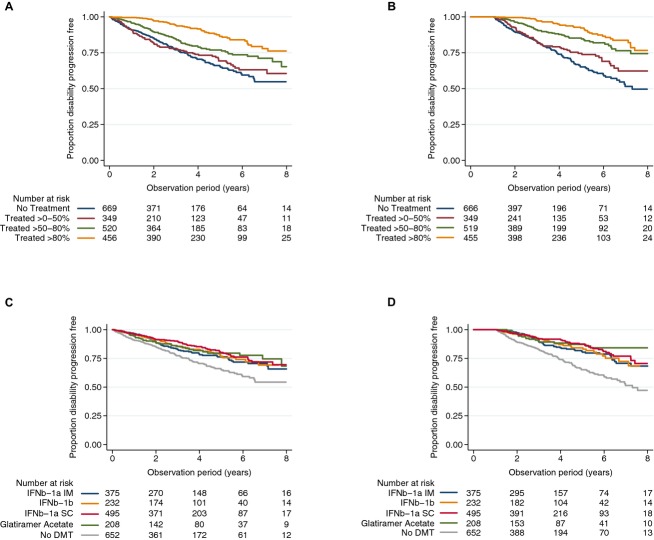
Results: About 1989 patients were analyzed, the largest seen-from-onset cohort reported to-date. A total of 391 patients had a first 3-month confirmed disability worsening event, of which 307 were sustained for 12 months. Older age at CIS onset (adjusted hazard ratio: aHR 1.17, 95% 1.06, 1.30), pyramidal (aHR 1.45, 95% CI 1.13, 1.89) and ambulation (HR 1.60, 95% CI 1.09, 2.34) system dysfunction, annualized relapse rate (aHR 1.20, 95% CI 1.18, 1.22), and lower proportion of observation time on treatment were associated with 3-month confirmed worsening. Predictors of time to 12-month sustained worsening included pyramidal system dysfunction (Hazard ratio: aHR 1.38, 95% CI 1.05, 1.83), and older age at CIS onset (aHR 1.17, 95% CI 1.04, 1.31). Greater proportion of follow-up time exposed to treatment was associated with greater reductions in the rate of worsening.
Interpretation: This study provides class IV evidence for a strong protective effect of disease-modifying treatment to reduce disability worsening events in patients with CIS and early MS, and confirms age and pyramidal dysfunction at onset as risk factors.
Figures
References
-
- Kappos L, Traboulsee A, Constantinescu C, et al. Long-term subcutaneous interferon beta-1a therapy in patients with relapsing-remitting MS. Neurology. 2006;67:944–953. - PubMed
-
- Polman CH, O'Connor PW, Havrdova E, et al. A randomized, placebo-controlled trial of natalizumab for relapsing multiple sclerosis. N Engl J Med. 2006;354:899–910. - PubMed
-
- Rudick RA, Stuart WH, Calabresi PA, et al. Natalizumab plus interferon beta-1a for relapsing multiple sclerosis. N Engl J Med. 2006;354:911–923. - PubMed
-
- Kurtzke JF. Rating neurologic impairment in multiple sclerosis: an expanded disability status scale (EDSS) Neurology. 1983;33:1444–1452. - PubMed
-
- Group PS. Randomised double-blind placebo-controlled study of interferon beta-1a in relapsing/remitting multiple sclerosis. PRISMS (Prevention of Relapses and Disability by Interferon beta-1a Subcutaneously in Multiple Sclerosis) Study Group. Lancet. 1998;352:1498–1504. - PubMed
LinkOut - more resources
Full Text Sources
Other Literature Sources
