Review
. 2015 May;2(5):581-93.
doi: 10.1002/acn3.194. Epub 2015 Mar 18.

The primate autoimmune encephalomyelitis model; a bridge between mouse and man

Affiliations
Review

The primate autoimmune encephalomyelitis model; a bridge between mouse and man

Bert A 't Hart et al. Ann Clin Transl Neurol. 2015 May.

Abstract

Introduction: Multiple sclerosis (MS) is an enigmatic autoimmune-driven inflammatory/demyelinating disease of the human central nervous system (CNS), affecting brain, spinal cord, and optic nerves. The cause of the disease is not known and the number of effective treatments is limited. Despite some clear successes, translation of immunological discoveries in the mouse experimental autoimmune encephalomyelitis (EAE) model into effective therapies for MS patients has been difficult. This translation gap between MS and its elected EAE animal model reflects the phylogenetic distance between humans and their experimental counterpart, the inbred/specific pathogen free (SPF) laboratory mouse.

Objective: Here, we discuss that important new insights can be obtained into the mechanistic basis of the therapy paradox from the study of nonhuman primate EAE (NHP-EAE) models, the well-validated EAE model in common marmosets (Callithrix jacchus) in particular.

Interpretation: Data presented in this review demonstrate that due to a considerable immunological and pathological overlap with mouse EAE on one side and MS on the other, the NHP EAE model can help us bridge the translation gap.


Figures

Figure 1
Figure 1
Alignment of mammalian MOGED sequences. The depicted sequences were downloaded from the Swissprot database (http://www.uniprot.org/uniprot/?query=myelin+oligodendrocyte+glycoprotein&sort=score). (A) Highlighted in yellow is the highly conserved domain MOG21–52, which contains the only N-glycosylation site at Asn31 (marked with #). (B) The conserved sequence 21–50 contains the two most relevant epitopes, namely residues 24–36 (Th1 epitope; yellow) and residues 40–48 (NK-CTL epitope; green). *M. fascicularis = cynomolgus macaque; M. Mulatta = rhesus macaque; S. sciureus = Saimiri sciureus.
Figure 2
Figure 2
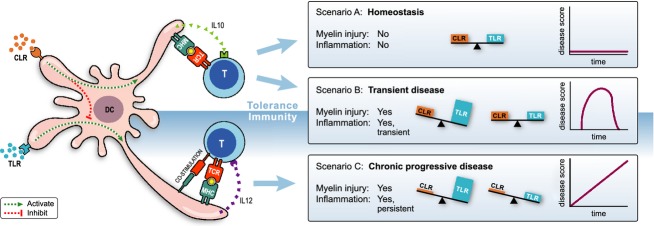
Yin-Yang regulation of myeloid APC. Depicted is a myeloid APC, for example, a microglia or dendritic cell, which expresses C-type lectin (CLR) and toll-like receptors (TLR). Via the integration of inhibitory input signals via CLR and stimulatory input signals via TLR the APC is instructed whether it needs to display tolerogenic or immunogenic activity. In a healthy brain APC are in a tolerogenic state as danger signals received via TLR are counterbalanced by inhibitory signals via CLR, for example, binding of normally glycosylated MOG to DC-SIGN (scenario A). CNS infection or tissue damage induces increase in danger signals, resulting in a, CLR/TLR dysbalance and maturation of APC to an immunogenic state. When the danger signals are cleared, the CLR/TLR balance that maintains homeostasis is restored (scenario B). When scenario B occurs in inflamed tissue where normal glycosylation is disturbed resulting in impaired CLR signaling, return to homeostasis after clearance of the danger does not occur. APS, antigen presenting cell; CNS, central nervous system; DC, dendritic cell.
Figure 3
Figure 3
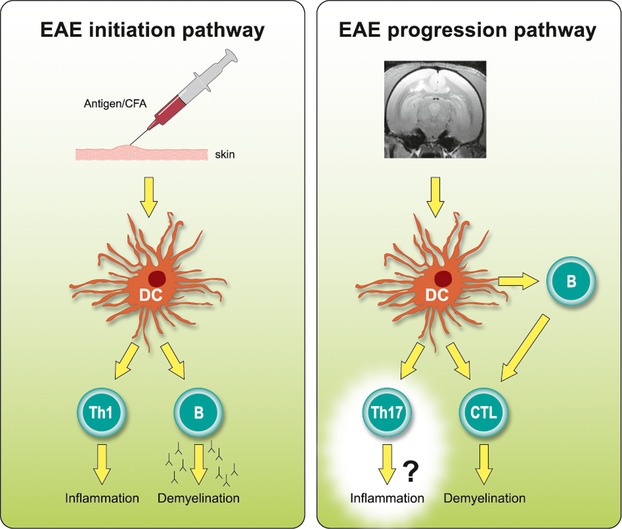
EAE development in marmosets involves two consecutively activated pathways. Injection of rhMOG/CFA emulsion into the skin induces local activation of APC, which induce activation of MHC class II/Caja-DRB1*W1201-restricted Th1 cells specific for MOG24–36 and B cells against conformational epitopes. The combined autoimmune attack initiates the inflammation and demyelination of white matter. Antigens released from such primary lesions can be retrieved within DC-SIGN+ APC within the cervical lymph nodes. Autoimmune factors induced at this location, in particular MHC-E restricted CTL, are critical mediators of chronic EAE. Virus-infected B cells have an important role in the progression pathway as requisite APC of the CTL. EAE, experimental autoimmune encephalomyelitis; CFA, complete Freund's adjuvant; APS, antigen presenting cell; MHC, major histocompatibility complex; DC, dendritic cell.
Figure 4
Figure 4
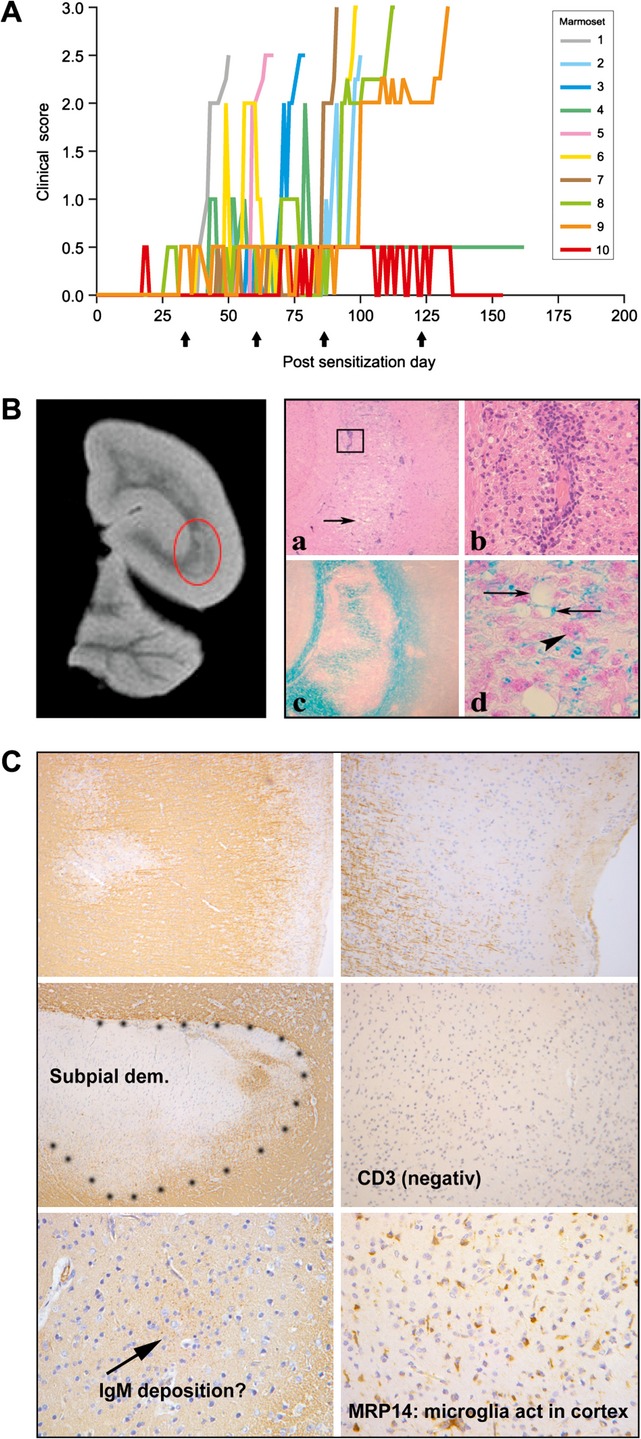
Clinical and pathological presentation of the EAE model induced with MOG34–56/IFA. A total of 10 marmosets were immunized with MOG34–56/IFA on days 0, 28, 56, 84, and 112 (arrows). (A) Nine monkeys developed clinically evident progressive EAE; one monkey went into remission after short lasting neurological impairment Characteristic pathological changes in cerebral white matter (B) and cortical gray matter (C) are shown. EAE, experimental autoimmune encephalomyelitis; IFA, incomplete Freund's adjuvant.
Figure 5
Figure 5
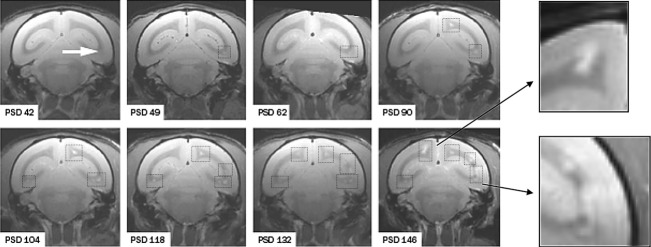
Brain lesion development in the rhMOG/CFA EAE model disseminated in time and space. Depicted is a series of T2-weighted MRI scans of the same coronal brain section recorded at periodic intervals (psd = postsensitization day). The arrow in the first picture points to the first abnormality recorded at 6 weeks after EAE induction. At 7 days later the first lesion has been enlarged and again 40 days later a second lesion can be observed. Squares with dotted lines are placed around lesions for better visualization. The inserts show an enhancement of lesions expanded into the cortical gray matter, which is a late event. CFA, complete Freund's adjuvant; EAE, experimental autoimmune encephalomyelitis.

References

    1. Sawcer S, Hellenthal G, Pirinen M, et al. Genetic risk and a primary role for cell-mediated immune mechanisms in multiple sclerosis. Nature. 2011;476:214–219. - PMC - PubMed
    1. Farooqi N, Gran B, Constantinescu CS. Are current disease-modifying therapeutics in multiple sclerosis justified on the basis of studies in experimental autoimmune encephalomyelitis? J Neurochem. 2010;115:829–844. - PubMed
    1. Lee YK, Menezes JS, Umesaki Y, Mazmanian SK. Proinflammatory T-cell responses to gut microbiota promote experimental autoimmune encephalomyelitis. Proc Natl Acad Sci USA. 2011;108(suppl 1):4615–4622. - PMC - PubMed
    1. Berer K, Mues M, Koutrolos M, et al. Commensal microbiota and myelin autoantigen cooperate to trigger autoimmune demyelination. Nature. 2011;479:538–541. - PubMed
    1. ‘t Hart BA, Gran B, Weissert R. EAE: imperfect but useful models of multiple sclerosis. Trends Mol Med. 2011;17:119–125. - PubMed

LinkOut - more resources