


A transdiagnostic comparison of enhanced cognitive behaviour therapy (CBT-E) and interpersonal psychotherapy in the treatment of eating disorders
- PMID: 26000757
- PMCID: PMC4461007
- DOI: 10.1016/j.brat.2015.04.010
A transdiagnostic comparison of enhanced cognitive behaviour therapy (CBT-E) and interpersonal psychotherapy in the treatment of eating disorders
Abstract
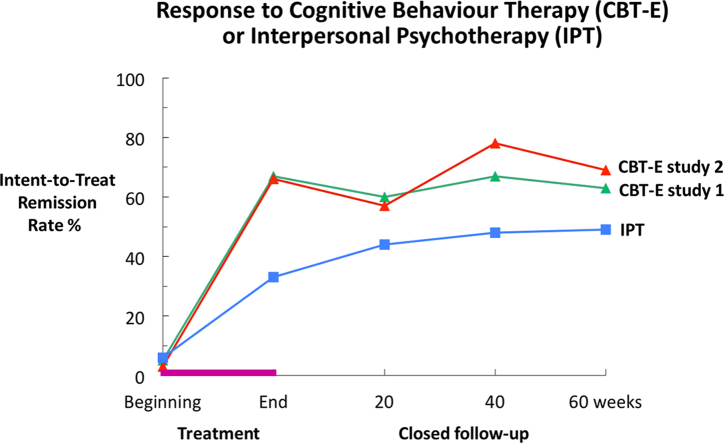
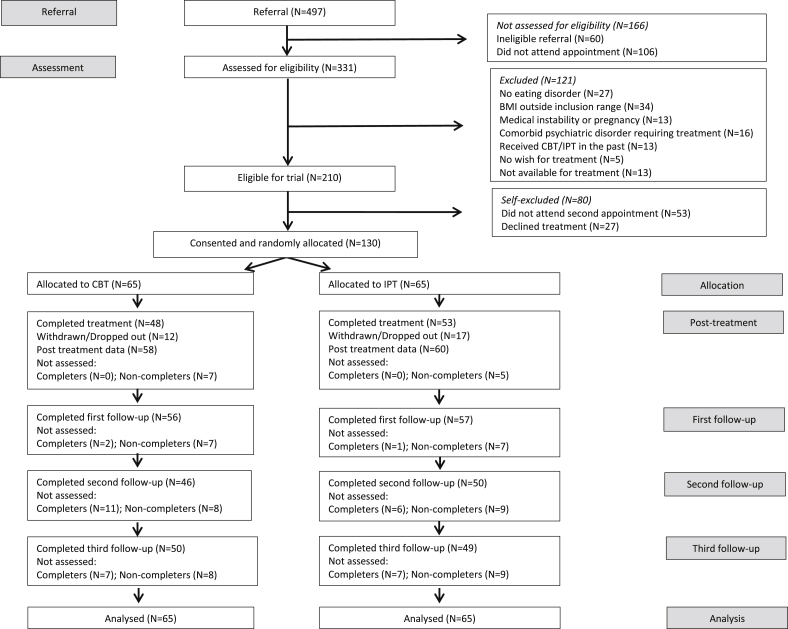
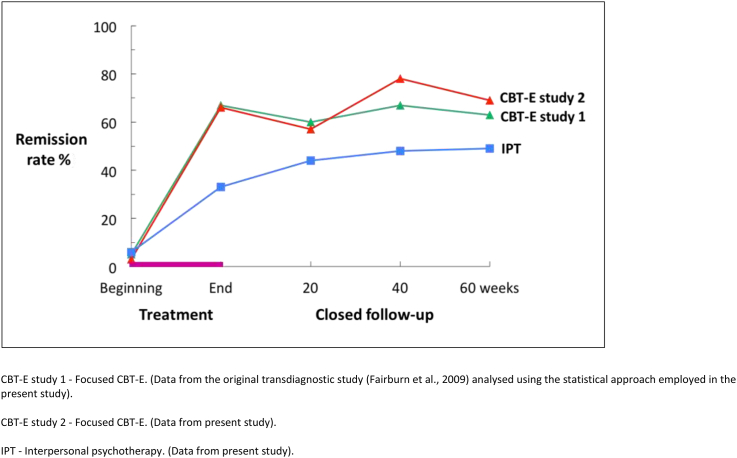
Eating disorders may be viewed from a transdiagnostic perspective and there is evidence supporting a transdiagnostic form of cognitive behaviour therapy (CBT-E). The aim of the present study was to compare CBT-E with interpersonal psychotherapy (IPT), a leading alternative treatment for adults with an eating disorder. One hundred and thirty patients with any form of eating disorder (body mass index >17.5 to <40.0) were randomized to either CBT-E or IPT. Both treatments involved 20 sessions over 20 weeks followed by a 60-week closed follow-up period. Outcome was measured by independent blinded assessors. Twenty-nine participants (22.3%) did not complete treatment or were withdrawn. At post-treatment 65.5% of the CBT-E participants met criteria for remission compared with 33.3% of the IPT participants (p < 0.001). Over follow-up the proportion of participants meeting criteria for remission increased, particularly in the IPT condition, but the CBT-E remission rate remained higher (CBT-E 69.4%, IPT 49.0%; p = 0.028). The response to CBT-E was very similar to that observed in an earlier study. The findings indicate that CBT-E is potent treatment for the majority of outpatients with an eating disorder. IPT remains an alternative to CBT-E, but the response is less pronounced and slower to be expressed.
Current controlled trials: ISRCTN 15562271.
Keywords: Cognitive behaviour therapy; Eating disorders; Interpersonal psychotherapy; Treatment.
Copyright © 2015 The Authors. Published by Elsevier Ltd.. All rights reserved.
Figures
References
-
- Agras W., Walsh B., Fairburn C.G., Wilson G., Kraemer H. A multicenter comparison of cognitive-behavioral therapy and interpersonal psychotherapy for bulimia nervosa. Archives of General Psychiatry. 2000;57:459–466. - PubMed
-
- American Psychiatric Association . 5th ed. American Psychiatric Association; Washington DC: 1994. Diagnostic and statistical manual of mental disorders.
-
- Beck A., Ward C., Mendelson M., Mock J., Erbaugh J. An inventory for measuring depression. Archives of General Psychiatry. 1961;4:561–571. - PubMed
-
- Beglin S.J. University of Oxford. University of Oxford; 1990. Eating disorders in young adult women. DPhil thesis.
Publication types
MeSH terms
Associated data
Grants and funding
LinkOut - more resources
Full Text Sources
Other Literature Sources
Medical
Miscellaneous
