


Review
doi: 10.1016/j.molcel.2015.05.005.
Advances and applications of single-cell sequencing technologies
Affiliations
- PMID: 26000845
- PMCID: PMC4441954
- DOI: 10.1016/j.molcel.2015.05.005
Item in Clipboard
Review
Advances and applications of single-cell sequencing technologies
Mol Cell.
.
Abstract
Single-cell sequencing (SCS) has emerged as a powerful new set of technologies for studying rare cells and delineating complex populations. Over the past 5 years, SCS methods for DNA and RNA have had a broad impact on many diverse fields of biology, including microbiology, neurobiology, development, tissue mosaicism, immunology, and cancer research. In this review, we will discuss SCS technologies and applications, as well as translational applications in the clinic.
Copyright © 2015 Elsevier Inc. All rights reserved.
Figures
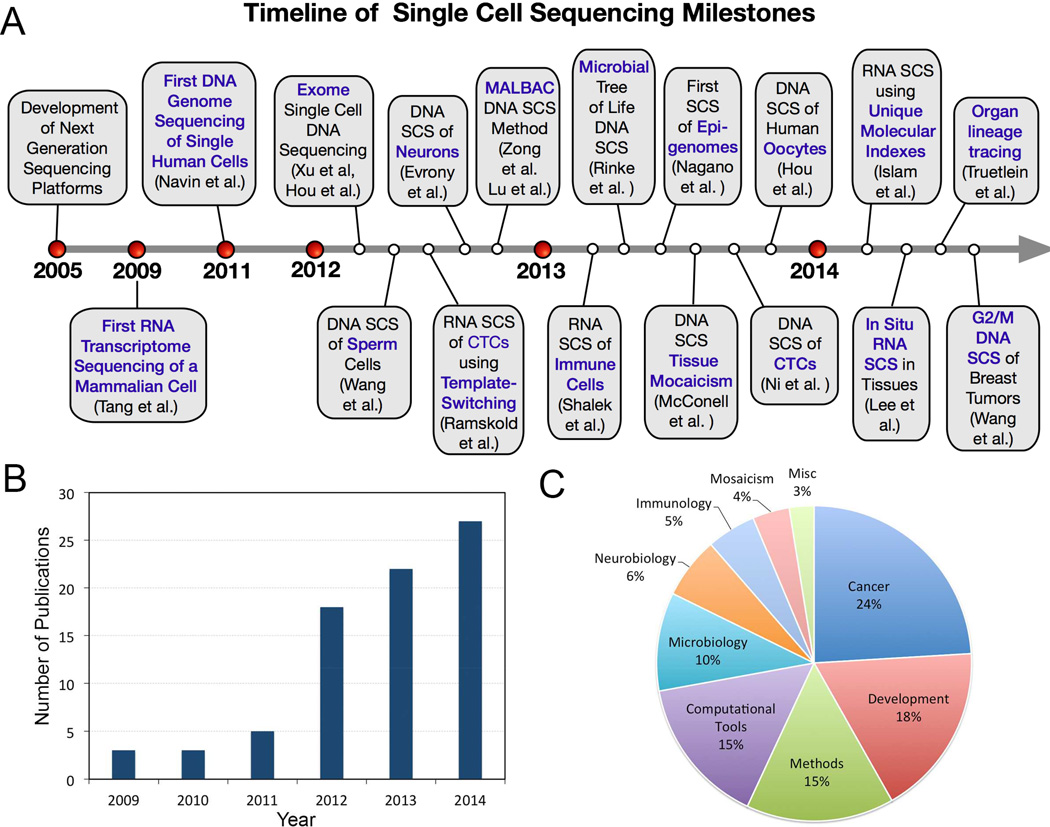
(A) Timeline of SCS Milestones (B) Histogram of the growing number of publications in SCS over the past 5 years (C) Prevalence of publications categorized by fields.
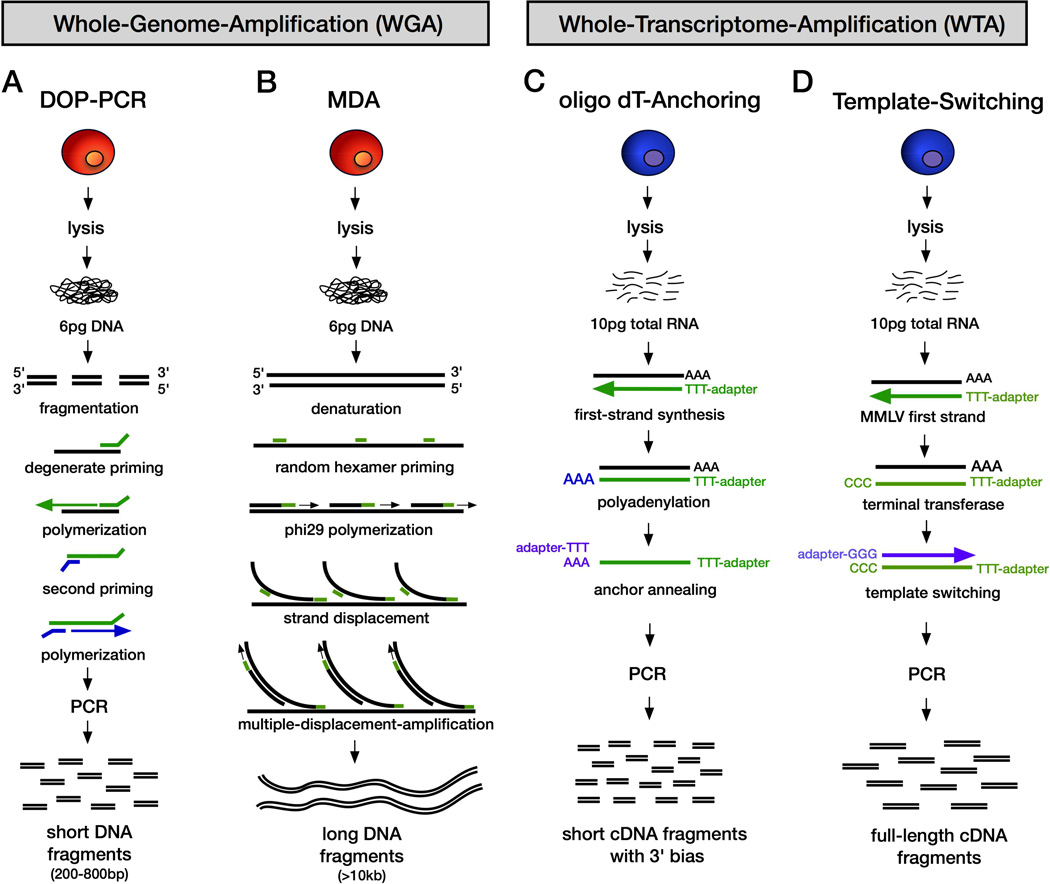
(A–B) Whole-genome-amplification methods. (C-D) Whole-transcriptome-amplification methods. (A) Degenerative-Oligonucleotide-Primer PCR (B) Multiple-displacementamplification. (C) oligo dT-Anchor Approach (D) Template switching
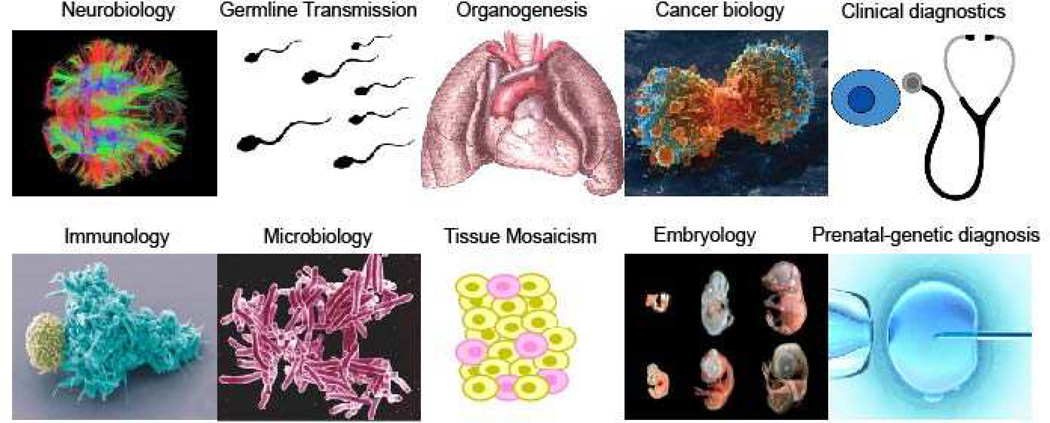
Panels illustrating the diverse fields of biology that have been impacted by SCS technologies over the past 5 years. Image credits: neurobiology, Zeynep Saygin (Cell Picture Show); germline transmission, Wang and Navin; organogenesis, Mikael Häggström (Wikimedia Commons); cancer biology, NIH; clinical diagnostics, Wang and Navin; immunology, Olivier Schwartz and the Electron Microscopy Core Facility, Institut Pasteur (Cell Picture Show); microbiology, NIAID; tissue mosaicism, Wang and Navin; embryology, Seth Ruffins, Russell Jacobs, and the Caltech MRI Atlas of Mouse Development (Cell Picture Show); prenatal genetic diagnosis, Shutterstock. All images used with permission.
References
-
- Altomare L, Borgatti M, Medoro G, Manaresi N, Tartagni M, Guerrieri R, Gambari R. Levitation and movement of human tumor cells using a printed circuit board device based on software-controlled dielectrophoresis. Biotechnology and bioengineering. 2003;82:474–479. - PubMed
-
- Bankevich A, Nurk S, Antipov D, Gurevich AA, Dvorkin M, Kulikov AS, Lesin VM, Nikolenko SI, Pham S, Prjibelski AD, et al. SPAdes: a new genome assembly algorithm and its applications to single-cell sequencing. Journal of computational biology : a journal of computational molecular cell biology. 2012;19:455–477. - PMC - PubMed
Publication types
MeSH terms
Grants and funding
LinkOut - more resources
Full Text Sources
Other Literature Sources
Miscellaneous
