


Ribonucleotide reductase subunit M2 predicts survival in subgroups of patients with non-small cell lung carcinoma: effects of gender and smoking status
- PMID: 26001082
- PMCID: PMC4441434
- DOI: 10.1371/journal.pone.0127600
Ribonucleotide reductase subunit M2 predicts survival in subgroups of patients with non-small cell lung carcinoma: effects of gender and smoking status
Abstract
Background: Ribonucleotide reductase catalyzes the conversion of ribonucleotide diphosphates to deoxyribonucleotide diphosphates. The functional enzyme consists of two subunits - one large (RRM1) and one small (RRM2 or RRM2b) subunit. Expression levels of each subunit have been implicated in prognostic outcomes in several different types of cancers.
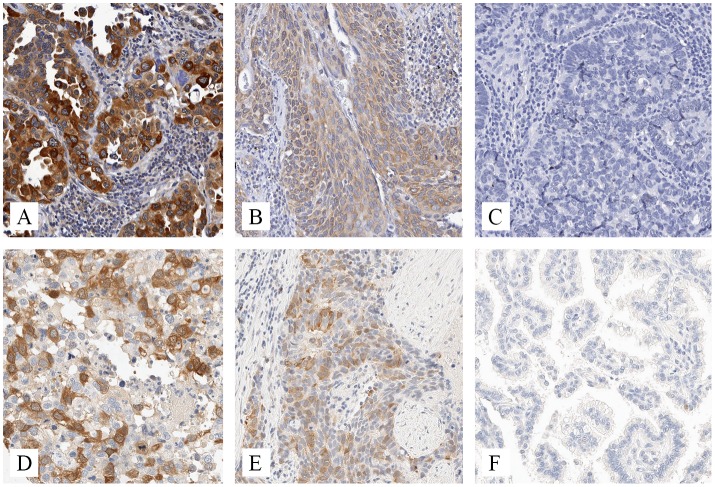
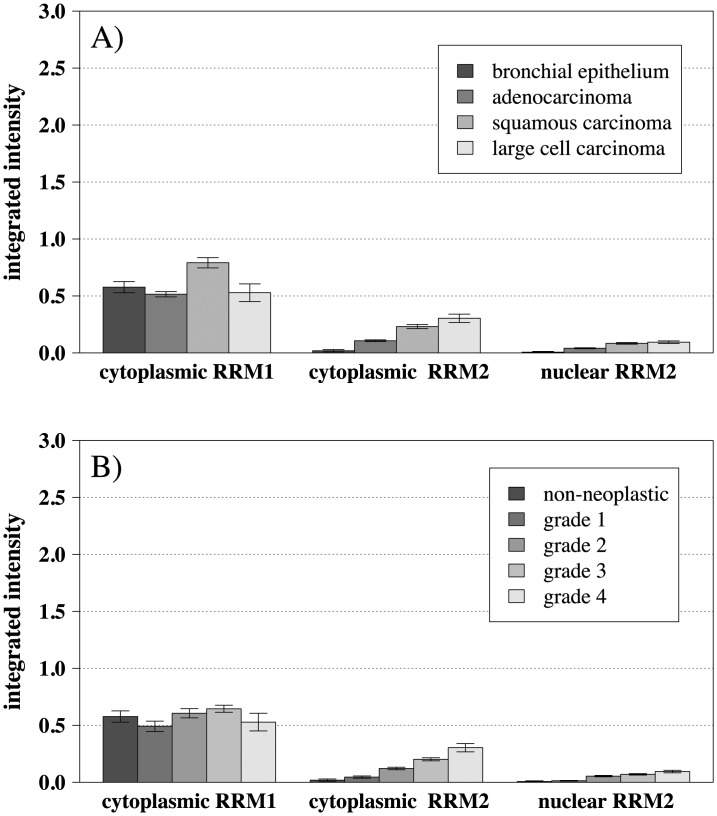
Experimental design: Immunohistochemistry for RRM1 and RRM2 was performed on a lung cancer tissue microarray (TMA) and analyzed. 326 patients from the microarray were included in this study.
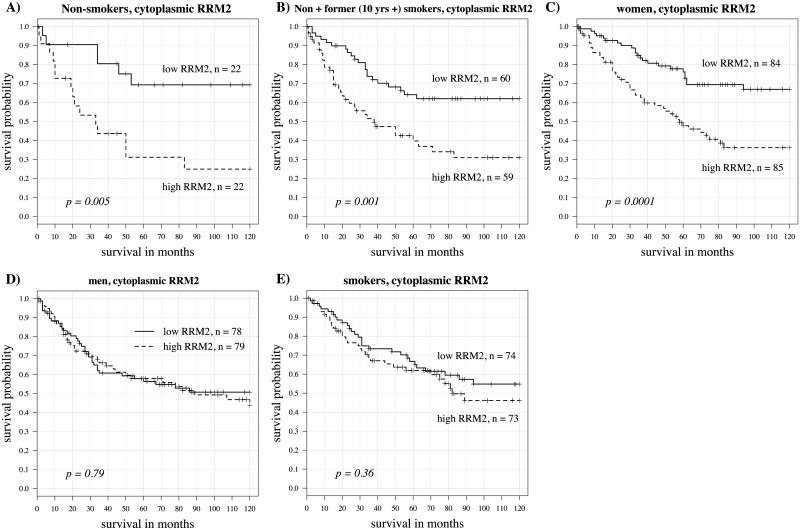
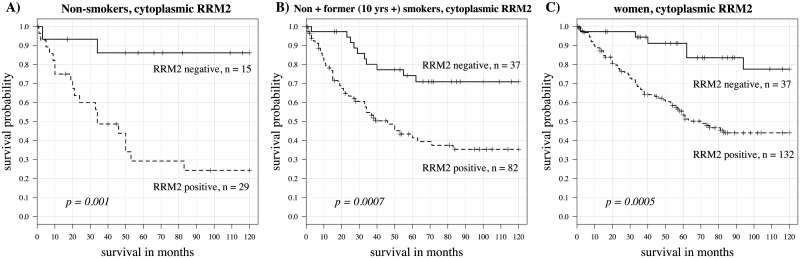
Results: In non-small cell lung cancer (NSCLC), RRM2 expression was strongly predictive of disease-specific survival in women, non-smokers and former smokers who had quit at least 10 years prior to being diagnosed with lung cancer. Higher expression was associated with worse survival. This was not the case for men, current smokers and those who had stopped smoking for shorter periods of time. RRM1 was not predictive of survival outcomes in any subset of the patient group.
Conclusion: RRM2, but not RRM1, is a useful predictor of survival outcome in certain subsets of NSCLC patients.
Conflict of interest statement
Figures


References
-
- American Cancer Society: Cancer Facts & Figures 2014. Available: http://www.cancer.org/acs/groups/content/@research/documents/webcontent/....
-
- Sakurai H, Asamura H, Goya T, Eguchi K, Nakanishi Y, Sawabata N, et al. Survival differences by gender for resected non-small cell lung cancer: a retrospective analysis of 12,509 cases in a Japanese Lung Cancer Registry study. J Thorac Oncol. 2010;5(10):1594–601. Epub 2010/08/26. 10.1097/JTO.0b013e3181f1923b . - DOI - PubMed
Publication types
MeSH terms
Substances
Grants and funding
LinkOut - more resources
Full Text Sources
Other Literature Sources
Medical
Miscellaneous
