


Asymmetric Mating Interference between Two Related Mosquito Species: Aedes (Stegomyia) albopictus and Aedes (Stegomyia) cretinus
- PMID: 26001099
- PMCID: PMC4441505
- DOI: 10.1371/journal.pone.0127762
Asymmetric Mating Interference between Two Related Mosquito Species: Aedes (Stegomyia) albopictus and Aedes (Stegomyia) cretinus
Erratum in
-
Correction: Asymmetric Mating Interference between Two Related Mosquito Species: Aedes (Stegomyia) albopictus and Aedes (Stegomyia) cretinus.PLoS One. 2015 Jul 6;10(7):e0132862. doi: 10.1371/journal.pone.0132862. eCollection 2015. PLoS One. 2015. PMID: 26147374 Free PMC article. No abstract available.
Abstract
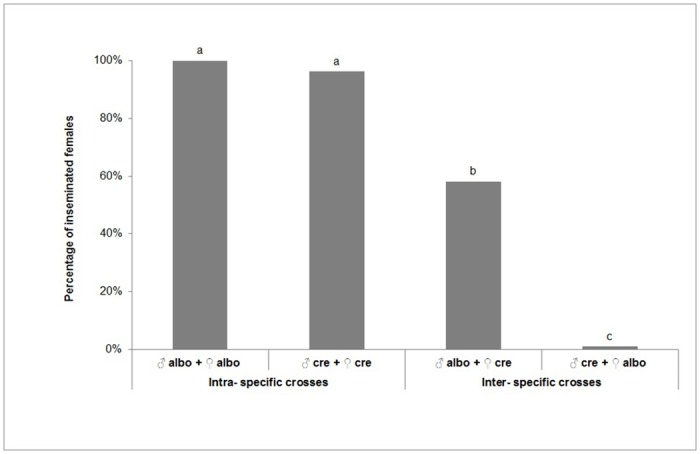
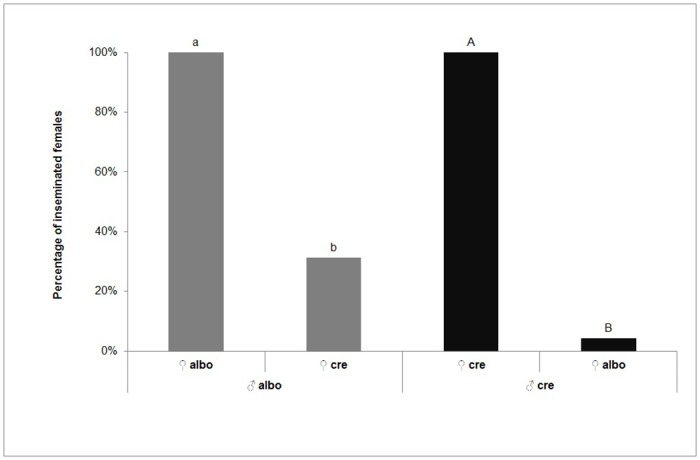
Aedes (Stegomyia) albopictus (Skuse) and Aedes (Stegomyia) cretinus Edwards are closely related mosquito species with common morphological features and bio-ecological similarities. Recent mosquito surveillance in Athens, Greece, showed that they are sympatric mosquito species, with Ae. albopictus [corrected] developing quite higher population densities than Ae. cretinus [corrected] . The potential of mating interference between these species was investigated by reciprocal and homologous mating experiments in cages under laboratory conditions. In non-choice interspecific crosses (groups of males and females) females of both species produced sterile eggs. Insemination rate was 58% for Ae. cretinus females and only 1% for Ae. albopictus [corrected] females. Aedes albopictus males were sexually aggressive and inseminated Ae. cretinus females (31%) in choice experiments, where males of one species had access to mate with females of both species. Whereas, interspecific mating of Ae. albopictus [corrected] females with Ae. cretinus males in the co-occurrence of Ae. cretinus females was weaker (4%). Aedes cretinus females from non-choice crossing with Ae. albopictus [corrected] or Ae. cretinus males were paired individually with conspecific males. The percentage of fertile Ae. cretinus females was 17.5% when had encaged before with Ae. albopictus [corrected] males, compared to 100% when Ae. cretinus [corrected] females were encaged with conspecific males only. Probable ecological consequences of asymmetric mating between these ecologically homologous species in nature are discussed.
Conflict of interest statement
Figures
References
-
- DeBach P (1966) The competitive displacement and coexistence principles. Annu. Rev. Entomol. 11: 183–212.
-
- Reitz S, Trumble J (2002) Competitive displacement among insects and arachnids. Annu. Rev. Entomol. 47: 435–465. - PubMed
-
- Mack RN, Simberloff D, Lonsdale WM, Evans H, Clout M, Bazzaz F (2000) Biotic invasions: Causes, epidemiology, global consequences, and control. Ecol. Appl. 10: 689–710.
-
- Ribeiro J, Spielman A (1986) The satyr effect: a model predicting parapatry and species extinction. Amer. Nat. 128: 513–528.
Publication types
MeSH terms
LinkOut - more resources
Full Text Sources
Other Literature Sources
