Infection prevention and control in nursing homes: a qualitative study of decision-making regarding isolation-based practices
- PMID: 26002947
- PMCID: PMC4575834
- DOI: 10.1136/bmjqs-2015-003952
Infection prevention and control in nursing homes: a qualitative study of decision-making regarding isolation-based practices
Abstract
Background: Isolation-based practices in nursing homes (NHs) differ from those in acute care. NHs must promote quality of life while preventing infection transmission. Practices used in NHs to reconcile these goals of care have not been characterised.
Purpose: To explore decision-making in isolation-based infection prevention and control practices in NHs.
Methods: A qualitative study was conducted with staff (eg, staff nurses, infection prevention directors and directors of nursing) employed in purposefully sampled US NHs. Semistructured, role-specific interview guides were developed and interviews were digitally recorded, transcribed verbatim and analysed using directed content analysis. The research team discussed emerging themes in weekly meetings to confirm consensus.
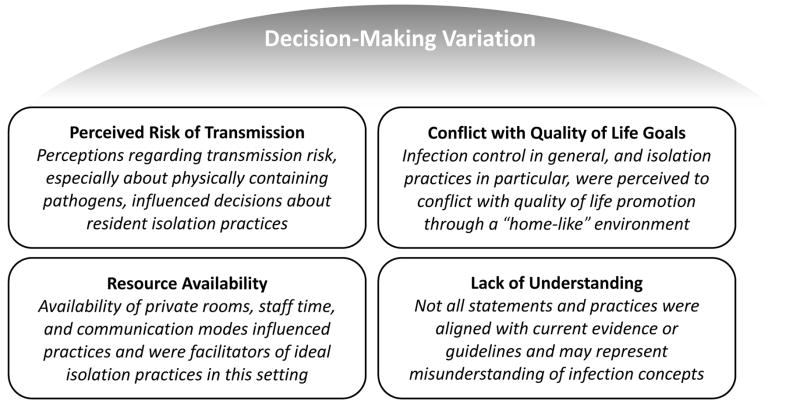
Results: We inferred from 73 interviews in 10 NHs that there was variation between NHs in practices regarding who was isolated, when isolation-based practices took place, how they were implemented, and how they were tailored for each resident. Interviewees' decision-making depended on staff perceptions of acceptable transmission risk and resident quality of life. NH resources also influenced decision-making, including availability of private rooms, extent to which staff can devote time to isolation-based practices and communication tools. A lack of understanding of key infection prevention and control concepts was also revealed.
Conclusions and implications: Current clinical guidelines are not specific enough to ensure consistent practice that meets care goals and resource constraints in NHs. However, new epidemiological research regarding effectiveness of varying isolation practices in this setting is needed to inform clinical practice. Further, additional infection prevention and control education for NH staff may be required.
Keywords: Decision making; Infection control; Nosocomial infections; Nursing homes.
Published by the BMJ Publishing Group Limited. For permission to use (where not already granted under a licence) please go to http://group.bmj.com/group/rights-licensing/permissions.
Conflict of interest statement
MPM has served as a consultant to Becton, Dickinson and Company. This consulting work was not related to the research presented in this article. The other authors have no potential conflicts of interest to report.
Figures
Similar articles
-
Healthcare-associated pathogens and nursing home policies and practices: results from a national survey.Infect Control Hosp Epidemiol. 2015 Jul;36(7):759-66. doi: 10.1017/ice.2015.59. Epub 2015 Mar 23. Infect Control Hosp Epidemiol. 2015. PMID: 25797334 Free PMC article.
-
Infection Prevention and Control Programs in US Nursing Homes: Results of a National Survey.J Am Med Dir Assoc. 2016 Jan;17(1):85-8. doi: 10.1016/j.jamda.2015.10.017. J Am Med Dir Assoc. 2016. PMID: 26712489 Free PMC article.
-
High-performing and low-performing nursing homes: a view from complexity science.Health Care Manage Rev. 2007 Oct-Dec;32(4):341-51. doi: 10.1097/01.HMR.0000296789.39128.f6. Health Care Manage Rev. 2007. PMID: 18075443
-
Nursing home safety: a review of the literature.Annu Rev Nurs Res. 2006;24:179-215. Annu Rev Nurs Res. 2006. PMID: 17078415 Review.
-
State of the science: relationship-oriented management practices in nursing homes.Nurs Outlook. 2011 Jul-Aug;59(4):221-7. doi: 10.1016/j.outlook.2011.05.001. Nurs Outlook. 2011. PMID: 21757079 Review.
Cited by
-
The situation of infection in the elderly in Spain: a multidisciplinary opinion document.Rev Esp Quimioter. 2020 Oct;33(5):327-349. doi: 10.37201/req/057.2020. Epub 2020 Sep 8. Rev Esp Quimioter. 2020. PMID: 32896115 Free PMC article.
-
Infection Control in Alternative Health Care Settings: An Update.Infect Dis Clin North Am. 2016 Sep;30(3):785-804. doi: 10.1016/j.idc.2016.05.001. Infect Dis Clin North Am. 2016. PMID: 27515148 Free PMC article. Review.
-
Importance of clinical educators to research use and suggestions for better efficiency and effectiveness: results of a cross-sectional survey of care aides in Canadian long-term care facilities.BMJ Open. 2018 Jul 13;8(7):e020074. doi: 10.1136/bmjopen-2017-020074. BMJ Open. 2018. PMID: 30007925 Free PMC article.
-
A systematic review on the causes of the transmission and control measures of outbreaks in long-term care facilities: Back to basics of infection control.PLoS One. 2020 Mar 10;15(3):e0229911. doi: 10.1371/journal.pone.0229911. eCollection 2020. PLoS One. 2020. PMID: 32155208 Free PMC article.
-
Barriers and facilitators to person-centred infection prevention and control: results of a survey about the Dementia Isolation Toolkit.BMC Geriatr. 2022 Jan 25;22(1):74. doi: 10.1186/s12877-022-02759-4. BMC Geriatr. 2022. PMID: 35078424 Free PMC article.
References
-
- Richards C. Infections in residents of long-term care facilities: an agenda for research report of an expert panel. J Am Geriatr Soc. 2002;20:570–6. - PubMed
-
- Siegel JD, Rhinehart E, Jackson M, et al. Management of multidrug-resistant organisms in health care settings, 2006. American Journal of Infection Control. 2006;35(10):S165–S93. - PubMed
-
- World Health Organization. “Ageing well” must be a global priority. Geneva, Switzerland: 2014. [accessed January 9 2015]. updated November 6 2014. Available from: http://www.who.int/ageing/en/
-
- U.S. Department of Health and Human Services. National action plan to prevent health care-associated infections: Road map to elimination. Washington D.C: 2013. pp. 194–239.
Publication types
MeSH terms
Grants and funding
LinkOut - more resources
Full Text Sources
Other Literature Sources
Medical