. 2015 Oct;9(8):1553-64.
doi: 10.1016/j.molonc.2015.04.008. Epub 2015 May 8.

Concomitant inactivation of the p53- and pRB- functional pathways predicts resistance to DNA damaging drugs in breast cancer in vivo

Affiliations

Concomitant inactivation of the p53- and pRB- functional pathways predicts resistance to DNA damaging drugs in breast cancer in vivo

Stian Knappskog et al. Mol Oncol. 2015 Oct.

Abstract

Chemoresistance is the main obstacle to cancer cure. Contrasting studies focusing on single gene mutations, we hypothesize chemoresistance to be due to inactivation of key pathways affecting cellular mechanisms such as apoptosis, senescence, or DNA repair. In support of this hypothesis, we have previously shown inactivation of either TP53 or its key activators CHK2 and ATM to predict resistance to DNA damaging drugs in breast cancer better than TP53 mutations alone. Further, we hypothesized that redundant pathway(s) may compensate for loss of p53-pathway signaling and that these are inactivated as well in resistant tumour cells. Here, we assessed genetic alterations of the retinoblastoma gene (RB1) and its key regulators: Cyclin D and E as well as their inhibitors p16 and p27. In an exploratory cohort of 69 patients selected from two prospective studies treated with either doxorubicin monotherapy or 5-FU and mitomycin for locally advanced breast cancers, we found defects in the pRB-pathway to be associated with therapy resistance (p-values ranging from 0.001 to 0.094, depending on the cut-off value applied to p27 expression levels). Although statistically weaker, we observed confirmatory associations in a validation cohort from another prospective study (n = 107 patients treated with neoadjuvant epirubicin monotherapy; p-values ranging from 7.0 × 10(-4) to 0.001 in the combined data sets). Importantly, inactivation of the p53-and the pRB-pathways in concert predicted resistance to therapy more strongly than each of the two pathways assessed individually (exploratory cohort: p-values ranging from 3.9 × 10(-6) to 7.5 × 10(-3) depending on cut-off values applied to ATM and p27 mRNA expression levels). Again, similar findings were confirmed in the validation cohort, with p-values ranging from 6.0 × 10(-7) to 6.5 × 10(-5) in the combined data sets. Our findings strongly indicate that concomitant inactivation of the p53- and pRB- pathways predict resistance towards anthracyclines and mitomycin in breast cancer in vivo.

Keywords: Breast cancer; Resistance; p53; pRB.


Figures

Figure 1
Figure 1
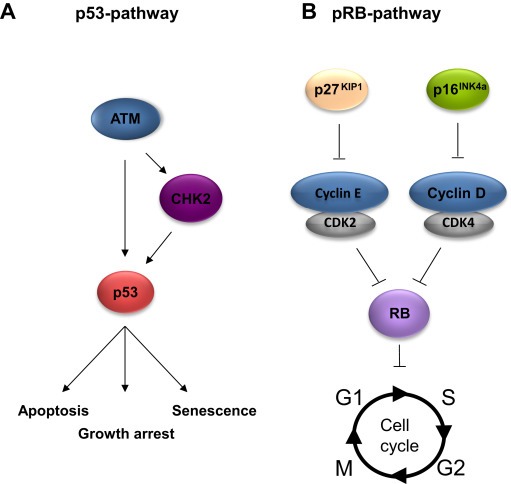
Schematic illustrations of the p53 (A) and the pRB (B) functional pathways.
Figure 2
Figure 2
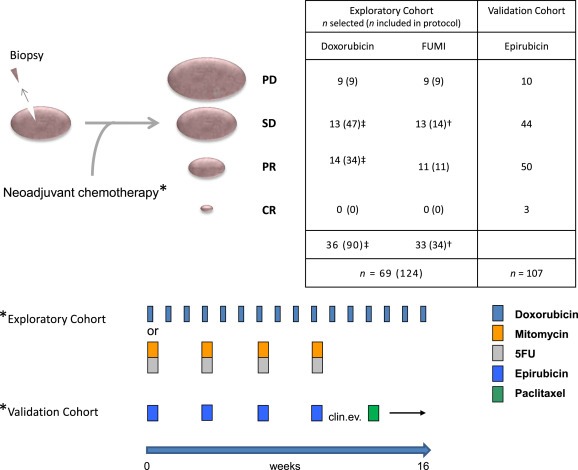
Study design and treatment regimens of included patients. All patients were diagnosed with locally advanced breast cancers and subject to biopsy for genetic analyses before commencement of neoadjuvant chemotherapy. Post therapy, all patients were evaluated for primary response to therapy before surgery (CR = Complete response, PR = Partial Response, SD = Stable Disease, PD = Progressive Disease, see Supplementary Information for details). In the exploratory cohort (n = 69), 36 of the patients were originally selected from the 90 patients enrolled in a prospective study assessing resistance to treatment with doxorubicin in locally advanced breast cancer (‡ selection of all patients with PD along with representative control groups of SD and PR). These patients received weekly doxorubicin for 16 weeks or until progressive disease was recorded. The remaining 33 patients were from a prospective study assessing resistance to mitomycin and 5‐fluorouracil (FUMI; † one patient was omitted due to lack of biological material). These patients received mitomycin and FUMI every third week (four cycles). Patients in the validation cohort received epirubicin every third week (four cycles) before clinical evaluation of response and change of therapy to paclitaxel every third week (four cycles) in case of an inferior response to the first line treatment. For further information regarding the cohorts, see Supplementary Information.
Figure 3
Figure 3
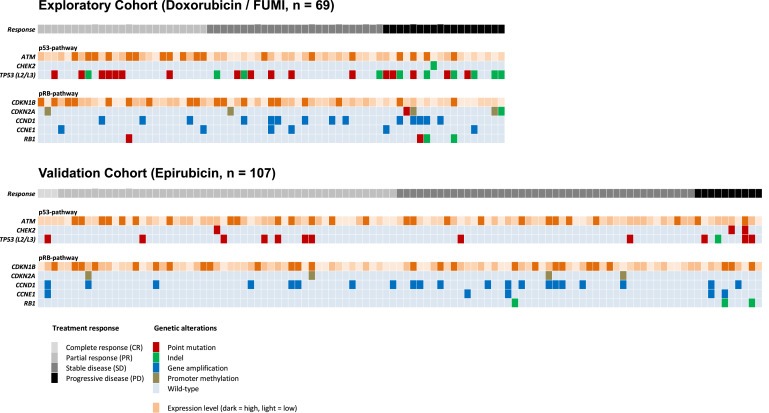
Graphical summary of the detected genetic alterations. Each column represent one of the 176 patients analyzed (Exploratory Cohort; n = 69 and Validation Cohort; n = 107) while each row represent one of the analyzed genes in the p53‐or the pRB‐pathway. Treatment response and genetic alterations for each individual patient is given as colored squares according to the color‐key (bottom panel). A detailed summary of these findings are listed in Supplementary Tables S3A and S3B.
Figure 4
Figure 4
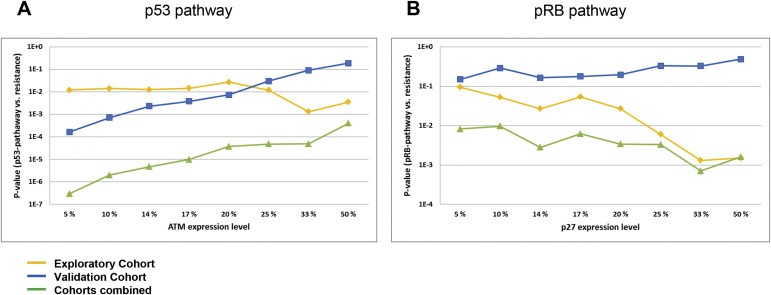
Correlations between p53‐/or pRB‐pathway defects and resistance to DNA damaging drugs. (A) Lines representing p‐values (Y‐axis) for the correlations between defects in the p53‐pathway (TP53 mutations, CHEK2 mutation or low levels of ATM mRNA) and resistance to DNA damaging drugs in vivo, plotted as a function of different cut‐offs applied to define “pathologically” low levels of ATM (X‐axis). The percentages refer to the lower percentile of patients in each cohort. (B) Lines representing p‐values (Y‐axis) for the correlations between defects in the pRb pathway (RB1 mutations, Cyclin D or E amplifications, CDKN2A defects or low levels of p27 mRNA) and resistance to DNA damaging drugs in vivo, plotted as a function of different cut‐offs applied to define “pathologically” low levels of p27 (X‐axis). Exploratory cohort (Cohort 1; treated with doxorubicin or 5‐FU/mitomycin; yellow line), validation cohort (Cohort 2; treated with epirubicin; blue line) and combined data from cohort 1 and 2 (green line).
Figure 5
Figure 5
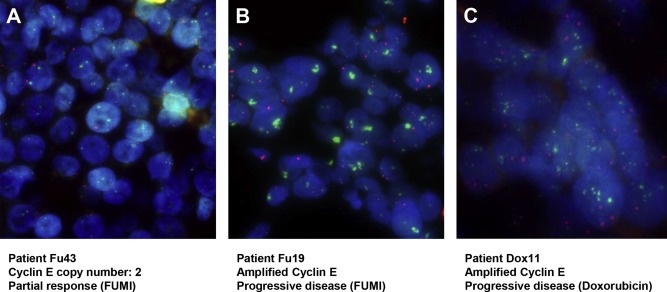
Cyclin E copy number analysis. Representative pictures of Cyclin E copy number analyses as performed by fluorescence in situ hybridization (FISH) using Cyclin E specific probe (green) and centromere 11 specific probe (red). (A) Normal copy number. (B) Highly amplified Cyclin E locus in patient with progressive disease upon 5‐FU and mitomycin treatment. (C) Highly amplified Cyclin E locus in patient with progressive disease upon doxorubicin monotherapy treatment. Magnification 630×.
Figure 6
Figure 6
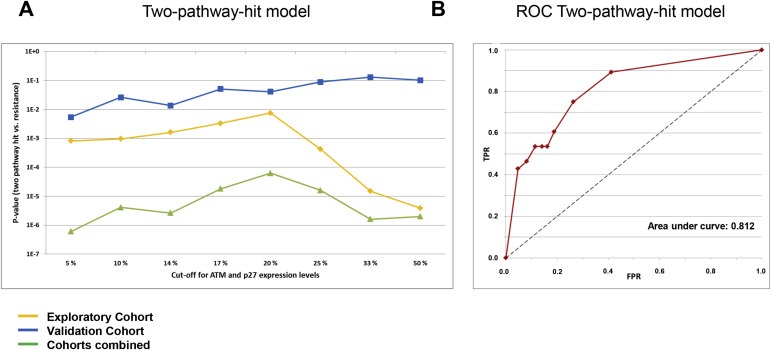
Correlations between the two‐pathway‐hit model and resistance to DNA damaging drugs. (A) Lines representing p‐values for the correlations between concomitant defects in the p53 and the pRB pathway and resistance to DNA damaging drugs in vivo, plotted as a function of different cut‐offs applied to define “pathologically” low levels of ATM and p27. Exploratory cohort (treated with doxorubicin or 5‐FU/mitomycin; yellow line), validation cohort (treated with epirubicin; blue line), and combined data from both cohorts (green line). (B) ROC‐curve for the twopathway‐ hit model, based on the combined data from the exploratory‐ and the validation cohorts (green line in Figure 6A). TPR: True positive rate; FPR: False positive rate. The eight points on the ROC‐curve corresponds to the eight cut offs on the x‐axis of panel A.
Figure 7
Figure 7
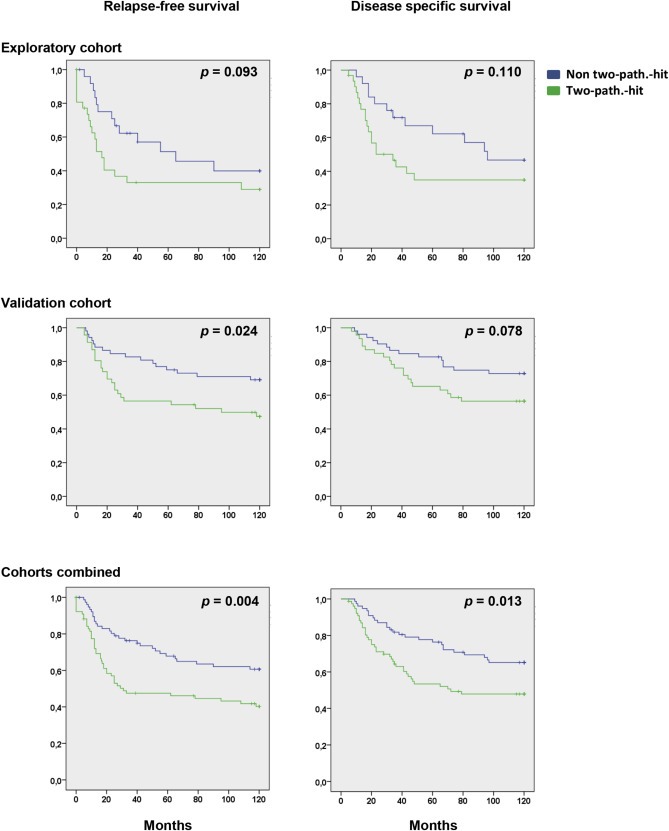
Kaplan–Meier plots illustrating the impact of concomitant inactivation of the p53‐and pRB‐functional pathways on 10 years relapse‐free survival and disease specific survival. Green lines represent patients with concomitant inactivation (two‐pathway‐hit). Blue lines represent patients without concomitant inactivation.

References

    1. Alba, E. , Martin, M. , Ramos, M. , Adrover, E. , Balil, A. , Jara, C. , Barnadas, A. , Fernandez-Aramburo, A. , Sanchez-Rovira, P. , Amenedo, M. , Casado, A. , 2004. Multicenter randomized trial comparing sequential with concomitant administration of doxorubicin and docetaxel as first-line treatment of metastatic breast cancer: a Spanish Breast Cancer Research Group (GEICAM-9903) phase III study. J. Clin. Oncol. 22, (13) 2587–2593. - PubMed
    1. Albain, K.S. , Barlow, W.E. , Shak, S. , Hortobagyi, G.N. , Livingston, R.B. , Yeh, I.T. , Ravdin, P. , Bugarini, R. , Baehner, F.L. , Davidson, N.E. , Sledge, G.W. , Winer, E.P. , Hudis, C. , Ingle, J.N. , Perez, E.A. , Pritchard, K.I. , Shepherd, L. , Gralow, J.R. , Yoshizawa, C. , Allred, D.C. , Osborne, C.K. , Hayes, D.F. , Breast Cancer Intergroup of North A, 2010. Prognostic and predictive value of the 21-gene recurrence score assay in postmenopausal women with node-positive, oestrogen-receptor-positive breast cancer on chemotherapy: a retrospective analysis of a randomised trial. Lancet Oncol. 11, (1) 55–65. - PMC - PubMed
    1. Albain, K. , Anderson, S. , Arriagada, R. , Barlow, W. , Bergh, J. , Bliss, J. , Buyse, M. , Cameron, D. , Carrasco, E. , Clarke, M. , Correa, C. , Coates, A. , Collins, R. , Costantino, J. , Cutter, D. , 2012. Comparisons between different polychemotherapy regimens for early breast cancer: meta-analyses of long-term outcome among 100000 women in 123 randomised trials. Lancet. 379, 432–444. - PMC - PubMed
    1. Berge, E.O. , Knappskog, S. , Geisler, S. , Staalesen, V. , Pacal, M. , Borresen-Dale, A.L. , Puntervoll, P. , Lillehaug, J.R. , Lonning, P.E. , 2010. Identification and characterization of retinoblastoma gene mutations disturbing apoptosis in human breast cancers. Mol. Cancer. 9, 173 - PMC - PubMed
    1. Berge, E.O. , Knappskog, S. , Lillehaug, J.R. , Lonning, P.E. , 2011. Alterations of the retinoblastoma gene in metastatic breast cancer. Clin. Exp. Metastasis. 28, (3) 319–326. - PMC - PubMed

Publication types

MeSH terms