


Practical Dyspnea Assessment: Relationship Between the 0-10 Numerical Rating Scale and the Four-Level Categorical Verbal Descriptor Scale of Dyspnea Intensity
- PMID: 26004401
- PMCID: PMC5008963
- DOI: 10.1016/j.jpainsymman.2015.04.015
Practical Dyspnea Assessment: Relationship Between the 0-10 Numerical Rating Scale and the Four-Level Categorical Verbal Descriptor Scale of Dyspnea Intensity
Abstract
Context: Measurement of dyspnea is important for clinical care and research.
Objectives: To characterize the relationship between the 0-10 Numerical Rating Scale (NRS) and four-level categorical Verbal Descriptor Scale (VDS) for dyspnea assessment.
Methods: This was a substudy of a double-blind randomized controlled trial comparing palliative oxygen to room air for relief of refractory breathlessness in patients with life-limiting illness. Dyspnea was assessed with both a 0-10 NRS and a four-level categorical VDS over the one-week trial. NRS and VDS responses were analyzed in cross section and longitudinally. Relationships between NRS and VDS responses were portrayed using descriptive statistics and visual representations.
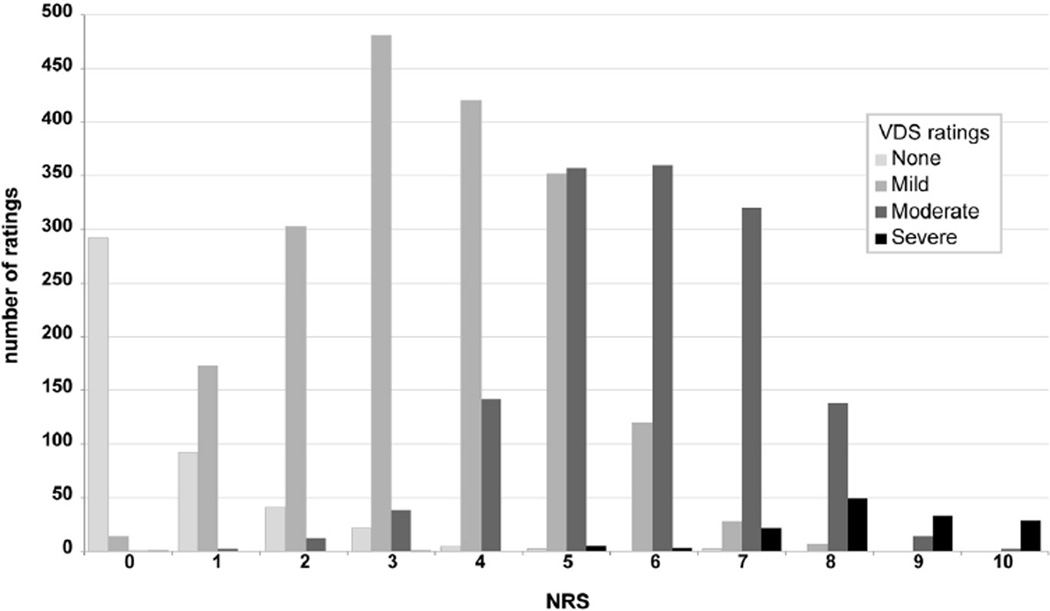
Results: Two hundred twenty-six participants contributed responses. At baseline, mild and moderate levels of breathlessness were reported by 41.9% and 44.6% of participants, respectively. NRS scores demonstrated increasing mean and median levels for increasing VDS intensity, from a mean (SD) of 0.6 (±1.04) for VDS none category to 8.2 (1.4) for VDS severe category. The Spearman correlation coefficient was strong at 0.78 (P < 0.0001). Based on the distribution of NRS scores within VDS categories, we calculated test characteristics of two different cutpoint models. Both models yielded 75% correct translations from NRS to VDS; however, Model A was more sensitive for moderate or greater dyspnea, with fewer misses downcoded.
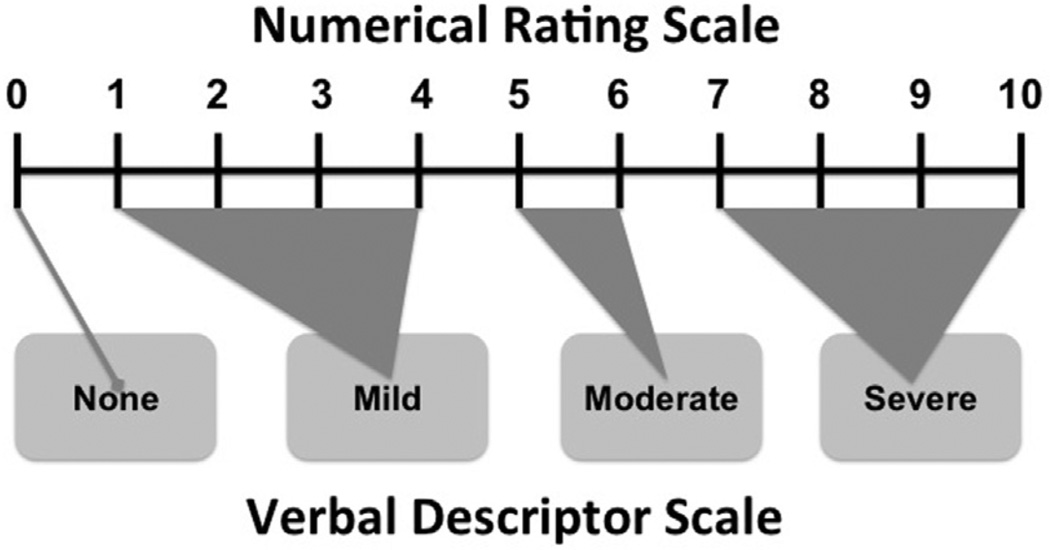
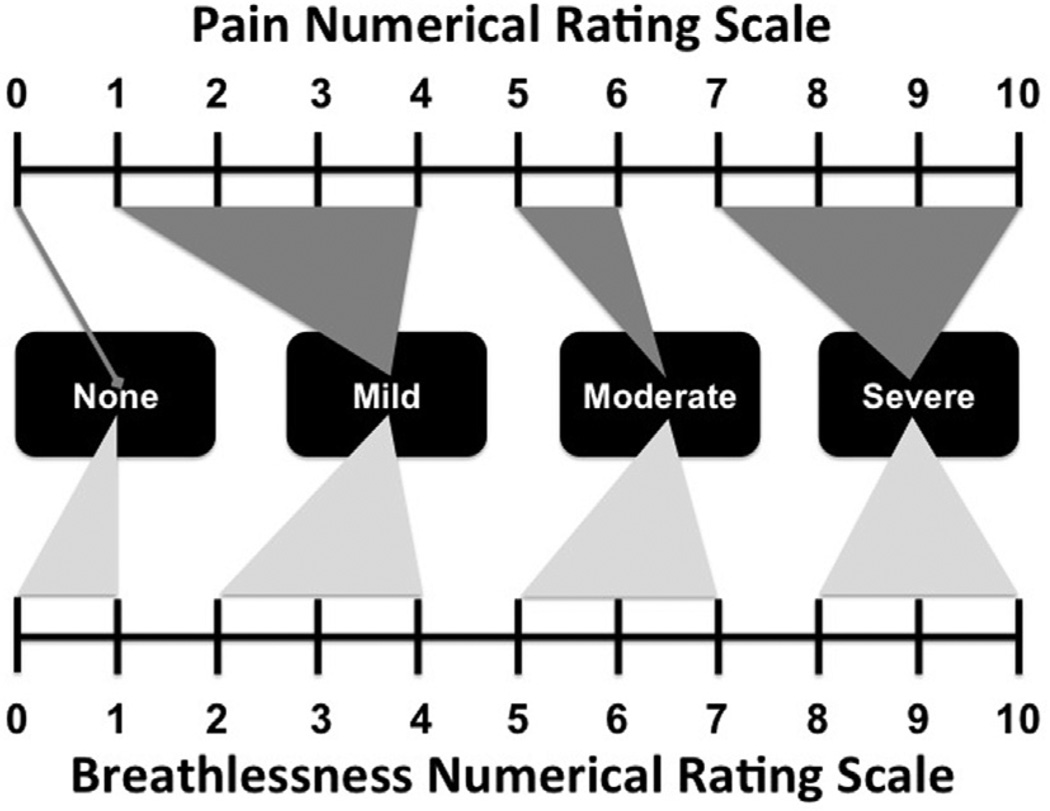
Conclusion: There is strong correlation between VDS and NRS measures for dyspnea. Proposed practical cutpoints for the relationship between the dyspnea VDS and NRS are 0 for none, 1-4 for mild, 5-8 for moderate, and 9-10 for severe.
Keywords: Dyspnea; Numerical Rating Scale; Verbal Descriptor Scale.
Copyright © 2015 American Academy of Hospice and Palliative Medicine. Published by Elsevier Inc. All rights reserved.
Figures
References
-
- American Thoracic Society. Dyspnea. Mechanisms, assessment, and management: a consensus statement. Am J Respir Crit Care Med. 1999;159:321–340. - PubMed
-
- Lynn J, Teno JM, Phillips RS, et al. Perceptions by family members of the dying experience of older and seriously ill patients. Ann Intern Med. 1997;126:97–106. - PubMed
-
- Mercadante S, Casuccio A, Fulfaro F. The course of symptom frequency and intensity in advanced cancer patients followed at home. J Pain Symptom Manage. 2000;20:104–112. - PubMed
-
- Seow H, Barbera L, Sutradhar R, et al. Trajectory of performance status and symptom scores for patients with cancer during the last six months of life. J Clin Oncol. 2011;29:1151–1158. - PubMed
-
- Bausewein C, Booth S, Gysels M, et al. Individual breathlessness trajectories do not match summary trajectories in advanced cancer and chronic obstructive pulmonary disease: results from a longitudinal study. Palliat Med. 2010;24:777–786. - PubMed
Publication types
MeSH terms
Grants and funding
LinkOut - more resources
Full Text Sources
Other Literature Sources
Medical
