


Nurture net of nature: Re-evaluating the role of shared environments in academic achievement and verbal intelligence
- PMID: 26004471
- PMCID: PMC4888873
- DOI: 10.1016/j.ssresearch.2015.02.011
Nurture net of nature: Re-evaluating the role of shared environments in academic achievement and verbal intelligence
Abstract
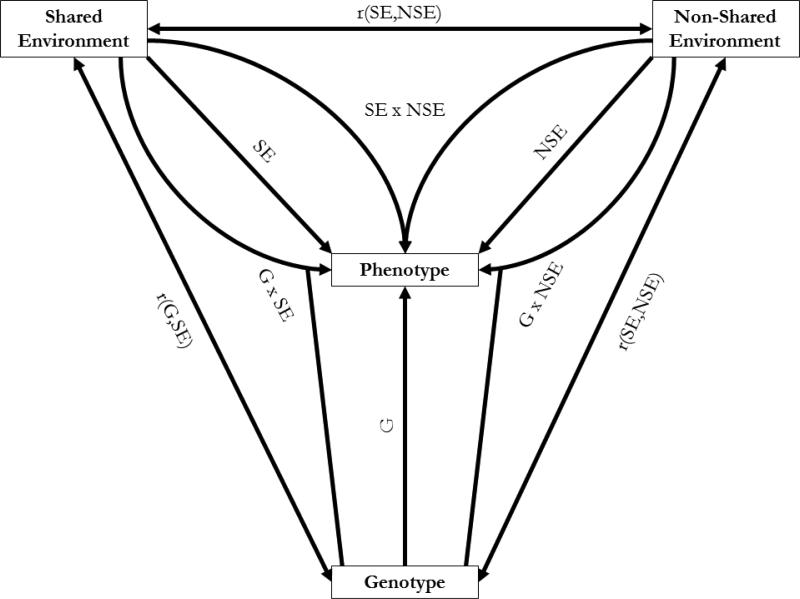
Prominent authors in the behavioral genetics tradition have long argued that shared environments do not meaningfully shape intelligence and academic achievement. However, we argue that these conclusions are erroneous due to large violations of the additivity assumption underlying behavioral genetics methods - that sources of genetic and shared and nonshared environmental variance are independent and non-interactive. This is compounded in some cases by the theoretical equation of the effective and objective environments, where the former is defined by whether siblings are made more or less similar, and the latter by whether siblings are equally subject to the environmental characteristic in question. Using monozygotic twin fixed effects models, which compare outcomes among genetically identical pairs, we show that many characteristics of objectively shared environments significantly moderate the effects of nonshared environments on adolescent academic achievement and verbal intelligence, violating the additivity assumption of behavioral genetic methods. Importantly, these effects would be categorized as nonshared environmental influences in standard twin models despite their roots in shared environments. These findings should encourage caution among those who claim that the frequently trivial variance attributed to shared environments in behavioral genetic models means that families, schools, and neighborhoods do not meaningfully influence these outcomes.
Keywords: Academic achievement; Monozygotic twins; Nature/nurture; Verbal intelligence.
Copyright © 2015. Published by Elsevier Inc.
Figures
References
-
- Acs G. Can we promote child well-being by promoting marriage? Journal of Marriage and Family. 2007;69:1326–1344.
-
- Aksoy T, Link CR. A panel analysis of student mathematics achievement in the US in the 1990s: does increasing the amount of time in learning activities affect math achievement? Economics of Education Review. 2000;19:261–277.
-
- Alexander KL, Entwisle DR, Olson LS. Lasting consequences of the summer learning gap. American Sociological Review. 2007;72:167–180.
-
- Ashenfelter O, Krueger A. Estimates of the Economic Return to Schooling from a New Sample of Twins. American Economic Review. 1994;84:1157–1173.
Publication types
MeSH terms
Grants and funding
LinkOut - more resources
Full Text Sources
Other Literature Sources
