. 2015 May 8:9:235.
doi: 10.3389/fnhum.2015.00235. eCollection 2015.

Neurophysiological and neurocognitive mechanisms underlying the effects of yoga-based practices: towards a comprehensive theoretical framework

Affiliations

Neurophysiological and neurocognitive mechanisms underlying the effects of yoga-based practices: towards a comprehensive theoretical framework

Laura Schmalzl et al. Front Hum Neurosci. .

Abstract

During recent decades numerous yoga-based practices (YBP) have emerged in the West, with their aims ranging from fitness gains to therapeutic benefits and spiritual development. Yoga is also beginning to spark growing interest within the scientific community, and yoga-based interventions have been associated with measureable changes in physiological parameters, perceived emotional states, and cognitive functioning. YBP typically involve a combination of postures or movement sequences, conscious regulation of the breath, and various techniques to improve attentional focus. However, so far little if any research has attempted to deconstruct the role of these different component parts in order to better understand their respective contribution to the effects of YBP. A clear operational definition of yoga-based therapeutic interventions for scientific purposes, as well as a comprehensive theoretical framework from which testable hypotheses can be formulated, is therefore needed. Here we propose such a framework, and outline the bottom-up neurophysiological and top-down neurocognitive mechanisms hypothesized to be at play in YBP.

Keywords: allostatic load; attention; basal ganglia; bottom-up; breath; movement; top-down; yoga.


Figures
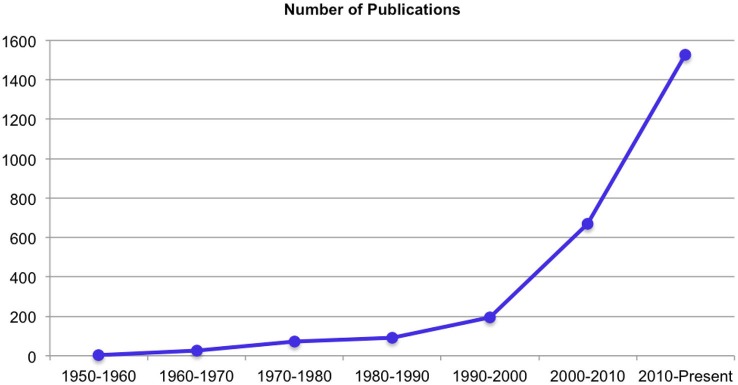
Figure 1
Figure 1
Increase of yoga related publications over the past decades—PubMed search performed in March 2015 for articles with the term yoga in the title, abstract or keywords.
Figure 2
Figure 2
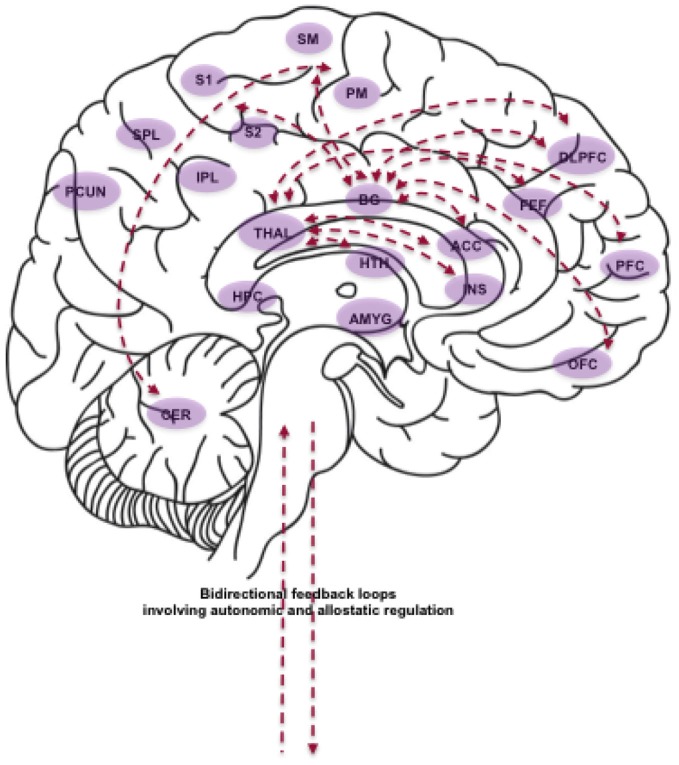
Schematic depiction of some of the brain areas, neural circuits and physiological processes proposed to be affected by YBP. Abbreviations (in alphabetical order): ACC (Anterior Cingulate Cortex); AMYG (Amygdala); BG (Basal Ganglia); CER (Cerebellum); DLPFC (Dorsolateral Prefrontal Cortex); FEF (Frontal Eye Fields); HPC (Hippocampus); HTH (Hypothalamus); INS (Insula); IPL (Inferior Parietal Lobule); OFC (Orbitofrontal Cortex); PCUN (Precuneus); PFC (Prefrontal Cortex); PM (Premotor Cortex); S1 (Primary Somatosensory Cortex); S2 (Secondary Somatosensory Cortex); SM (Supplementary Motor Cortex); SPL (Superior Parietal Lobule); THAL (Thalamus). The role of BG and cerebellar circuits: BG circuits involving PM and SM support the coordination of complex movements. BG circuits involving the DLPFC, OFC and ACC support executive functioning and procedural learning implicated in the planning and learning of motor sequences. BG circuits involving the DLPFC additionally support working memory required for the execution of motor sequences. BG circuits involving S1, S2, DLPFC, and ACC support somatosensory processing as well as the perception of noxious stimuli. BG circuits involving FEF support voluntary eye movements and gaze control. Lastly, CER circuits involving PM and SM support motor coordination and action execution. Brain areas and neural circuits supporting body-focused attention and interoceptive awareness: The INS is the key neural structure for the processing of both exteroceptive (somatic) and interoceptive (physiological) information for bodily awareness and autonomic regulation. The ACC supports the processing of noxious stimuli as well as error detection and conflict monitoring. S1 and S2 are the core regions for the processing of tactile and proprioceptive sensations. The PCUN supports higher-order body awareness, self-related processing and attentional shifting. The IPL and SPL are involved in the computation of body size and shape, and in the integration of multimodal spatial information in body-centered coordinates. The PFC supports executive control and self-referential processing. Integration of bottom-up and top-down processes: The breath employed in YBP putatively promotes synchronization of cortical areas via stimulation of THAL nuclei, with a consequent positive impact on alertness and executive functioning. In addition, slow and rhythmic breathing is known to promote vagal tone and in turn reduce allostatic load. The THAL mediates vagal afferent information to the INS, ACC and PFC, which are all involved in self-regulatory processes. The AMYG supports fear-detection, and consequent modulation of autonomic states. The HPC contains stress hormone receptors that can influence the evaluation and memory of stress-related events.

References

    1. Achard S., Salvador R., Whitcher B., Suckling J., Bullmore E. (2006). A resilient, low-frequency, small-world human brain functional network with highly connected association cortical hubs. J. Neurosci. 26, 63–72. 10.1523/jneurosci.3874-05.2006 - DOI - PMC - PubMed
    1. Adolphs R. (2002). Trust in the brain. Nat. Neurosci. 5, 192–193. 10.1038/nn0302-192 - DOI - PubMed
    1. Akers B. D. (2002). The Hatha Yoga Pradipika: The Original Sanskrit (Swami Svatmarama)–An English translation (Brian Dana Akers). New York, NY: Woodstock.
    1. Alexander G. (1985). Eutony: The Holistic Discovery of the Total Person. Great Neck, NY: Felix Morrow.
    1. Alexander G. E. (1994). Basal ganglia-thalamocortical circuits: their role in control of movements. J. Clin. Neurophysiol. 11, 420–431. 10.1097/00004691-199407000-00004 - DOI - PubMed

LinkOut - more resources