The generation of carcinogenic etheno-DNA adducts in the liver of patients with nonalcoholic fatty liver disease
- PMID: 26005678
- PMCID: PMC4405412
- DOI: 10.3978/j.issn.2304-3881.2015.01.14
The generation of carcinogenic etheno-DNA adducts in the liver of patients with nonalcoholic fatty liver disease
Abstract
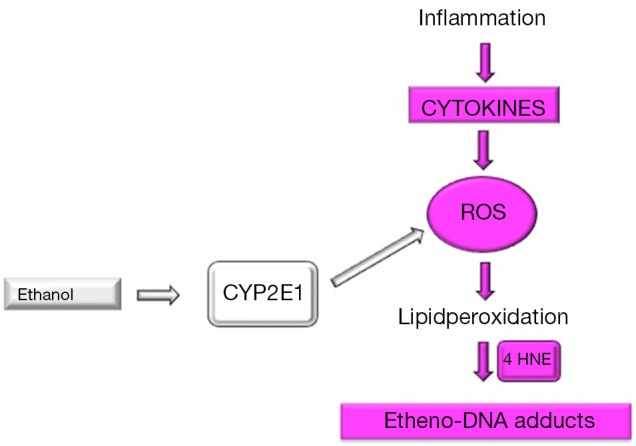
Background: Nonalcoholic fatty liver disease (NAFLD), in particular its more aggressive form nonalcoholic steatohepatitis (NASH) is increasingly observed as a cause of end stage liver disease and hepatocellular carcinoma (HCC). Reactive oxygen species (ROS) are an important factor in the pathogenesis of HCC. ROS can react with polyunsaturated fatty acids derived from membrane phospholipids resulting in the production of reactive aldehydes as lipid oxidation (LPO) byproducts, such as 4-hydroxynonenal (4 HNE). 4 HNE can react with DNA to form mutagenic exocyclic etheno-DNA adducts. ROS is induced by inflammatory processes, but also by induction of cytochrome P450 2E1 (CYP2E1), as seen with chronic alcohol consumption.
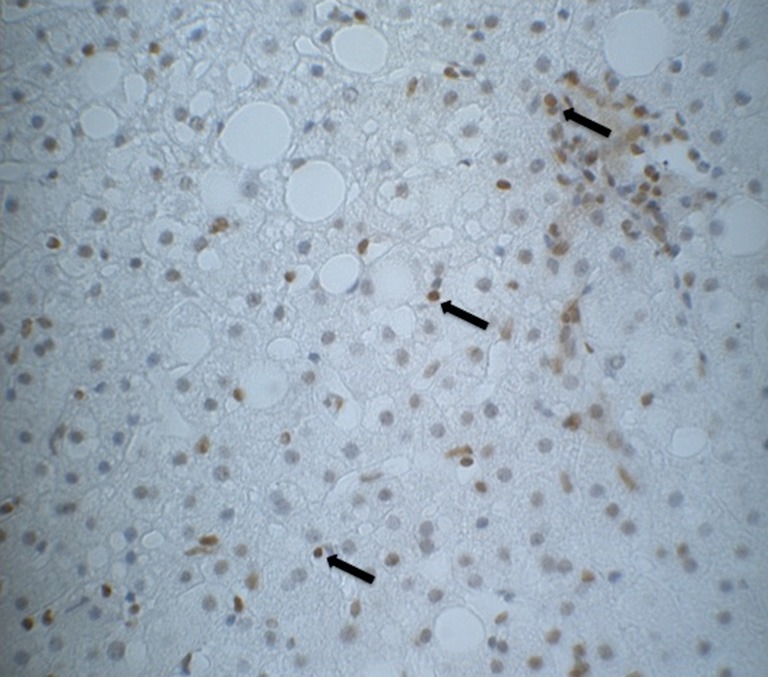
Methods: Immunohistochemical detection of CYP2E1, 4 HNE and hepatic exocyclic etheno-DNA adducts was performed on liver sections from 39 patients with NFLD. Spearman rank correlation was calculated to examine possible correlations.
Results: Exocyclic etheno-DNA adducts were detected and correlated significantly with 4 HNE, but not with CYP2E1.
Conclusions: This is the first description of highly carcinogenic exocyclic etheno-DNA adducts in NAFLD patients. We could show that exocyclic etheno-DNA adducts significantly correlated with lipid peroxidation product 4 HNE, but not with CYP2E1, implying that in NAFLD ROS generation with consecutive DNA damage is rather inflammation driven through various cytokines than by induction of CYP2E1.
Keywords: Nonalcoholic fatty liver disease (NAFLD); etheno-DNA adducts; hepatocellular carcinoma (HCC).
Figures
References
-
- Schaffner F, Thaler H.Nonalcoholic fatty liver disease. Prog Liver Dis 1986;8:283-98. - PubMed
-
- Hamaguchi M, Kojima T, Takeda N, et al. The metabolic syndrome as a predictor of nonalcoholic fatty liver disease. Ann Intern Med 2005;143:722-8. - PubMed
-
- Suzuki A, Angulo P, Lymp J, et al. Chronological development of elevated aminotransferases in a nonalcoholic population. Hepatology 2005;41:64-71. - PubMed
-
- Torres DM, Harrison SA. Diagnosis and therapy of nonalcoholic steatohepatitis. Gastroenterology 2008;134:1682-98. - PubMed
-
- Ong JP, Younossi ZM. Epidemiology and natural history of NAFLD and NASH. Clin Liver Dis 2007;11:1-16. - PubMed
LinkOut - more resources
Full Text Sources