


Dual-task costs in aging are predicted by formal education
- PMID: 26006256
- PMCID: PMC5014893
- DOI: 10.1007/s40520-015-0385-5
Dual-task costs in aging are predicted by formal education
Abstract
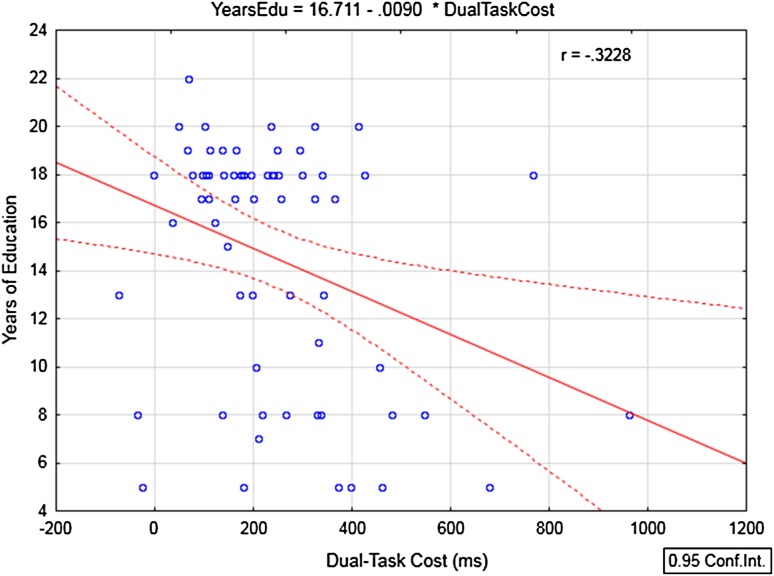
The capacity to manage different concurrent tasks at the same time decays in older adults. There is however a considerable amount of inter-individual variability in this capacity even in healthy aging. The purpose of this empirical study is to investigate which factors help explaining this variability. A dual-task paradigm was administered to 64 older adults and 31 younger controls. In this paradigm, a primary simple response time task had to be carried out either by itself (single-task condition) or while concurrently performing a secondary subtraction task (dual-task condition). Dual-task costs were operationalized by comparing dual-task and single-task conditions. Older adults showed higher dual-task interference than younger controls. Within the older group, the influence of age, general cognitive abilities, performance on the secondary task, and years of formal education was assessed with a multiple regression analysis. The results showed that years of formal education in older adults were the best predictor that significantly explained a portion of the variance in dual-task performance. These findings extend previous literature by showing that formal education provides an important dose of cognitive reserve, which is useful to successfully implement cognitive dual-task management despite aging.
Keywords: Cognitive aging; Cognitive reserve; Dual-task interference; Education level; Executive functions; Multiple regression.
Figures
References
MeSH terms
LinkOut - more resources
Full Text Sources
Other Literature Sources
Medical
