


Prevalence of malnutrition among HIV-infected children in Central and West-African HIV-care programmes supported by the Growing Up Programme in 2011: a cross-sectional study
- PMID: 26007232
- PMCID: PMC4494161
- DOI: 10.1186/s12879-015-0952-6
Prevalence of malnutrition among HIV-infected children in Central and West-African HIV-care programmes supported by the Growing Up Programme in 2011: a cross-sectional study
Abstract
Background: The burden of malnutrition among HIV-infected children is not well described in sub-Saharan Africa, even though it is an important problem to take into account to guarantee appropriate healthcare for these children. We assessed the prevalence of malnutrition and its associated factors among HIV-infected children in HIV care programmes in Central and West-Africa.
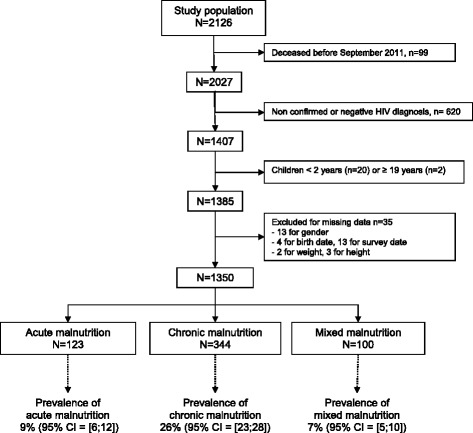
Methods: A cross-sectional study was conducted from September to December 2011 among the active files of HIV-infected children aged 2-19 years old, enrolled in HIV-care programmes supported by the Sidaction Growing Up Programme in Benin, Burundi, Cameroon, Côte d'Ivoire, Mali, Chad and Togo. Socio-demographics characteristics, anthropometric, clinical data, and nutritional support were collected. Anthropometric indicators, expressed in Z-scores, were used to define malnutrition: Height-for-age (HAZ), Weight-for-Height (WHZ) for children < 5 years and BMI-for-age (BAZ) for children ≥5 years. Three types of malnutrition were defined: acute malnutrition (WHZ/BAZ < -2 SD and HAZ ≥ -2 SD), chronic malnutrition (HAZ < -2 SD and WHZ/BAZ ≥ -2 SD) and mixed malnutrition (WHZ/BAZ < -2 SD and HAZ < -2 SD). A multinomial logistic regression model explored associated factors with each type of malnutrition.
Results: Overall, 1350 HIV-infected children were included; their median age was 10 years (interquartile range [IQR]: 7-13 years), 49 % were girls. 80 % were on antiretroviral treatment (ART), for a median time of 36 months. The prevalence of malnutrition was 42 % (95 % confidence interval [95% CI]: 40-44 %) with acute, chronic and mixed malnutrition at 9 % (95% CI: 6-12 %), 26 % (95% CI: 23-28 %), and 7 % (95% CI: 5-10 %), respectively. Among those malnourished, more than half of children didn't receive any nutritional support at the time of the survey. Acute malnutrition was associated with male gender, severe immunodeficiency, and the absence of ART; chronic malnutrition with male gender and age (<5 years); and mixed malnutrition with male gender, age (<5 years), severe immunodeficiency and recent ART initiation (<6 months). Orphanhood and Cotrimoxazole prophylaxis were not associated with any type of malnutrition.
Conclusions: The prevalence of malnutrition in HIV-infected children even on ART remains high in HIV care programmes. Anthropometric measurements and appropriate nutritional care of malnourished HIV-infected children remain insufficient and a priority to improve health care of HIV-infected children in Africa.
Figures
References
-
- UNAIDS . UNAIDS report on the global AIDS. Geneva, Switzerland: UNAIDS; 2013.
-
- United Nations Children’s Fund, World Health Organization, and World Bank. UNICEF-WHO-World Bank Joint Child Malnutrition Estimates. New York, USA: UNICEF; Geneva, Switzerland: WHO; and Washington DC, USA: World Bank; 2012
-
- WHO . World Health Statistics 2012. Geneva, Switzerland: World Health Organization; 2012.
Publication types
MeSH terms
Substances
LinkOut - more resources
Full Text Sources
Other Literature Sources
Medical
