Meta-Analysis
. 2015 May 26:6:7213.
doi: 10.1038/ncomms8213.

Variants in ELL2 influencing immunoglobulin levels associate with multiple myeloma

Affiliations
Meta-Analysis

Variants in ELL2 influencing immunoglobulin levels associate with multiple myeloma

Bhairavi Swaminathan et al. Nat Commun. .

Abstract

Multiple myeloma (MM) is characterized by an uninhibited, clonal growth of plasma cells. While first-degree relatives of patients with MM show an increased risk of MM, the genetic basis of inherited MM susceptibility is incompletely understood. Here we report a genome-wide association study in the Nordic region identifying a novel MM risk locus at ELL2 (rs56219066T; odds ratio (OR)=1.25; P=9.6 × 10(-10)). This gene encodes a stoichiometrically limiting component of the super-elongation complex that drives secretory-specific immunoglobulin mRNA production and transcriptional regulation in plasma cells. We find that the MM risk allele harbours a Thr298Ala missense variant in an ELL2 domain required for transcription elongation. Consistent with a hypomorphic effect, we find that the MM risk allele also associates with reduced levels of immunoglobulin A (IgA) and G (IgG) in healthy subjects (P=8.6 × 10(-9) and P=6.4 × 10(-3), respectively) and, potentially, with an increased risk of bacterial meningitis (OR=1.30; P=0.0024).


Conflict of interest statement

G.T., P.S., G.M., D.F.G., T.R., K.S. and U.T. are employed by deCODE Genetics/Amgen Inc. The remaining authors declare no competing financial interests.

Figures
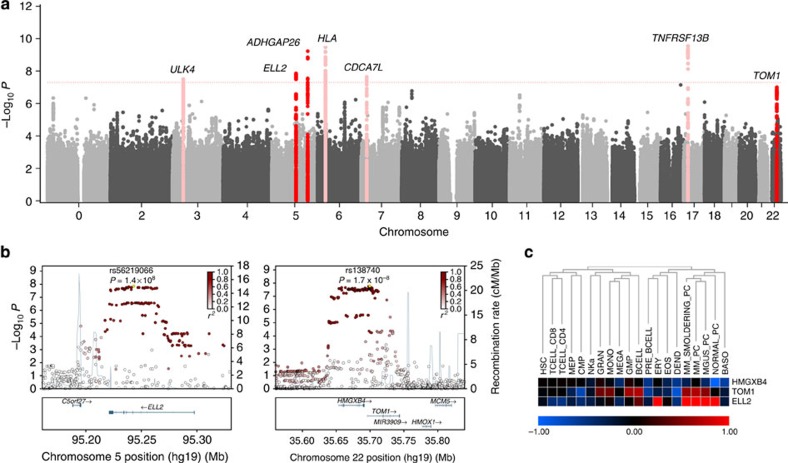
Figure 1
Figure 1. Identification of ELL2 at 5q15 as a novel MM risk locus and HMGXB4-TOM1 at 22q13 as a candidate MM risk locus.
(a) Manhattan plot for the meta-analysis of the Swedish-Norwegian and Icelandic MM data sets for 12.1 million SNPs that passed quality filtering. Seven loci showed association with MM or MM+MGUS at meta-analysis P<5 × 10⁻⁸, including four known MM risk loci (pink) and three previously unknown loci at 5q15 (ELL2), 5q35 (ARHGAP26) and 22q13 (HMGXB4 and TOM1) (red). The x axis indicates genomic position of the SNPs. The y axis indicates the –log10 of the combined P values. The dotted line indicates the threshold for genome-wide significance of meta-analysis P<5 × 10⁻⁸. The results shown were obtained with the MM+MGUS version of the Icelandic data. Similar results were obtained with the MM version (not shown). (b) Regional association plots of the novel risk locus at ELL2 and the tentative risk locus at HMGXB4-TOM1. Positions and P values of SNPs indicated on the x and y axes, respectively. Degree of linkage disequilibrium with sentinel SNPs indicated in shades of red. Blue background curves indicate meiotic recombination rates. The signal at ARHGAP26 was represented by an imputed rare variant that lost significance when genotyped directly, and was not investigated further. (c) Expression of ELL2, TOM1 and HMGXB4 in 20 different types of blood cells (Affymetrix microarrays). ELL2 and TOM1 are preferentially expressed in plasma cells. BASO, basophils; BCELL, B cells; CMP, common myeloid progenitors; EOS, eosinophils; ERY, erythroid progenitors; GMP, granulocyte–monocyte progenitors; HSCs, haematopoietic stem cells; MEGA, megakaryocytes; MEP, megakaryocyte–erythrocyte progenitors; MONO, monocytes; NEU, neutrophils; NK, natural killer cells; PC, CD138+ plasma cells; PRE-B, pre-B cells; TCELL, T cells.
Figure 2
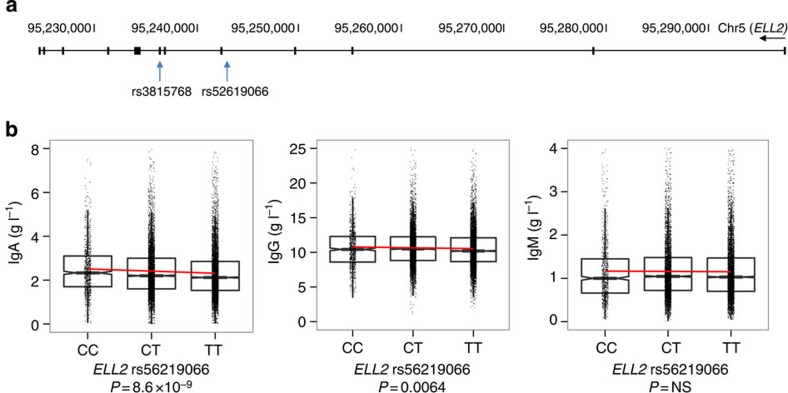
Figure 2. The ELL2 MM risk allele harbours a Thr298Ala missense variant, and the sentinel SNP rs56219066 is associated with reduced Ig levels.
(a) Schematic representation of the ELL2 gene showing the location of the sentinel SNP rs56219066 in intron 4 and the correlated variant rs3815768 in exon 7, which causes a Thr298Ala substitution in an ELL2 domain required for transcription elongation. (b) We analysed blood IgA, IgG and IgM levels from 24,279, 21,981 and 20,413 Icelandic individuals without MM or MGUS. We found a significant association between IgA and IgG levels and the ELL2 risk allele (log-linear regression P values shown). Compared with rs56219066C homozygotes, rs56219066T heterozygotes and homozygotes show 5.2 and 10.1% lower IgA and 2.6 and 5.1% lower IgG, respectively. We observed similar effects for IgA and IgG in an independent set of 1,012 Swedish blood donors (Supplementary Fig. 3). Boxes indicate medians and the first and third quartiles. Whiskers indicate first and third quartiles 1.5 times the interquartile range or the minimum/maximum values. Notches indicate confidence intervals around the median. NS, not significant.
Figure 3
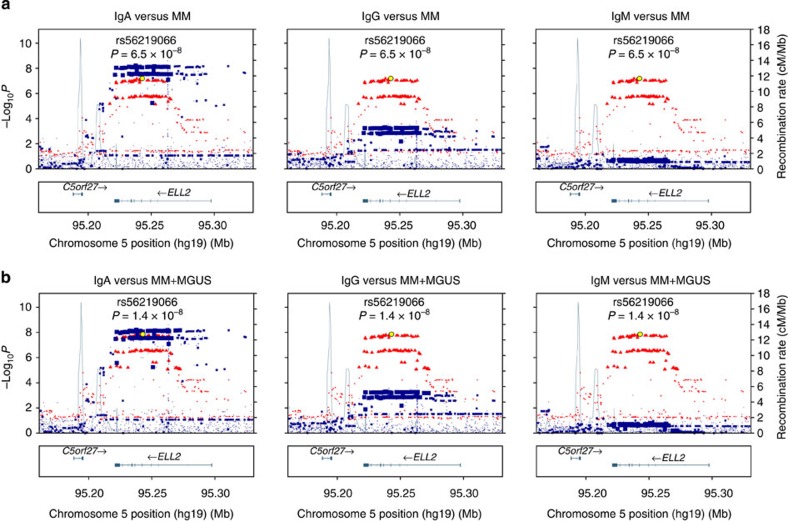
Figure 3. The ELL2 haplotype that predisposes for MM is identical to the ELL2 haplotype that influences IgA and IgG levels in healthy subjects.
In addition to the sentinel SNP rs56219066, the association between 5q15 identified in the MM and MM+MGUS meta-analyses was captured by numerous markers in strong linkage disequilibrium located in a ∼40-kb haplotype block in ELL2. To verify that the ELL2 haplotype associating with MM and MM+MGUS is identical to the ELL2 haplotype associating with Ig levels, we tested for association between each available SNP in the ELL2 region and IgA, IgG and IgM levels using the Icelandic Ig data set. We overlaid the log-linear regression P values for association with Ig levels with the meta-analysis P values obtained for the same SNPs for association with MM and MM+MGUS: (a) log-linear regression P values for association with IgA (red; left), IgG (red; middle) and IgM (red; right) overlaid on logistic regression P values for association with MM (blue); (b) corresponding results for MM+MGUS. The x axes indicate chromosomal positions. The y axes indicate −log10 P values. Sizes of markers reflect degree of association with MM or MM+MGUS. As shown, all SNPs in the ∼40-kb haplotype block associating with MM or MM+MGUS associate with IgA and, to a lesser extent, with IgG. We did not observe any association with IgM. Taken together, ELL2 SNPs associating with MM and MM+MGUS associate with IgA and IgG and vice versa, further supporting that the ELL2 haplotype that predisposes for MM also influences Ig levels.

References

    1. Rajkumar S. V. et al. International Myeloma Working Group updated criteria for the diagnosis of multiple myeloma. Lancet Oncol. 15, e538–e548 (2014). - PubMed
    1. Laubach J., Richardson P. & Anderson K. Multiple myeloma. Annu. Rev. Med. 62, 249–264 (2011). - PubMed
    1. Weiss B. M., Abadie J., Verma P., Howard R. S. & Kuehl W. M. A monoclonal gammopathy precedes multiple myeloma in most patients. Blood 113, 5418–5422 (2009). - PMC - PubMed
    1. Kristinsson S. Y. et al. Patterns of survival and causes of death following a diagnosis of monoclonal gammopathy of undetermined significance: a population-based study. Haematologica 94, 1714–1720 (2009). - PMC - PubMed
    1. Kyle R. A. et al. Prevalence of monoclonal gammopathy of undetermined significance. N. Engl. J. Med. 354, 1362–1369 (2006). - PubMed

Publication types

MeSH terms