


PLTP activity inversely correlates with CAAD: effects of PON1 enzyme activity and genetic variants on PLTP activity
- PMID: 26009633
- PMCID: PMC4479339
- DOI: 10.1194/jlr.P058032
PLTP activity inversely correlates with CAAD: effects of PON1 enzyme activity and genetic variants on PLTP activity
Abstract
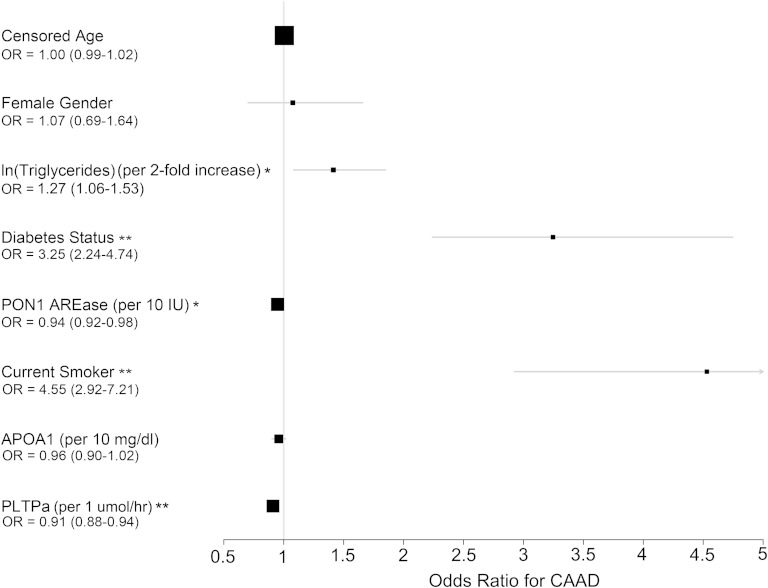
Recent studies have failed to demonstrate a causal cardioprotective effect of HDL cholesterol levels, shifting focus to the functional aspects of HDL. Phospholipid transfer protein (PLTP) is an HDL-associated protein involved in reverse cholesterol transport. This study sought to determine the genetic and nongenetic predictors of plasma PLTP activity (PLTPa), and separately, to determine whether PLTPa predicted carotid artery disease (CAAD). PLTPa was measured in 1,115 European ancestry participants from a case-control study of CAAD. A multivariate logistic regression model was used to elucidate the relationship between PLTPa and CAAD. Separately, a stepwise linear regression determined the nongenetic clinical and laboratory characteristics that best predicted PLTPa. A final stepwise regression considering both nongenetic and genetic variables identified the combination of covariates that explained maximal PLTPa variance. PLTPa was significantly associated with CAAD (7.90 × 10(-9)), with a 9% decrease in odds of CAAD per 1 unit increase in PLTPa (odds ratio = 0.91). Triglyceride levels (P = 0.0042), diabetes (P = 7.28 × 10(-5)), paraoxonase 1 (PON1) activity (P = 0.019), statin use (P = 0.026), PLTP SNP rs4810479 (P = 6.38 × 10(-7)), and PCIF1 SNP rs181914932 (P = 0.041) were all significantly associated with PLTPa. PLTPa is significantly inversely correlated with CAAD. Furthermore, we report a novel association between PLTPa and PON1 activity, a known predictor of CAAD.
Keywords: coronary artery disease; paraoxonase 1; phospholipid transfer protein.
Copyright © 2015 by the American Society for Biochemistry and Molecular Biology, Inc.
Figures
References
-
- Rosenson R. S. 2005. Low HDL-C: a secondary target of dyslipidemia therapy. Am. J. Med. 118: 1067–1077. - PubMed
-
- Castelli W. P. 1983. Cardiovascular disease and multifactorial risk: challenge of the 1980s. Am. Heart J. 106: 1191–1200. - PubMed
-
- Acharjee S., Boden W. E., Hartigan P. M., Teo K. K., Maron D. J., Sedlis S. P., Kostuk W., Spertus J. A., Dada M., Chaitman B. R., et al. 2013. Low levels of high-density lipoprotein cholesterol and increased risk of cardiovascular events in stable ischemic heart disease patients: a post-hoc analysis from the COURAGE trial (Clinical Outcomes Utilizing Revascularization and Aggressive Drug Evaluation). J. Am. Coll. Cardiol. 62: 1826–1833. - PMC - PubMed
-
- Boden W. E., Probstfield J. L., Anderson T., Chaitman B. R., Desvignes-Nickens P., Koprowicz K., McBride R., Teo K., Weintraub W.; AIM-HIGH Investigators. 2011. Niacin in patients with low HDL cholesterol levels receiving intensive statin therapy. N. Engl. J. Med. 365: 2255–2267. - PubMed
Publication types
MeSH terms
Substances
Grants and funding
LinkOut - more resources
Full Text Sources
Medical
Miscellaneous
