


Influence of prior anterograde shear rate exposure on exercise-induced brachial artery dilation
- PMID: 26009637
- PMCID: PMC4463839
- DOI: 10.14814/phy2.12414
Influence of prior anterograde shear rate exposure on exercise-induced brachial artery dilation
Abstract
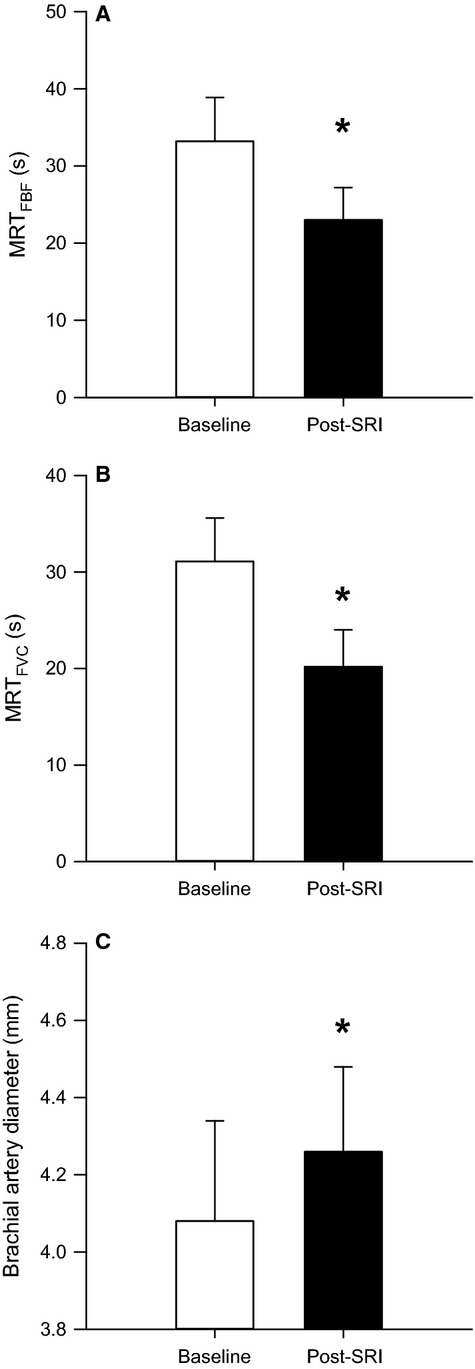
Shear rate can elicit substantial adaptations to vascular endothelial function. Recent studies indicate that prior exposure to anterograde flow and shear increases endothelium-dependent flow-mediated dilation at rest and that anterograde shear can create an anti-atherosclerotic and provasodilatory state. The primary aim of the present study was therefore to determine the effects of prior exposure to anterograde shear on exercise-induced brachial artery dilation, total forearm blood flow (FBF), and vascular conductance (FVC) during dynamic handgrip exercise. Eight men completed a constant-load exercise test corresponding to 10% maximal voluntary contraction, prior to (baseline) and following a 40 min shear rate intervention (post-SRI) achieved via unilateral forearm heating, which has previously been shown to increase anterograde shear rate in the brachial artery. During the SRI, anterograde shear rate increased 60.9 ± 29.2 sec(-1) above baseline (P < 0.05). Post-SRI, the exercise-induced brachial artery vasodilation was significantly increased compared to baseline (4.1 ± 0.7 vs. 4.3 ± 0.6 mm, P < 0.05). Post-SRI FBF mean response time (33.2 ± 16.0 vs. 23.0 ± 11.8 sec, P < 0.05) and FVC mean response time (31.1 ± 12.8 20.2 ± 10.7 sec, P < 0.05) at exercise onset were accelerated compared to baseline. These findings demonstrate that prior exposure to anterograde shear rate increases the vascular responses to exercise and supports the possible beneficial effects of anterograde shear rate in vivo.
Keywords: Blood Flow; exercise; shear rate.
© 2015 The Authors. Physiological Reports published by Wiley Periodicals, Inc. on behalf of the American Physiological Society and The Physiological Society.
Figures

References
-
- Ade CJ, Broxterman RM, Wong BJ. Barstow TJ. Anterograde and retrograde blood velocity profiles in the intact human cardiovascular system. Exp. Physiol. 2012;97:849–860. - PubMed
-
- Barakat A. Lieu D. Differential responsiveness of vascular endothelial cells to different types of fluid mechanical shear stress. Cell Biochem. Biophys. 2003;38:323–343. - PubMed
-
- Casey DP, Mohamed EA. Joyner MJ. Role of nitric oxide and adenosine in the onset of vasodilation during dynamic forearm exercise. Eur. J. Appl. Physiol. 2013;113:295–303. - PubMed
-
- Clifford PS. Hellsten Y. Vasodilatory mechanisms in contracting skeletal muscle. J. Appl. Physiol. 2004;97:393–403. - PubMed
-
- Delp MD. Laughlin MH. Regulation of skeletal muscle perfusion during exercise. Acta Physiol. Scand. 1998;162:411–419. - PubMed
LinkOut - more resources
Full Text Sources
Other Literature Sources
