


Understanding Associations among Family Support, Friend Support, and Psychological Distress
- PMID: 26009699
- PMCID: PMC4441343
- DOI: 10.1111/pere.12063
Understanding Associations among Family Support, Friend Support, and Psychological Distress
Abstract
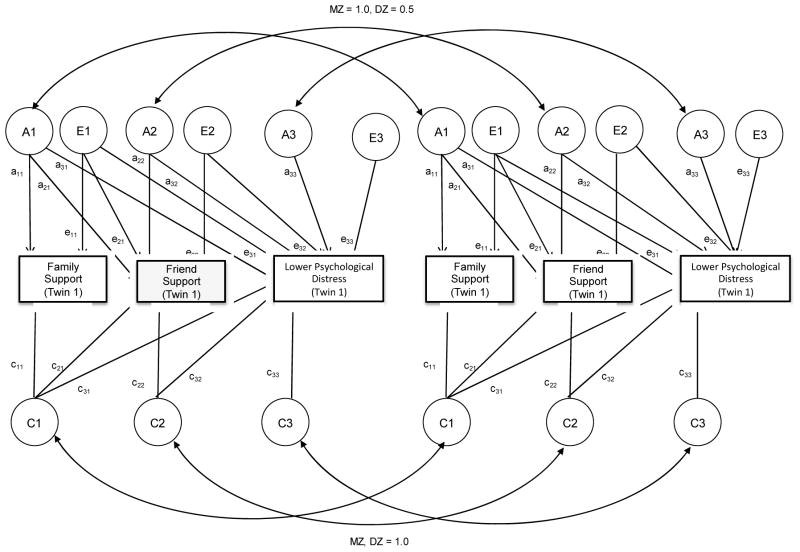
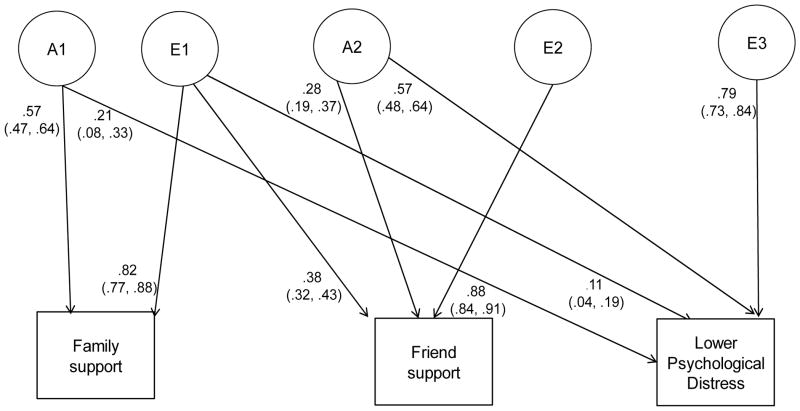
Emotional support from family and friends is associated with lower psychological distress. This study examined whether genetic and environmental influences explain associations among family support, friend support, and psychological distress. Data were drawn from the Midlife Development in the United States (MIDUS) study and included 947 pairs of MZ, same-sex DZ, and opposite-sex DZ twins. Results showed that a genetic factor explains the relationship between friend support and psychological distress, independent of family support. Alternatively, a nonshared environmental factor accounts for an association among family support, friend support, and psychological distress. Thus, heritable factors shape a distinct relationship between friend support and psychological distress, but unique experiences contribute to a link among family support, friend support, and psychological distress.
Figures
References
-
- Bergeman CS, Plomin R, Pederson NL, McClearn GE. Genetic mediation of the relationship between social support and psychological well-being. Psychology and Aging. 6:640–646. - PubMed
-
- Brendgen M. Genetics and peer relations: A review. Journal of Research on Adolescence. 2012;22:419–437.
-
- Brim OG, Ryff CD, Kessler RC. The John D. and Catherine T. MacArthur foundation series on mental health and development. Studies on successful midlife development. University of Chicago Press; Chicago: 2004. How healthy are we? A national study of well-being at midlife; pp. 124–152.
-
- Cohen S. Social Relationships and Health. American Psychologist. 2004;59:676–684. - PubMed
Grants and funding
LinkOut - more resources
Full Text Sources
Other Literature Sources