


Factor Structure of Subjective Responses to Alcohol in Light and Heavy Drinkers
- PMID: 26010049
- PMCID: PMC4490987
- DOI: 10.1111/acer.12737
Factor Structure of Subjective Responses to Alcohol in Light and Heavy Drinkers
Abstract
Background: Subjective responses (SRs) to alcohol have been implicated in alcoholism etiology, yet less is known about the latent factor structure of alcohol responses. The aim of this study was to examine the factor structure of SR using a battery of self-report measures during a controlled alcohol challenge.
Methods: Nontreatment seeking drinkers (N = 242) completed an intravenous alcohol challenge including the following SR measures: Biphasic Alcohol Effects Scale, Subjective High Assessment Scale, Profile of Mood States, Alcohol Urge Questionnaire, and single items assessing alcohol "Liking" and "Wanting." Ascending limb target breath alcohol concentrations were 0.02, 0.04, and 0.06, and descending limb target was 0.04 g/dl. Exploratory factor analyses were conducted separately on estimates of mean and dose responses on the ascending limb and on descending limb data. To examine the generalizability of this factor structure, these analyses were repeated in heavy drinkers (≥14 drinks/wk for men, ≥7 for women; n = 132) and light drinkers (i.e., nonheavy drinkers; n = 110).
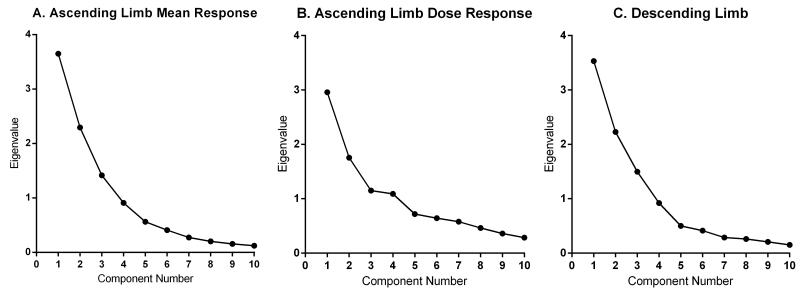
Results: In the full sample, a 4-factor solution was supported for ascending limb mean and dose responses and descending limb data representing the following SR domains: Stimulation/Hedonia, Craving/Motivation, Sedation/Motor Intoxication, and Negative Affect. This 4-factor solution was replicated in heavy drinkers. In light drinkers, however, SR was better summarized by a 3-factor solution where ascending mean and descending limb responses consisted of Stimulation/Hedonia, Craving/Motivation, and a general negative valence factor, and dose responses consisted of a general positive valence factor, Sedation/Motor Intoxication, and Negative Affect.
Conclusions: These findings suggest that SR represents a multifaceted construct with consistent factor structure across both ascending and descending limbs. Further, as drinking levels escalate, more defined Craving/Motivation and negative valence dimensions may emerge. Longitudinal studies examining these constructs are needed to further our understanding of SR as potentially sensitive to alcohol-induced neuroadaptation.
Keywords: Craving; Factor Analysis; Sedation; Stimulation; Subjective Response.
Copyright © 2015 by the Research Society on Alcoholism.
Figures
References
-
- Addolorato G, et al. Neurobiochemical and clinical aspects of craving in alcohol addiction: a review. Addictive behaviors. 2005;30(6):1209–1224. - PubMed
-
- Bice PJ, Kiefer SW. Taste reactivity in alcohol preferring and nonpreferring rats. Alcoholism: Clinical and Experimental Research. 1990;14(5):721–727. - PubMed
-
- Bliese P. multilevel: Multilevel Functions. R Package; 2008.
-
- Bohn MJ, et al. Development and Initial Validation of a Measure of Drinking Urges in Abstinent Alcoholics. Alcoholism: Clinical and Experimental Research. 1995;19(3):600–606. [Online] - PubMed
-
- Bujarski S, Ray LA. [Accessed 19 May 2014];Subjective response to alcohol and associated craving in heavy drinkers vs. alcohol dependents: An examination of Koob’s allostatic model in humans. Drug and Alcohol Dependence. 2014 [Online] [online]. Available from: http://www.sciencedirect.com/science/article/pii/S0376871614008412. - PMC - PubMed
Publication types
MeSH terms
Grants and funding
LinkOut - more resources
Full Text Sources
Other Literature Sources
Medical
Research Materials
