Practice- and Community-Based Interventions to Increase Human Papillomavirus Vaccine Coverage: A Systematic Review
- PMID: 26010507
- PMCID: PMC4862306
- DOI: 10.1001/jamapediatrics.2015.0310
Practice- and Community-Based Interventions to Increase Human Papillomavirus Vaccine Coverage: A Systematic Review
Abstract
Importance: Vaccines against human papillomavirus (HPV) are recommended for routine use in adolescents aged 11 to 12 years in the United States, but uptake remains suboptimal. Educational interventions focused on parents and patients to increase coverage have not generally demonstrated effectiveness.
Objective: To systematically review the literature on effectiveness of interventions conducted at the practice or community level to increase uptake of HPV vaccines in the United States.
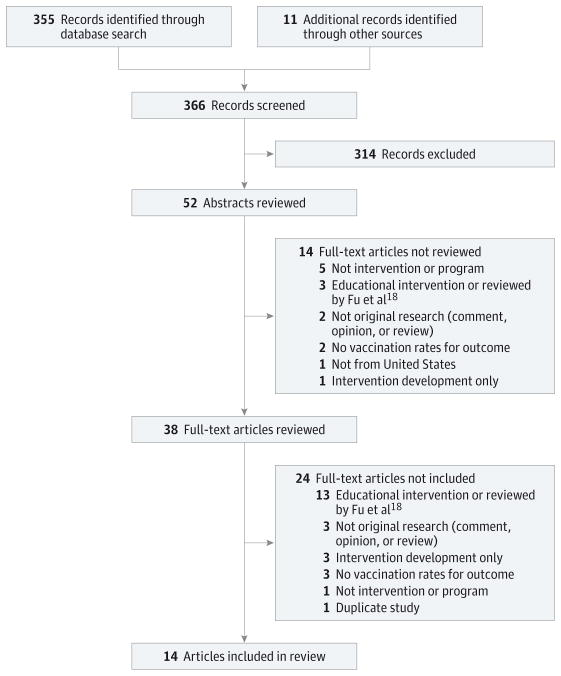
Evidence review: Keyword searches of the PubMed, Web of Science, and MEDLINE databases identified studies of adolescents that included the outcome of HPV vaccination published through July 2014. References of identified articles were also reviewed. A total of 366 records were screened, 38 full-text articles were reviewed, and 14 published studies were included. Results were summarized by different intervention approaches.
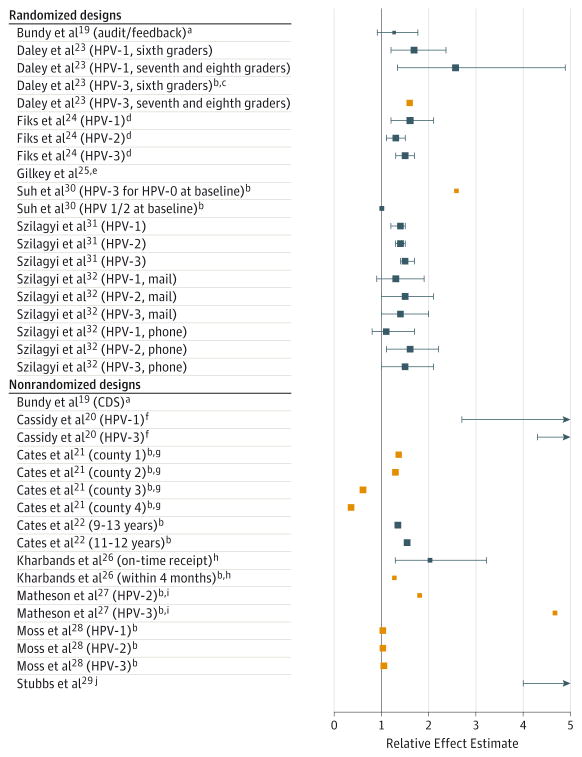
Findings: Practice- and community-based intervention approaches included reminder and recall (n = 7), physician-focused interventions (eg, audit and feedback) (n = 6), school-based programs (n = 2), and social marketing (n = 2) (2 interventions tested multiple approaches). Seven studies used a randomized design, and 8 used quasiexperimental approaches (one used both). Thirteen studies included girls, and 2 studies included boys. Studies were conducted in a variety of populations and geographic locations. Twelve studies reported significant increases in at least one HPV vaccination outcome, one reported a nonsignificant increase, and one reported mixed effects.
Conclusions and relevance: Most practice- and community-based interventions significantly increased HPV vaccination rates using varied approaches across diverse populations. This finding is in stark contrast to a recent review that did not find effects to warrant widespread implementation for any educational intervention. To address the current suboptimal rates of HPV vaccination in the United States, future efforts should focus on programs that can be implemented within health care settings, such as reminder and recall strategies and physician-focused efforts, as well as the use of alternative community-based locations, such as schools.
Conflict of interest statement
Figures
References
-
- Satterwhite CL, Torrone E, Meites E, et al. Sexually transmitted infections among US women and men: prevalence and incidence estimates, 2008. Sex Transm Dis. 2013;40(3):187–193. - PubMed
-
- Syrjänen K, Hakama M, Saarikoski S, et al. Prevalence, incidence, and estimated life-time risk of cervical human papillomavirus infections in a nonselected Finnish female population. Sex Transm Dis. 1990;17(1):15–19. - PubMed
-
- Winer RL, Lee SK, Hughes JP, Adam DE, Kiviat NB, Koutsky LA. Genital human papillomavirus infection: incidence and risk factors in a cohort of female university students. Am J Epidemiol. 2003;157(3):218–226. - PubMed
-
- Dunne EF, Unger ER, Sternberg M, et al. Prevalence of HPV infection among females in the United States. JAMA. 2007;297(8):813–819. - PubMed
-
- Manhart LE, Holmes KK, Koutsky LA, et al. Human papillomavirus infection among sexually active young women in the United States: Implications for developing a vaccination strategy. Sex Transm Dis. 2006;33(8):502–508. - PubMed
Publication types
MeSH terms
Substances
Grants and funding
LinkOut - more resources
Full Text Sources
Other Literature Sources
Medical