. 2015 Aug;197(16):2631-41.
doi: 10.1128/JB.00261-15. Epub 2015 May 26.

Functional Analysis of Porphyromonas gingivalis W83 CRISPR-Cas Systems

Affiliations

Functional Analysis of Porphyromonas gingivalis W83 CRISPR-Cas Systems

Michał Burmistrz et al. J Bacteriol. 2015 Aug.

Abstract

The CRISPR-Cas (clustered regularly interspaced short palindromic repeats/CRISPR-associated genes) system provides prokaryotic cells with an adaptive and heritable immune response to foreign genetic elements, such as viruses, plasmids, and transposons. It is present in the majority of Archaea and almost half of species of Bacteria. Porphyromonas gingivalis is an important human pathogen that has been proven to be an etiological agent of periodontitis and has been linked to systemic conditions, such as rheumatoid arthritis and cardiovascular disease. At least 95% of clinical strains of P. gingivalis carry CRISPR arrays, suggesting that these arrays play an important function in vivo. Here we show that all four CRISPR arrays present in the P. gingivalis W83 genome are transcribed. For one of the arrays, we demonstrate in vivo activity against double-stranded DNA constructs containing protospacer sequences accompanied at the 3' end by an NGG protospacer-adjacent motif (PAM). Most of the 44 spacers present in the genome of P. gingivalis W83 share no significant similarity with any known sequences, although 4 spacers are similar to sequences from bacteria found in the oral cavity and the gastrointestinal tract. Four spacers match genomic sequences of the host; however, none of these is flanked at its 3' terminus by the appropriate PAM element.

Importance: The CRISPR-Cas (clustered regularly interspaced short palindromic repeats/CRISPR-associated genes) system is a unique system that provides prokaryotic cells with an adaptive and heritable immunity. In this report, we show that the CRISPR-Cas system of P. gingivalis, an important human pathogen associated with periodontitis and possibly also other conditions, such as rheumatoid arthritis and cardiovascular disease, is active and provides protection from foreign genetic elements. Importantly, the data presented here may be useful for better understanding the communication between cells in larger bacterial communities and, consequently, the process of disease development and progression.


Figures

FIG 1
FIG 1
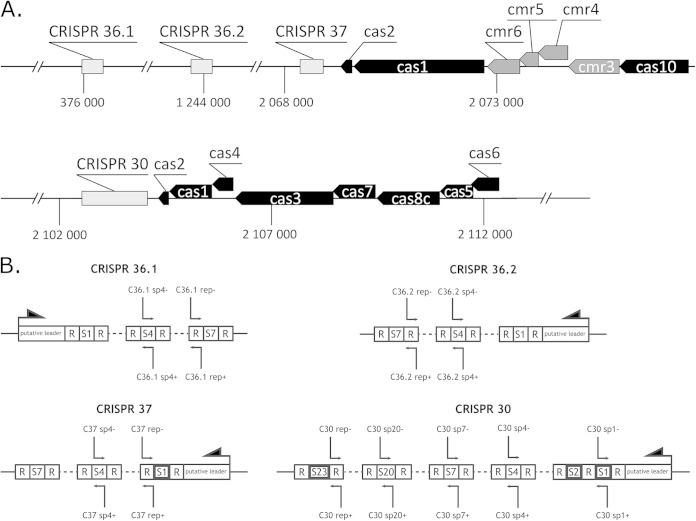
(A) Locations of CRISPR arrays and cas genes in the P. gingivalis chromosome. Protein annotation and CRISPR array nomenclature are presented according to the system of Watanabe et al. (26). The name of each CRISPR contains the length of a single repeat (and a consecutive number, if there are other arrays with the same repeat length). Arrows indicate the predicted direction of gene transcription. Blocks representing overlapping sequences are shifted upwards. Regions of the genome not related to the CRISPR-Cas system are omitted. Positions of CRISPR regions in the genome are shown below the axis. (B) Scheme for analysis of the CRISPR arrays. Probes used in Northern blots are marked with thin arrows above and below the CRISPR arrays. The arrow at the end of a given CRISPR array indicates the determined direction of transcription. Self-targeting spacers are marked with bold frames.
FIG 2
FIG 2
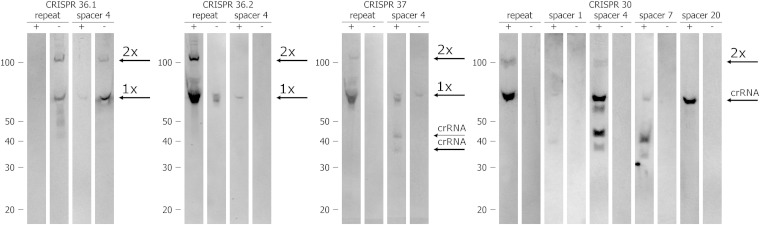
Northern analysis of CRISPR array transcription. Total RNA of P. gingivalis W83 was separated in a 15% polyacrylamide gel containing 8 M urea; RNAs were transferred to nylon membranes by electroblotting and analyzed using biotinylated synthetic DNA probes specific to repeat and spacer sequences. “+” probes have a direction consistent with the direction of cas gene transcription (identical for all). “−” probes are complementary to “+” probes. Arrows to the right of each gel indicate the expected sizes of crRNA processing products, as follows: crRNA, mature crRNA; 1×, single repeat-spacer unit; and 2×, double repeat-spacer unit.
FIG 3
FIG 3
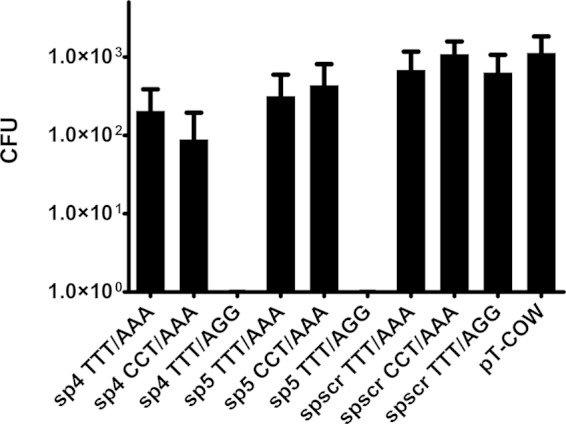
Protospacer-adjacent sequences are important for CRISPR-Cas-mediated target degradation. The plasmid pT-COW and its derivatives were delivered to P. gingivalis W83 via conjugation. The name of each plasmid contains the number of the spacer introduced into the plasmid and the three-nucleotide 5′ and 3′ flanks of the protospacer. The significance of the observed differences between samples and the control plasmid was analyzed using Student's t test. All experiments were repeated three times, and results are expressed as means ± standard deviations (SD).
FIG 4
FIG 4
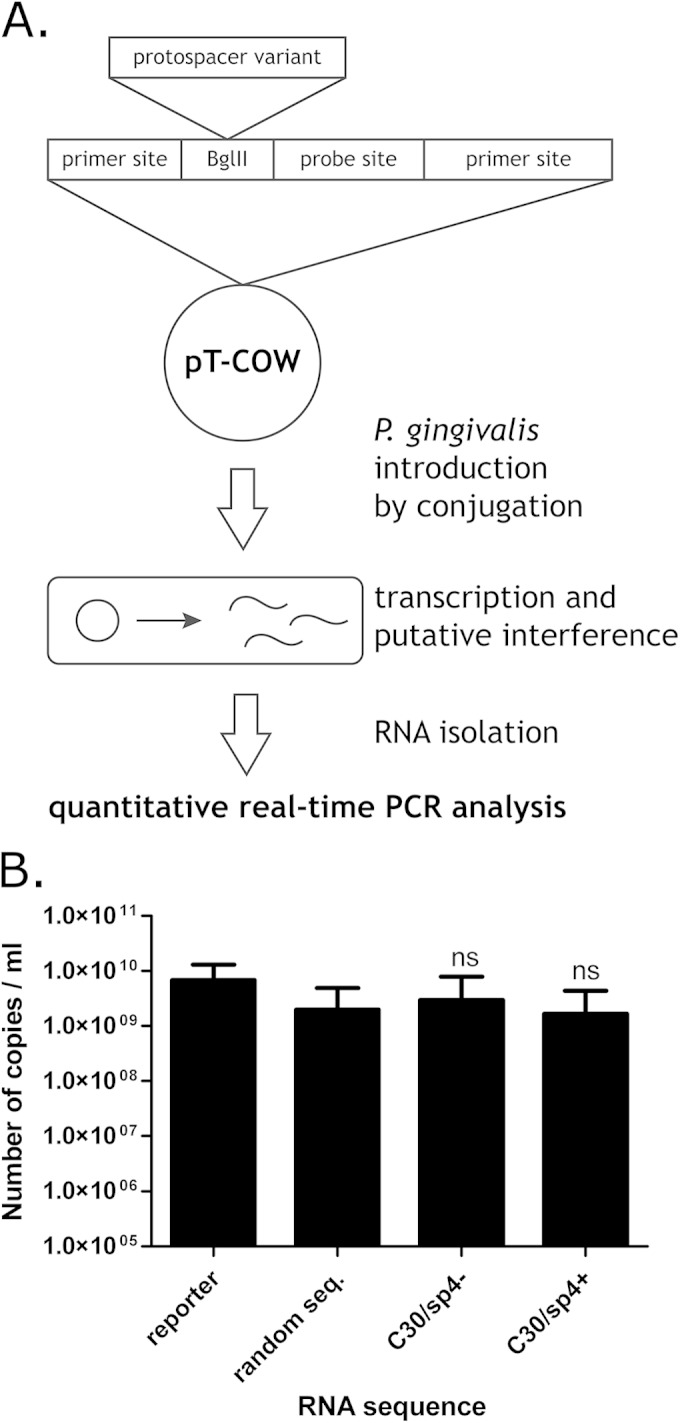
(A) Scheme of CRISPR 30 RNA interference experiment. The pT-COW plasmid was supplemented with a synthetic reporter sequence containing a protospacer variant together with a nucleotide probe annealing site flanked by PCR priming sites. Introduction of the modified plasmid into P. gingivalis results in transcription of the reporter cassette, which is a potential target for CRISPR RNA interference. This interference results in a decrease of transcript levels, which can be detected by quantitative RT-PCR analysis. (B) Degradation of RNA by the CRISPR 30/Cas system. The graph shows numbers of RNA copies in bacteria conjugated with plasmids carrying the reporter cassette with protospacers. Reporter, plasmid carrying the reporter cassette; random seq., plasmid carrying the reporter cassette with a random sequence inserted into the region targeted by the real-time PCR primers and probe; C30/sp4−, plasmid carrying the reporter cassette with a sequence identical to that of the corresponding crRNA inserted into the region targeted by the real-time PCR primers and probe; C30/sp4+, plasmid carrying the reporter cassette with a sequence complementary to that of the corresponding crRNA inserted into the region targeted by the real-time PCR primers and probe. The significance of the observed differences between samples and positive-control samples was analyzed using Student's t test. ns, not significant (P > 0.05). All experiments were repeated three times, and the results are expressed as means ± SD.

References

    1. Bryant J, Chewapreecha C, Bentley SD. 2012. Developing insights into the mechanisms of evolution of bacterial pathogens from whole-genome sequences. Future Microbiol 7:1283–1296. doi:10.2217/fmb.12.108. - DOI - PMC - PubMed
    1. Hyman P, Abedon ST. 2010. Bacteriophage host range and bacterial resistance. Adv Appl Microbiol 70:217–248. doi:10.1016/S0065-2164(10)70007-1. - DOI - PubMed
    1. Labrie SJ, Samson JE, Moineau S. 2010. Bacteriophage resistance mechanisms. Nat Rev Microbiol 8:317–327. doi:10.1038/nrmicro2315. - DOI - PubMed
    1. Forde A, Fitzgerald GF. 1999. Bacteriophage defence systems in lactic acid bacteria. Antonie Van Leeuwenhoek 76:89–113. doi:10.1023/A:1002027321171. - DOI - PubMed
    1. McGrath S, Fitzgerald GF, van Sinderen D. 2002. Identification and characterization of phage-resistance genes in temperate lactococcal bacteriophages. Mol Microbiol 43:509–520. doi:10.1046/j.1365-2958.2002.02763.x. - DOI - PubMed

Publication types

MeSH terms

LinkOut - more resources