


Cerebral Cortical Microvascular Rarefaction in Metabolic Syndrome is Dependent on Insulin Resistance and Loss of Nitric Oxide Bioavailability
- PMID: 26014499
- PMCID: PMC4551443
- DOI: 10.1111/micc.12209
Cerebral Cortical Microvascular Rarefaction in Metabolic Syndrome is Dependent on Insulin Resistance and Loss of Nitric Oxide Bioavailability
Erratum in
-
Corrigendum.Microcirculation. 2016 Apr;23(3):272. doi: 10.1111/micc.12265. Microcirculation. 2016. PMID: 27037953 No abstract available.
Abstract
Objective: Chronic presentation of the MS is associated with an increased likelihood for stroke and poor stroke outcomes following occlusive cerebrovascular events. However, the physiological mechanisms contributing to compromised outcomes remain unclear, and the degree of cerebral cortical MVD may represent a central determinant of stroke outcomes.
Methods: This study used the OZR model of MS and clinically relevant, chronic interventions to determine the impact on cerebral cortical microvascular rarefaction via immunohistochemistry with a parallel determination of cerebrovascular function to identify putative mechanistic contributors.
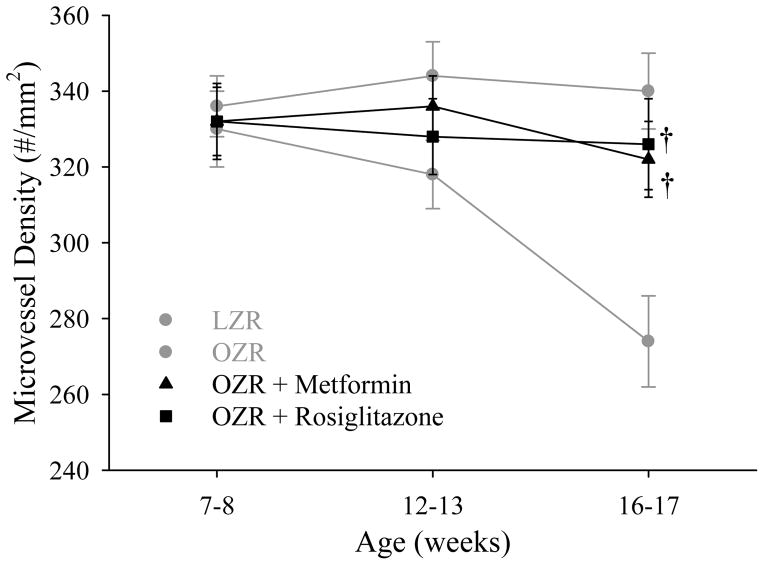
Results: OZR exhibited a progressive rarefaction (to ~80% control MVD) of the cortical microvascular networks vs. lean Zucker rats. Chronic treatment with antihypertensive agents (captopril/hydralazine) had limited effectiveness in blunting rarefaction, although treatments improving glycemic control (metformin/rosiglitazone) were superior, maintaining ~94% control MVD. Chronic treatment with the antioxidant TEMPOL severely blunted rarefaction in OZR, although this ameliorative effect was prevented by concurrent NOS inhibition.
Conclusions: Further analyses revealed that the maintenance of glycemic control and vascular NO bioavailability were stronger predictors of cerebral cortical MVD in OZR than was prevention of hypertension, and this may have implications for chronic treatment of CVD risk under stroke-prone conditions.
Keywords: capillary density; obesity; perfusion; rodent models of cardiovascular disease risk.
© 2015 John Wiley & Sons Ltd.
Figures




References
-
- Aleixandre de Artiñano A, Miguel Castro M. Experimental rat models to study the metabolic syndrome. Br J Nutr. 2009 Nov;102(9):1246–53. - PubMed
-
- Ashoff A, Qadri F, Eggers R, Jöhren O, Raasch W, Dendorfer A. Pioglitazone prevents capillary rarefaction in streptozotocin-diabetic rats independently of glucose control and vascular endothelial growth factor expression. J Vasc Res. 2012;49(3):260–6. - PubMed
-
- Bastien M, Poirier P, Lemieux I, Després JP. Overview of epidemiology and contribution of obesity to cardiovascular disease. Prog Cardiovasc Dis. 2014 Jan-Feb;56(4):369–81. - PubMed
-
- Bray GA. The Zucker-fatty rat: a review. Fed Proc. 1977 Feb;36(2):148–53. - PubMed
Publication types
MeSH terms
Substances
Grants and funding
LinkOut - more resources
Full Text Sources
Other Literature Sources
Medical
